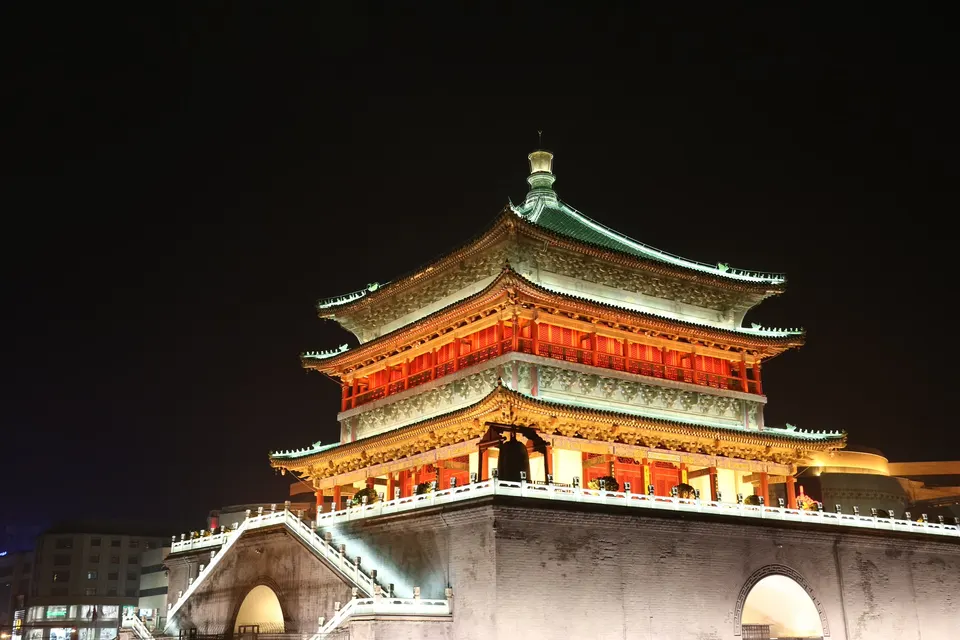
Ming clock tower
Bell Tower Audio Guide (Zhonglou)
A 36-metre Ming tower that in 1582 was taken apart piece by piece and put back together a kilometre to the east to stay at the exact centre of the walled city, now in the middle of a roundabout where Xi'an's four great avenues cross.
- 40 min of audio
- Ming dynasty
The tower was built in 1384, the 17th year of the Hongwu era, beside the Taoist Yingxiang temple, at the mouth of Guangji Street. But the city grew eastward, the gates were rebuilt, the East, South, West and North streets were laid out, and the tower was left off-centre. In 1582 it was moved to its present site with a new base and its own timber structure. Since then it has marked the crossing: 36 metres from the ground to the peak, a brick plinth 35.5 metres on each side and a green triple-eaved roof over just two storeys, crowned by a gilded finial.
Its bell has a stranger story than the tower itself. The Jingyun, cast in bronze in 711 with an inscription calligraphed by Emperor Ruizong, is no longer here: in 1953 it was taken to the Forest of Steles Museum, and in the northwest corner a replica has hung since 1997. It is no longer struck, but its sound, recorded by China National Radio, sees off the year every Chinese New Year's Eve. And legend has it that, while it hung in the tower, it fell silent.
Highlights
- Base and bricked-up arches — 35.5 m per side and the old crossing of the four avenues beneath the tower
- Replica of the Jingyun bell — 6.5 tonnes in the northwest corner, a copy of the Tang bell of 711
- Steles on the west wall — The account of the 1582 move and of the 1740 restoration
- Doors with reliefs — 64 scenes from classic stories, with the Eight Immortals crossing the sea
- Upper-floor balcony — The four avenues toward the wall and the Drum Tower about 200 m away
In the heart of Xi’an’s walled city, where the East, West, South and North streets meet at a roundabout of ceaseless traffic, rises the Bell Tower (西安钟楼, Zhonglou). It is a 36-metre Ming clock tower, built in 1384 and moved in 1582 so as to keep occupying the centre of a city that had shifted eastward. That gesture, taking a building apart and reassembling it from its own pieces a kilometre away, sums up its purpose: to mark the heart and the hour of Xi’an.
The history of the Bell Tower does not stop with the Ming. In 1740 Governor Zhang Kai restored it; in 1927 Shi Lin, just back from studying in the United States, opened a sound cinema in it, the first in the city’s history; on 10 October 1939 a Japanese air raid damaged it badly, and during the war against Japan it served as an air-raid warning post, while the Kuomintang used the vaulted passages of its base to lock up and interrogate prisoners. Two legends also circulate about its origin: one says it was built to chain an underground dragon blamed for the earthquakes of Guanzhong; the other, that it was meant to hold back the “dragon energy” that threatened Zhu Yuanzhang’s throne. The surviving documentation, however, describes it as a tower for telling the time and sounding the alarm.
Its architecture reads from the bottom up. A square plinth of grey brick 8.6 metres high supports a two-storey timber structure with three eaves of dark green glazed tile, crowned by a gold-covered wooden finial that in 2020 was regilded for the first time in 25 years. The red doors on all four sides, on both floors, carry 8 reliefs each, 64 in all, with classic Chinese stories; on the pillars of the upper floor, the calligraphed couplets are recent additions. And at nightfall, with the tower lit up, it has become fashionable to come dressed in hanfu, traditional Chinese dress, to be photographed with the building behind and the cars circling around.
To know what to see at the Bell Tower, the audio guide covers it in four stops and 40 minutes: from the pavement of the roundabout, through the underpass, to the base with the replica of its Tang bell, the steles of the ground-floor hall and the wooden balcony, with the avenues and the Drum Tower in sight. The thread is a single one: the centre of Xi’an is not a fixed point but a decision.
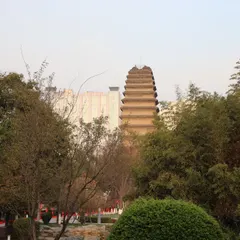
A short distance away are the Muslim Quarter, beside the Drum Tower, and the Forest of Steles, against the south wall; beyond the walls, to the south, rises the Small Wild Goose Pagoda.
Four avenues and a bricked-up crossing
Xi'an Bell Tower
Summary of this stop
From the pavement, the tower appears in the middle of the great roundabout, right where the four avenues leading to the gates of the wall begin. It was not always there, and the spot was not always the centre either: with the city’s expansion in the early Ming, the urban core shifted eastward, and about two centuries later the gates were rebuilt and the East, South, West and North streets were laid out. The tower had to follow them.
The base keeps the trace of that crossing. In the middle of each side of the plinth, 35.5 metres wide and 8.6 high, opens an arch about 6 metres across; the four met inside in the shape of a cross, and people and carts passed through them from one street to another. Traffic ended up closing them, and today the tower is reached through a circular underpass beneath the roundabout.
The scene had another life. For a time after the founding of the People’s Republic in 1949, every May Day and every National Day the tower became a rostrum from which the authorities presided over parades, reviews and celebrations. On the pavement, the audio guide opens the route by reading in those bricked-up arches the crossing that once ran through the tower.
A Tang bell that lost its voice
Replica of the Jingyun bell
Summary of this stop
In the northwest corner of the base hangs a bronze bell 2.45 metres tall and weighing 6.5 tonnes. It is a copy, hung on 30 January 1997, with the decoration and inscription imitated from the original: the Jingyun bell, cast in 711, of about 6 tonnes and 247 centimetres, which bears on its front face an inscription of 292 characters composed and calligraphed by Emperor Ruizong himself, Li Dan. The genuine one left the tower in 1953 for the Forest of Steles Museum.
Legend has it that, in Ming times, the Jingyun bell fell silent in this corner although nothing in the building had changed, and that another one, much smaller, of about 5 tonnes, had to be cast. The same legend adds that the old Tang bell recovered its voice on reaching the Forest of Steles.
The documented history offers another explanation. In 1740, during the restoration, Governor Zhang Kai found that the enclosed hall muffled the bell’s sound and moved it outside so that the hour could be heard far away. In front of the replica, the narration sets the two versions of the silence against each other.
The tower that moved a kilometre
Steles on the west wall
Summary of this stop
On the west wall of the ground-floor hall three steles survive: that of the 1953 restoration, that of the “Record of the Restoration of the Xi’an Bell Tower” after the works of 1740, and the “Song of the Eastward Move of the Bell Tower”, by Gong Maoxian. The last one tells the building’s most singular episode.
The tower was built in 1384, the 17th year of the Hongwu era, beside the Taoist Yingxiang temple, at the mouth of Guangji Street, facing the Drum Tower and about 1,000 metres from where it stands today. In 1582, the tenth year of the Wanli era, the Shaanxi censor Gong Maoxian had the magistrates of Xianning and Chang’an move it to the new centre. Only a new base was built: the timber structure was reassembled from the original pieces. In front of the steles, the audio guide reconstructs how an entire building changed place to go on being the centre.
Bell at dawn, drum at dusk
Upper-floor balcony
Summary of this stop
The route ends on the upper-floor balcony. From there the four avenues run straight toward the gates of the wall and, to the northwest, about 200 metres away, the Drum Tower appears, its partner in measuring time. The Bell and Drum Towers Museum, born in 1953 as an exhibition hall of the Drum Tower and under that name since 2008, keeps up a period reenactment of “bell at dawn, drum at dusk”.
This balcony was also a lookout post. According to the documented tradition, during the 1911 revolution that toppled the Qing dynasty, imperial troops dug in at the tower and the insurgents fought them fiercely here. Decades later, its height made it an air-raid warning post during the war against Japan.
The original bell is no longer struck, to protect it, but its voice has not died out: China National Radio recorded it, and that sound is broadcast every Chinese New Year’s Eve as the chime that bids the year farewell. At the top of the tower, the audio guide’s last stop joins the hour of the empire to the chime that today sees off the year.