Ming Honorific Archway
Hu Wenguang Archway Audio Guide (Hu Wenguang Cishi Paifang)
Twelve metres of dark stone planted at the entrance to Xidi in 1578, with the emperor's leave. It is the only archway the village still has, and it carries an official's career carved on it like a résumé.
- 25 min of audio
- Huizhou Ming Architecture
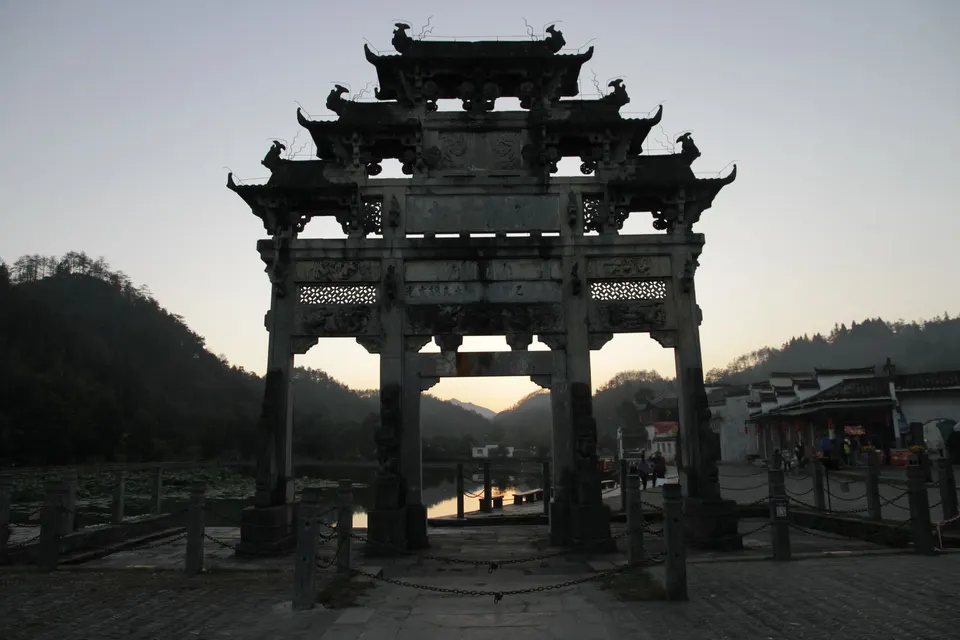
The Hu Wenguang Memorial Archway is a Ming-era paifang that greets visitors at the entrance to Xidi. In 1578, the sixth year of the Wanli era, the court granted Hu Wenguang, prefect of Jiaozhou, the privilege of raising a merit archway in his native village. It stands 12.3 metres high and 9.95 wide, is carved entirely from Yixian blue stone, a dark marble from the district itself, and is today the only paifang in a village that preserves 155 old Ming and Qing houses and three lineage halls.
The most surprising part is what it took to keep it standing. According to tradition, Hu Wenguang came home with the imperial edict but no money, and it was his clan that paid for the work with voluntary donations. Centuries later, in the 1960s and 1970s, when Xidi lived mostly from making lime, some villagers proposed putting the archway into the kiln. Most of the village refused.
Highlights
- Xidi's only paifang — A 1578 Ming archway, the only one in the village raised with imperial permission
- 12.3 metres of Yixian blue stone — Three bays, four columns and five small roofs in the district's dark marble
- Two faces, two offices — “Jiaozhou Cishi” to the west, “Jingfan Shouxiang” to the east and the “Enrong” seal on high
- Five lions with an embroidered ball — Openwork stone with phoenixes, qilin, cranes, deer and the Eight Immortals
- Zoumalou Tower and Wugeng Bridge — The setting of one of the Eight Views of Xidi
At the entrance to Xidi, beside the lake where the streams that cross the village meet, a mass of dark stone stands out against the white walls of the houses. This is the Hu Wenguang Memorial Archway, known in the village as Hu Wenguang Cishi Paifang: an honorific archway from 1578, the only one Xidi has kept and the only one raised with the throne’s permission. What is carved on it is neither a prayer nor a poem, but the service record of an official of the Hu clan.
The history of the Hu Wenguang Memorial Archway begins in the sixth year of the Wanli era, when the Ming court rewarded the administrative career of a son of the village with this privilege. Its architecture imitates timber carpentry in stone, and its carvings form a small bestiary of lions, phoenixes, qilin, cranes and deer. To know what to see at the Hu Wenguang Memorial Archway, one has to read it floor by floor and face by face, and that is what the audio guide proposes in four stops, from the esplanade of the archway to Zoumalou Tower and Wugeng Bridge.
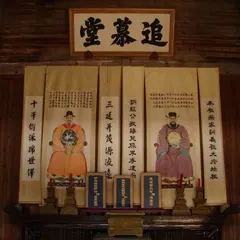
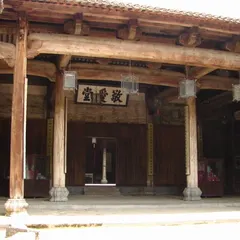
The lineage that paid for this honour still gathers at Jing’ai Hall, its great ancestral temple, and the merchant who built Zoumalou Tower beside the archway also funded Zhuimu Hall, on Dalu Street.
Twelve metres of black stone with imperial leave
Hu Wenguang Memorial Archway
Summary of this stop
From the esplanade, the archway imposes itself at once: 12.3 metres high, 9.95 wide, three bays, four columns and five small roofs. All of it is carved from “Yixian blue stone”, a dark marble from the district that contrasts with the white of Huizhou architecture. Xidi preserves 155 old Ming and Qing houses and three lineage halls, but only one paifang: this one. It is also the point where the visit to the village begins.
Its origin was no local whim. In 1578 the Ming court granted Hu Wenguang, prefect of Jiaozhou, the right to raise a merit archway in his native village. According to tradition, the official came back with the edict but without funds for the work, and it was the members of the Hu clan who paid for it with voluntary donations. The sources do not fully agree: some describe it as an archway built by imperial order, others maintain that the emperor only gave the permission. Before the stone, the narration explains what it meant for a whole village to take charge of the honour of one of its own.
Two faces, two offices and the emperor’s favour
Jiaozhou Cishi and Jingfan Shouxiang inscriptions
Summary of this stop
The archway has two faces with two different titles. On the second storey, the west face proclaims “Jiaozhou Cishi”, prefect of Jiaozhou; the east face, “Jingfan Shouxiang”, chief minister of the principality of Jing. Higher up, on the central axis of the third storey, two characters sum up the rest: “Enrong”, “imperial favour”, the seal that distinguished works authorised by the throne.
Behind those inscriptions lies a fairly concrete life. Hu Wenguang, of the eighteenth generation of the Mingjing Hu lineage, was magistrate of Wanzai, in Jiangxi, prefect of Jiaozhou, in Shandong, and chief secretary of the princely household of Jingzhou, in Hubei, the post that explains the title on the east face. In those posts he cleared backlogged court cases, founded schools, built granaries and drove out pirates. The sources differ on the length of the rewarded career, which some put at 23 years and others at 32. In Xidi a popular ditty still circulates that celebrates “Prefect Wenguang” for standing up to the wokou, and the audio guide tells, beside this face of the archway, why the village has not forgotten him.
The stone lacework that nearly became lime
Lions and openwork stone screens
Summary of this stop
At the foot of the central columns one understands how far the stonemasons thought like carpenters. Brackets, corbels, stone lions and ridge finials are joined with hidden tenons, as if they were timber pieces. Two pairs of lions lying head down act as buttresses, the end columns rest on drum-shaped stones and three pairs of dragon-fish crown the silhouette. On the central beam of the first storey, five lions play with an embroidered ball among phoenixes, qilin, cranes and sika deer. The openwork screens at the sides, with branches so fine they look fragile, complete a programme with tigers, leopards, civil and military officials and the Eight Immortals.
That delicacy had its moment of danger. During the Cultural Revolution, between the 1960s and the 1970s, Xidi lost many structures and gateways. As it is remembered in the village, which then lived mostly from making lime, some villagers proposed burning the archway: it was stone, and burnt stone gives lime. Most refused, although survival was hard. In December 1984 a restoration directed by the cultural relics office of Yi County was completed, and in 2016 the archway entered a new repair programme together with seven other protected buildings in Xidi. Among the lions, the narration returns to those years when the monument was one step from the kiln.
A tower for an in-law and Hui ink
Zoumalou Tower and Wugeng Bridge
Summary of this stop
Beside the archway rises Zoumalou Tower, also called Lingyun Pavilion: two storeys of white wall and curved eaves. It was built in 1787 by order of Hu Guansan, one of the six richest men in Jiangnan, and according to tradition it was put up in great haste to receive his in-law, the senior minister Cao Zhenyong. The present tower is a reconstruction on the original plan, and the sources do not agree on its relation to the old Hall of the Seven Sages. Today it hosts Huangmei opera performances and tea ceremonies. Beneath it, the West Stream passes under the single-arch stone Wugeng Bridge, the setting of “the night moon at Wu Bridge”, one of the Eight Views of Xidi.
The square stays alive for another reason. In a workshop beside the archway, visitors try their hand at making Hui ink, the ink stick of old Huizhou, whose technique appears on China’s first national list of intangible heritage. At midday a queue forms, and the last step is gilding the stick with a stroke that is “light, precise and firm”. At the foot of an archway that honours a literate official, people make the ink that men like him wrote with, and it is here that the audio guide closes the route.