Hu Clan Ancestral Temple
Jing'ai Hall Audio Guide (Jing'ai Tang)
Xidi's largest ancestral temple began as one man's house. His three sons turned it into the hall where the Hu clan venerated its ancestors, held its weddings and judged its own, beneath a gigantic character for filial piety.
- 35 min of audio
- Huizhou Clan Temple
Jing'ai Hall, the ancestral temple of the Hu clan, is at about 1,800 m² the largest in Xidi. It was born in 1600, in the 28th year of the Wanli era, as the building of Shiheng, an ancestor of the 14th generation of the Mingjing Hu lineage, and his three sons transformed it into a clan temple with an eloquent name: Jing'ai, “respect and love”, in token of the affection between brothers. The original building burned down, and what is seen today is a Qing-era reconstruction, with two six-metre blue-stone columns and two of ginkgo wood holding up the sacrificial hall.
For centuries it was at once temple, assembly room and lineage court: here the clan's affairs were debated, weddings and festivals were held, and descendants who strayed from the rules were reprimanded and punished. Women were forbidden to enter. The paradox came much later: in the 2010s, with the hall turned into a museum of folk customs, a red silk bridal sedan chair displayed in the upper courtyard drew women visitors, who sat inside to be photographed as brides under the gaze of the ancestors.
Highlights
- Xidi's largest ancestral temple — About 1,800 m² where the Hu clan worshipped, married and judged its own
- Columns of stone and ginkgo — Two six-metre shafts of Yi blue stone facing two thick ginkgo-wood columns
- The great character 孝 — A filial piety board attributed to Zhu Xi that, so the story goes, survived as a granary lid
- “Baidai zhengchang” plaque — The promise of offerings to the ancestors for a hundred generations
- A temple that is still alive — The Hu clan's annual rites and a keeper of the hall since 1991
Among the white-walled, black-roofed houses of Xidi there is a building that was not designed to be lived in, but so that an entire surname could live. Jing’ai Hall, known in the village as Jing’ai Tang (敬爱堂), is the ancestral temple of the Hu clan and, at about 1,800 m² by the most quoted figures, the largest in Xidi. Under one roof, the lineage venerated its dead, celebrated its weddings, discussed its affairs and punished whoever broke the rules. The family rules left by Hu Changyi, founder of the Mingjing Hu lineage of Xidi, more than a thousand years ago to instruct his descendants still hang there.
The history of Jing’ai Hall starts in 1600 with one man, Shiheng, and goes on with three brothers, a fire, a reconstruction and a twentieth century in which, so the story goes, almost all the characters attributed to Zhu Xi were lost. Its architecture reads in four beats: the small square at the entrance, the lower courtyard of stone columns, the great board of filial piety and the back of the upper courtyard, where the portraits of the ancestors still preside over a row of empty chairs. What to see at Jing’ai Hall and what each of those corners holds is truly appreciated by walking through it with the audio guide.
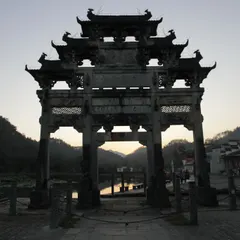
A few steps away, Zhuimu Hall is the secondary temple the Hu built in 1794; at the entrance to the village, the Hu Wenguang Archway honours one of their officials, and Dafudi Mansion now houses Xidi’s mediation workshop.
A house of three brothers beside the stream
Jing'ai Hall
Summary of this stop
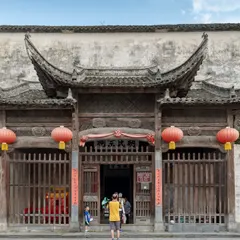
The visit begins outside, in the small square that opens before the gateway with its upturned eaves, the same kind of space that precedes other public buildings in Xidi and that served as the clan’s meeting point. One of the village’s streams runs beside the hall. Nothing in this façade reveals that the temple began as something far more domestic: in 1600, the 28th year of the Wanli era, it was the building of Shiheng, an ancestor of the 14th generation of the Mingjing Hu lineage. Xidi’s official website describes it as his residence; other sources, as his offering hall. His three sons turned it into a clan temple and named it Jing’ai, “respect and love”, in token of the mutual affection between brothers.
What is seen today, however, is not that Wanli-era building. A fire destroyed it, and the reconstruction is placed at the beginning of the Qing dynasty according to the official version, although other descriptions take it to the Qianlong era (1736-1795) and link it to an enlargement owing to the growth of the clan. Behind all this beats the founding story the lineage passes down: in the spring of 1077, Hu Shiliang, fifth ancestor of the Mingjing Hu of Wuyuan, stopped one night in this valley on his way to Jinling, read in the mountains a celestial horse and a rhinoceros gazing at the moon, found that the two streams ran from east to west and decided to bring his whole family here. Facing the water, the narration tells what exactly that traveller saw and why a stream running westward could promise fortune.
Six metres of stone to judge the clan
Blue-stone columns of the lower courtyard
Summary of this stop
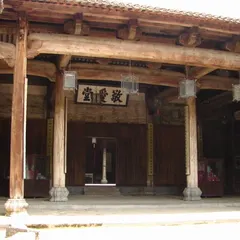
On crossing the gateway, the scale changes completely. The lower courtyard of the sacrificial hall opens onto a large open-air courtyard, flanked by two side wings, and the light falls full on two six-metre columns of Yi blue stone. Opposite, in the upper courtyard, two thick ginkgo-wood columns answer them. It is the architecture of an assembly hall, not of a dwelling: the space was meant to fill with people.
And it did fill. Besides being a temple, the hall was where the Hu clan debated its affairs, held weddings and festivals, and reprimanded and punished descendants who strayed from the rules. Justice was dispensed in Xidi’s largest building, and for a long time women were forbidden to enter. Among these columns, the audio guide reconstructs how that family court worked and what it meant to be left on one side of its door.
The character that was a granary lid
The 孝 board
Summary of this stop
From the upper courtyard, looking toward the gateway, the hall’s most famous piece appears: a large square board, about three metres on a side, hung over the entrance beam with the character 孝, “xiao”, filial piety. It is attributed to Zhu Xi, the Southern Song philosopher, although he died centuries before the hall was built and the attribution is passed down without source documentation. The board is today the axis of the filial piety culture programme that Xidi added to its guided visits.
Local tradition proposes reading it as a riddle: in the strokes one can make out a young man bowing in greeting before his elders, and the nape of his neck draws the profile of a monkey. The moral is blunt: whoever honours their elders is a person; whoever does not, a beast. Its survival also has something of a fable. It is said that during the Cultural Revolution (1966-1976) most of the characters “loyalty, filial piety, integrity, purity” attributed to Zhu Xi were lost, and that this one was saved because a villager took it home and used it as the lid of his granary. Beneath the board, the narration guides the eye until it finds the young man and the monkey hidden in the ink.
Empty chairs beneath a hundred generations
Portraits and Baidai zhengchang plaque
Summary of this stop
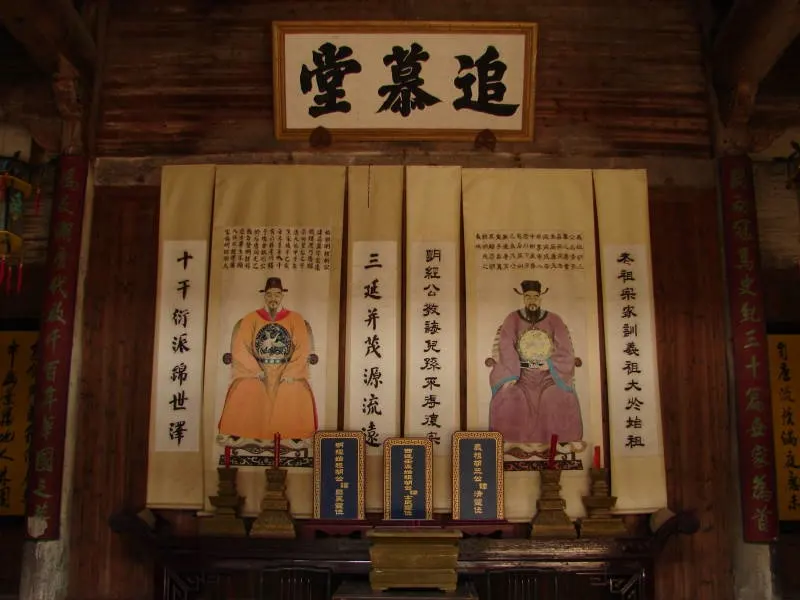
At the back of the upper courtyard, the wooden wall gathers the portraits of the ancestors beneath the “Baidai zhengchang” plaque. Its name joins two ancient rites, the autumn “chang” and the winter “zheng”, and holds a promise: for a hundred generations, descendants must offer sacrifices to their ancestors. From the beams hang other old plaques with gilded characters, such as “Tian’en chongmu” and “Sishi cheng’en”. In front wait a central armchair, two rows of chairs and tables, and a large table for the offerings; behind rises the two-storey pavilion that keeps the tablets of all the lineage’s ancestors.
Those chairs had owners. According to documented tradition, in Qing-era Huizhou the men of a village sharing one surname, up to a thousand of them, gathered in their temple on the great ritual dates and held the sacrifice following Zhu Xi’s family rites; here, the central armchair was the seat of the clan head, and the side rows those of the elders and men of standing. The promise of the hundred generations still stands: the hall remains the centre of the Hu clan and hosts its ancestor-worship rites every year, and since 1991 a village woman, Hu Xiaowen, has cleaned it, watched over it and explained it to whoever arrives. At this last point, the narration closes the circle between the temple that judged its own and the one that still awaits them.