Qing Clan Temple
Zhuimu Hall Audio Guide (Zhuimu Tang)
In 1794, one of the six richest men in Jiangnan raised this secondary Hu temple on Dalu Street in Xidi to remember his father and grandfather. Inside, however, a Tang emperor is also worshipped.
- 40 min of audio
- Huizhou Qing Architecture
Zhuimu Hall was founded in 1794, the 59th year of Qianlong's reign, as a secondary temple (zhici) of the Hu clan of Xidi. It was paid for by Hu Guansan, of the 24th generation of the Mingjing Hu lineage, in memory of his grandfather Hu Bingpei and his father Hu Yinghai, and its name means “to remember with longing”. It keeps two courtyards in depth, a gateway faced with polished marble and the status of a nationally protected monument; between October 2024 and January 2025 it was closed while its roof tiles were checked and relaid.
The contrast lies at the altar. According to the clan's genealogy, the Hu of Xidi descend from a son of Emperor Zhaozong of Tang who fled during the fall of the dynasty and took the surname Hu, and the first rule of the lineage forbade ever being called Li again. Even so, inside the Hu hall the statue of Li Shimin, the great Emperor Taizong of that same dynasty, is venerated, surrounded by portraits of his meritorious ministers.
Highlights
- Yi marble gateway — Walls splayed in the shape of the character 八, faced with whole slabs of polished marble
- Statue of Li Shimin — A Tang emperor venerated by a clan said to descend from his dynasty
- The door guardians — The legend of the geomancer who found the clan's bad fortune painted on the entrance
- Dalu Street and Diji Hall — The house where Hu Guansan received his in-law, a minister of the Qing court
- Dunren Hall — The merchant's house, still lived in by his descendants of the 30th generation
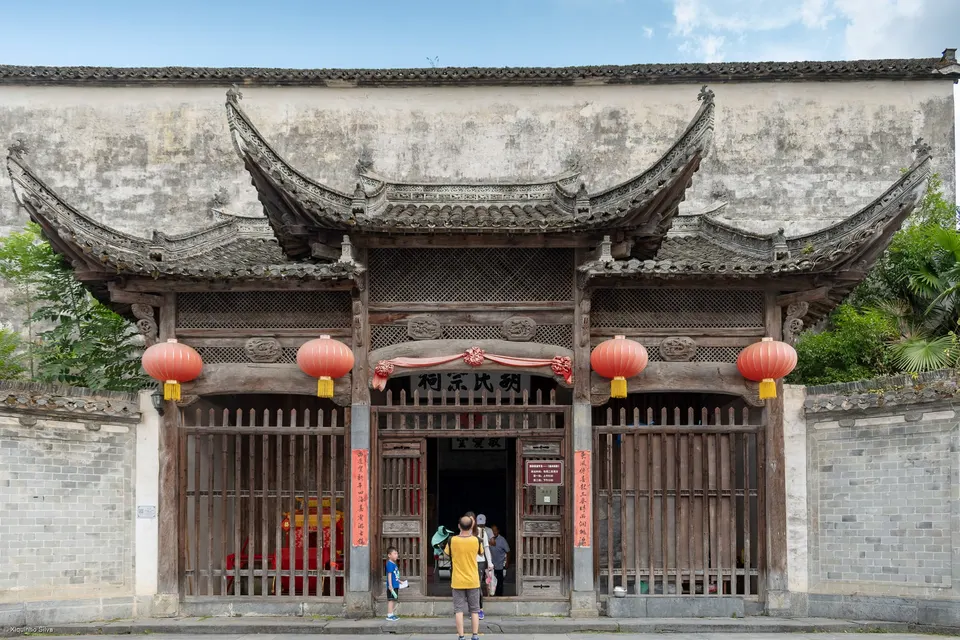
Right on Dalu Street in Xidi, a gateway faced with polished marble announces that behind it lie money and lineage. This is Zhuimu Hall, known in Xidi as Zhuimu Tang: the secondary temple of the Hu that Hu Guansan, one of the six richest men in Jiangnan, had built in 1794 to honour his father and grandfather. The fortune of a Huizhou merchant turned into stone, worship and lineage prestige.
The history of Zhuimu Hall also holds a paradox. The clan that built it claims descent from the Tang dynasty and swore never to take back the surname Li, yet inside it venerates the statue of Li Shimin, the most famous emperor of that dynasty. The sources do not even agree on whom the hall is first dedicated to: some speak of a son’s homage to his elders, others of the emperor, others of the passage from one surname to another. What to see at Zhuimu Hall goes beyond its architecture: the audio guide walks it in four stops that leave the gateway, pass the imperial altar and continue along the street to the family’s houses, one of them still lived in by his descendants.
The clan’s general temple is the neighbouring Jing’ai Hall; next to the Hu Wenguang Archway, Hu Guansan also built Zoumalou Tower, and Dafudi Mansion shows the house of another illustrious Hu, the prefect Hu Wenzhao.
Yi marble and the wrong guardians
Zhuimu Hall
Summary of this stop
The façade announces from outside that nothing was spared here. The entrance walls splay out in the shape of the character 八 (bazi) and are faced with whole slabs of polished Yi marble, beneath an eave with raised corners. Before the triple door, the sanyuanmen, runs a wooden railing. Above, the dark-tiled roof recently went through a restoration: the hall was closed from 20 October 2024 to 19 January 2025 while workers checked and relaid the tiles.
That cold, smooth stone is, above all, a filial gesture. Hu Guansan paid for the hall to honour the memory of his grandfather, Hu Bingpei, and his father, Hu Yinghai, and gave it a name that says it all: Zhuimu, “to remember with longing”. The most quoted date is 1794, the 59th year of Qianlong’s reign; one record speaks of the 58th year, although it also makes it equal 1794, a count that does not add up.
The door has its legend too. The legend says that at first it carried the same guardian gods everyone used, Shentu and Yulei, and that for more than 270 years the family had a single son per generation and an ordinary fortune. A renowned geomancer found the cause neither in mountains nor in rivers, until he noticed the door: in the time of Li Shimin, doors were painted with the generals Qin Shubao and Yuchi Gong. The guardians were changed and, according to the tale, the Hu began to prosper. The clan’s genealogy, however, places the end of the only sons much earlier, at the twelfth ancestor, Yu Si. Which figures guard the entrance today is what the narration reveals before the gateway.
A Li emperor in the Hu hall
Statue of Li Shimin
Summary of this stop
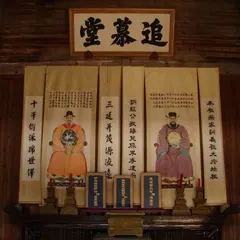
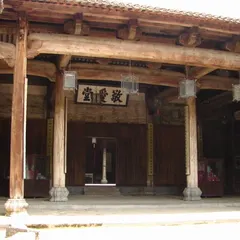
Past the gateway, the hall is arranged in two courtyards in depth: entrance pavilion, main hall and, at the back, the rear tablet hall (qintang), all surrounded by galleries. In the main hall a statue of Li Shimin, Emperor Taizong of Tang, receives worship, and portraits of his meritorious ministers are displayed. According to the local tradition, a plaque above the statue calls him “sovereign of the upright path”, the portraits of the twenty-four ministers of the Lingyan Pavilion hang on the partitions around the rear courtyard, and on beams and columns is carved the maxim of the three mirrors that the emperor pronounced in 643, at the death of his minister Wei Zheng.
The explanation lies in the genealogy. For the clan, its founding ancestor was a son of Emperor Zhaozong of Tang, Li Ye, who fled during the fall of the dynasty and took the surname Hu. How it happened is a disputed matter: the Hu genealogy speaks of a trusted servant, Hu San, who took the prince to Huizhou and raised him as Hu Changyi; the chronicle of Yi County attributes the rescue to the wet nurse and her husband. The clan’s documented tradition is more categorical: the first rule of the lineage ordered never to return to the surname Li, and in the New Year rites the “adoptive ancestor” Hu San received worship two days before the founder.
The rear hall, the tablet hall, was also the stage of the most feared punishment. According to the tradition of the clan halls, a descendant who committed a grave offence was expelled and forbidden to bear the surname Hu, and the tablets of his father and grandfather were taken out and burned in front of everyone. Before the statue, the narration resolves the paradox of a lineage that renounced being Li and yet still honours a Li emperor.
Guansan’s paving stones and the official’s hall
Diji Hall
Summary of this stop
Back on the street, the route puts a face to the patron. Zhuimu Hall and Diji Hall, Hu Guansan’s family house, both stand on Dalu Street. Diji Hall dates from 1664, and it was there that Hu Guansan received his in-law Cao Zhenyong, a senior official of the Qing court; because of that visit the house is known as Guanting, “the official’s hall”. Cao’s exact post is the subject of different accounts: some sources present him as a grand minister under the Qianlong, Jiaqing and Daoguang reigns, and others as tutor to a young prince.
Hu Guansan was among the six richest men in Jiangnan, and his money did not stay in the family temple. He financed the Biyang Academy of Yi County and the Mingjing Temple at the entrance to Xidi, and built nine roads of more than 160 li in the counties of Xiuning, Qimen and Yi. Local tradition also credits him with the stone paving of Xidi’s lanes, and recalls that he was the father of Hu Yuanxi, prefect of Hangzhou in the Daoguang era. In front of the façade of Diji Hall, the audio guide tells how, according to tradition, the fortune of a single man ended up beneath the feet of the whole village.
The merchant’s house, still inhabited
Dunren Hall
Summary of this stop
The last stop changes scale. Dunren Hall, built at the end of the Kangxi reign, was the residence of Hu Yinghai and his son Hu Guansan. It has five bays, two wings and two storeys, and combines a large “mother” light well before the hall with small “son” courtyards in the wings, an arrangement unique among Xidi’s old houses. Over the main wall of the hall, the taishibi, hangs the plaque with the name 惇仁堂, calligraphed in the Jiaqing era by Wang Chengpei, “the old man of the chrysanthemums”.
In the hall, two couplets carved in wood sum up the ethics of the house; one of them reads: “Several centuries of family are nothing but accumulated kindness; the best thing to do is simply to read”. It is not the only trace of study in this house. In 1906, the 32nd year of Guangxu’s reign, Huang Xingxian, wife of a great-great-grandson of Hu Guansan, opened the Chongde Girls’ School here, the first school for girls in Yi County. And the house is still alive: direct descendants of Hu Guansan of the 30th generation still live in it. In this courtyard, the narration closes the circle that began before the marble of Dalu Street.