Hui House of a Prefect
Dafudi Mansion Audio Guide
A prefect had the corner of his own house cut back so porters could pass, and engraved above the door “think of taking a step back”. That half metre ceded to the street still teaches Xidi to make peace.
- 30 min of audio
- Hui Architecture
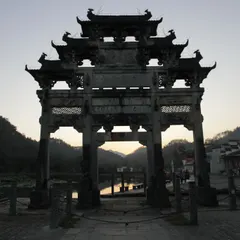
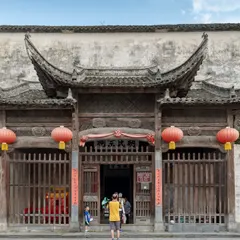
Dafudi Mansion is a Hui house of the Hu family, built in 1691, the 30th year of the Kangxi era, according to the village's descriptive record, and linked to the fourth-rank official Hu Wenzhao, prefect of Kaifeng and bearer of the honorary title chaolie dafu. It stands in the heart of Xidi's commercial district, the village inscribed on UNESCO's World Heritage List together with Hongcun, and within a few metres brings together a carved-brick gateway, a pavilion jutting over the alley, a light well ringed with lattice screens and a wing with marble columns, a rarity among the village's houses.
Its fame comes not from luxury but from a renunciation: the corner of the house was cut back and part of the façade stepped back half a metre so that peddlers, barrows and porters with carrying poles could pass. Above the door the lesson was left written, “Zuo tui yi bu xiang”, and the pavilion's plaque gave all of Xidi its motto, “a home in the Peach Blossom Spring”. The romantic legend that now surrounds that pavilion, by contrast, seems to have been written by the theatre.
Highlights
- Cut-back corner — The chamfer a prefect ceded to the porters and that visitors touch with their hands
- “Zuo tui yi bu xiang” plaque — Five stone characters that ask to think of taking a step back
- Viewing pavilion — The plaques that gave Xidi its motto and the fame of the embroidered ball
- Light well — Plum-on-ice lattice screens and lions hanging head down on the upper gallery
- Guifuting — An 1830 wing with marble columns, now the village's mediation workshop
In the alleys of Xidi the merchants’ houses press wall against wall, and every handspan of street counts. Dafudi Mansion is famous for precisely the opposite: for a handspan its owner gave back. Over the gateway, three characters in carved brick, “大夫第”, announce the residence of a man with a title; at the corner, a chamfer cut on purpose tells that the same man decided to step aside.
The history of Dafudi Mansion revolves around Hu Wenzhao, a fourth-rank official, prefect of Kaifeng and bearer of the honorary title chaolie dafu. The village record dates the house to 1691, the 30th year of the Kangxi era, and places in the Daoguang era (1821-1850) the renovation in which the corner was cut back and the viewing pavilion over the street was raised. The dates are not settled: a travel account makes the pavilion as old as the house, a commercial guide takes the whole mansion to the nineteenth century, and not all sources agree that this was Hu Wenzhao’s ancestral home, since Xidi’s official website assigns that role to other family residences. In early 2020 Yi County restored it with respect for the old fabric.
To know what to see at Dafudi Mansion and understand its architecture, from the cut-back wall to the light well and the wing of marble columns, the audio guide walks the house in four stops and follows the thread of a minimal gesture that ended up as the motto of a whole village.
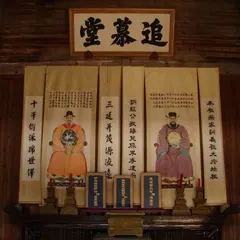
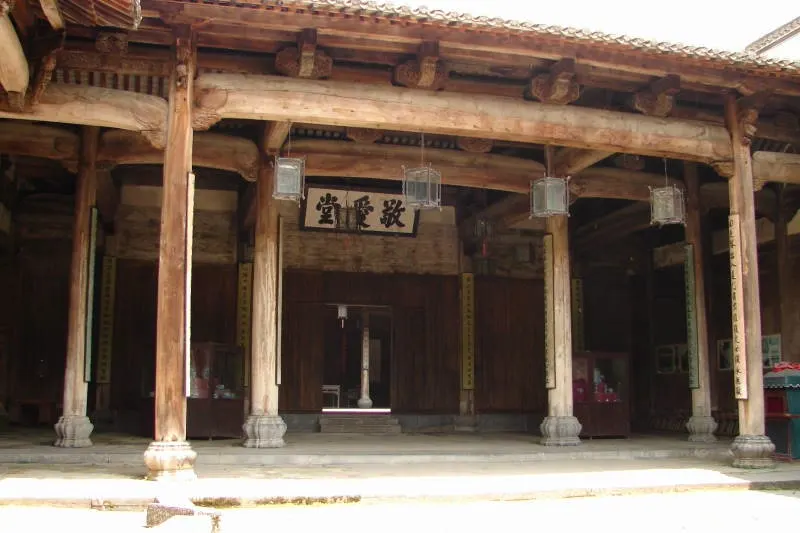
If mediation among neighbours happens here today, Jing’ai Hall was where the Hu clan judged its own; and on Dalu Street, Zhuimu Hall shows the fortune of another Hu, the merchant Hu Guansan.
The corner the prefect had cut back
Cut-back corner
Summary of this stop
The first point of the visit is outside, in the alley. The house stood in the middle of the commercial district, where peddlers passed with carts and loads on their shoulders, and in the Daoguang-era renovation its owner had the corner of the main dwelling cut back and part of the façade set back half a metre so that barrows and porters with carrying poles could get by. The versions differ on the detail: some speak of the corner cut away and the wall of the side door set back half a metre; others, of a rounded corner and the upper pavilion receding the same distance. What remains in view is the chamfer cut into the wall, and visitors stop before it and touch it with both hands.
Above it juts the overhanging pavilion, and with it another, more disputed story. It was built as a lookout to contemplate the mountains and the street, taking advantage of a gap beside the main house. The fame of “embroidery tower”, from which the daughters of the house threw the embroidered ball to their suitors, has been attaching itself to it in recent times because of its resemblance to scenes in period operas, and the village has taken it to the stage: the ball toss has been performed here, and the pavilion has served as the central stage of the Huangshan embroidered ball festival. The narration at the corner separates the courtesy of the wall, which is history, from the legend the theatre fabricated.
Five stone characters beneath the pavilion
“Zuo tui yi bu xiang” plaque
Summary of this stop
Beneath the viewing pavilion, called Guanjinglou, the door lintel has a stone plaque set into it with five characters: “Zuo tui yi bu xiang”, “think of taking a step back”. It is Hu Wenzhao’s message to his descendants, the idea that a step back opens the sky and yielding three parts brings calm, and it is the written explanation of the cut-back corner a few steps away.
Two other plaques hang from the eave. One reads “Taohuayuan li renjia”, “a home in the Peach Blossom Spring”, and from it comes the motto with which all of Xidi presents itself today; popular attribution assigns it to the Qing calligrapher from Yi County Wang Shidao, also written Wang Endao, in clerical script. Local custom invites looking in it for two details: a dot deliberately moved in the character for “spring” to balance the form, and a “person” character that looks like a young man leaning forward with arms outstretched to receive the young lady’s ball.
The other face bears the characters “Shan shi”, “mountain flowers like a market”, in the hand of Zhu Shilu. Legend has it that after a great fire on the main street of Xiuning, only one shop was left standing, whose sign he had written, and that from then on some paid enormous sums for his calligraphy to ward off misfortune. In a village of tightly packed wooden houses, the audio guide asks whether this plaque was hung for beauty or as an amulet.
Lions head down over the light well
Light well with plum-blossom screens
Summary of this stop
Inside, the penumbra of the wood opens onto a rectangle of sky: the light well, or tianjing. The main hall bears the plaque “Daya Tang”, although a recent chronicle claims that the 2020 restoration gave it back its old name, “Jiusi Tang”. On the table appear the vase and the mirror, whose names in Chinese, ping and jing, evoke “peace”.
The lattice panels around the courtyard are carved with blossoming plum branches over cracked ice, an allusion to the “ten years of cold window” that study demanded to become an official. On the upper floor, a curved balustrade, the meirenkao or “backrest of the beauties”, rings the whole courtyard, and the brackets are lions head down, an emblem of rank and power. The narration in the hall draws the portrait of the man who yielded half a metre to the street: a ranked official who filled his house with allusions to study and symbols of power.
Marble columns for making peace
Guifuting
Summary of this stop
The route ends at the Guifuting, a side wing of three bays and two storeys built in 1830, the 10th year of the Daoguang era, whose name evokes the scent of the osmanthus that fills its courtyard. It is a tall, bright hall with two marble columns, a rarity among Xidi’s houses.
After the 2020 restoration, the main hall received four couplets that explain the meaning of “Zuo tui yi bu xiang”, and the Guifuting works today as the mediation workshop of the Xidi municipality under that same name. Its method fits in six characters: listen, reason, persuade, rely on others, yield and reconcile. The audio guide closes here the circle opened by the corner of the alley and shows how a prefect’s step back still works among today’s neighbours.