The Fall That Splits the Town
Furongzhen Grand Waterfall Audio Guide (Furongzhen Da Pubu)
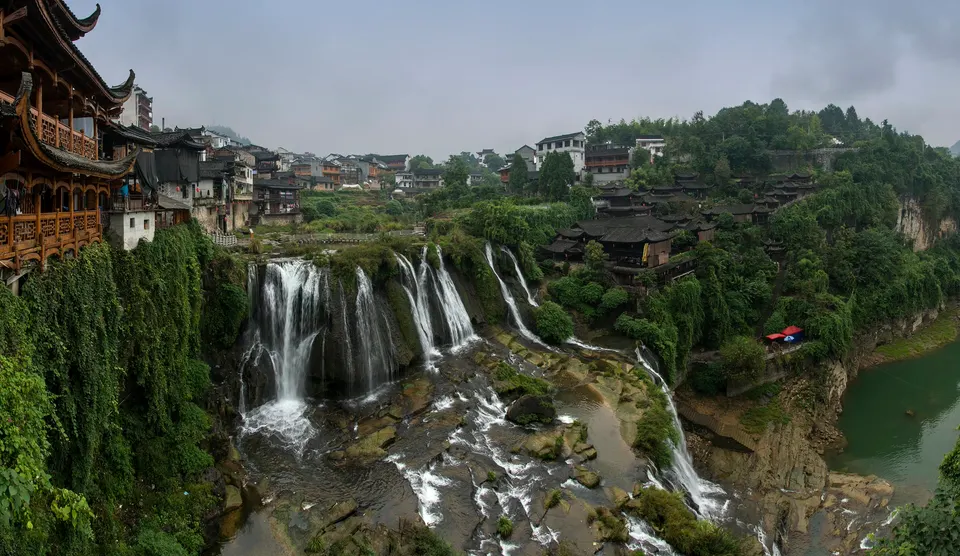
A mountain stream plunges some 60 metres in two leaps, splits the town in two and drops into the You River. A path carved into the rock runs behind the curtain of water, and above it stilt houses lean out, giving Furongzhen its motto of a town hanging from a waterfall.
- 45 min of audio
- Waterfall and stilt houses
Furongzhen Grand Waterfall, with a drop of about 60 metres in two tiers across a front of some 40, is the largest waterfall in Xiangxi, in western Hunan. On its cliff stood the seat of Youyang County under the Western Han and, from 691, the capital of Xizhou Prefecture, until in 1135 the hereditary prefect Peng Fushi moved it to the banks of the Lingxi River. The old seat kept the name Wangcun, “the king's village”, and the navigable Youshui at the foot of the fall made it the trading port of Yongshun, the “ford between Chu and Shu”, open to Sichuan and Guizhou upriver and to Dongting Lake downriver.
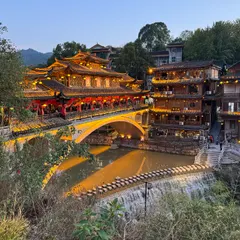
The most recent turn came with the light. A lighting plan worth more than 200 million yuan buried the cables, lit up the stilt houses and staged a show over the water, and the site, which used to close at 18:00, now closes at midnight. Every night at 19:30 the waterfall and the houses light up together, the mist takes on the colours of the spotlights and visitors have a nickname for it, “the real Spirited Away”. In 2025 night-time revenue exceeded 60% of the total: a town that used to go dark at dusk now lives mostly by night.
Highlights
- About 60 metres in two leaps — The largest waterfall in Xiangxi, across a front roughly 40 metres wide
- Path behind the curtain of water — A passage cut into the cliff that, at its narrowest, lets only one person through
- Flagstones at the edge — A near-silent stream a few metres from the drop, where Xizhou's capital stood from 691
- The cave of the first encounter — A legend of origin kept in the Wang family genealogy, with bronze statues at the foot of the fall
- The waterfall lit up — Every night at 19:30 the fall and the stilt houses light up together
Furongzhen does not sit beside its waterfall: it hangs from it. Furongzhen Grand Waterfall, Furongzhen Da Pubu (芙蓉镇大瀑布) in Chinese, plunges about 60 metres in two tiers down the cliff that splits the town in two, and from it comes the motto this Historic and Cultural Town of China goes by: the thousand-year-old town “hanging from a waterfall”. On both sides of the fall, wooden Tujia houses climb the rock in tiers; below, the green water of the pool flows into the You River.
The history of Furongzhen Grand Waterfall is also the history of power in western Hunan: a county seat under the Western Han, capital of Xizhou Prefecture from 691, old residence of the tusi after 1135 and, for centuries, a river port between Chu and Shu. The route descends in four beats, from the flagstones of the stream at the top to the viewpoint, by way of a path carved behind the water and a cave with a legend of its own. What to see at Furongzhen Grand Waterfall, and what each step of rock has to say, is truly appreciated by walking it with the audio guide.
At the foot of the fall, beside the You River, are the Wangcun Old Wharf, which made the town a port between Chu and Shu, and the Xizhou Bronze Pillar, the 940 peace treaty of the old Xizhou capital. From the landing stage rises Five-Li Flagstone Street, between the same Tujia stilt houses that lean out toward the waterfall.
Flagstones over a stream that is not the river
Flagstones and flat bridge above the fall
Summary of this stop
The route begins at the top, on stone slabs that cross the stream just before the edge. Here the water is calm, almost silent, and nothing announces that a few metres on it breaks into empty air. It is one of the most widespread misunderstandings about the place: the waterfall is not the You River. According to the most quoted field description, it is a stream running along the top of the cliff that, meeting two steps of rock, splits into two leaps, strikes a rock platform and plunges again to the Youshui below. Some popular texts present the fall as the You River itself crossing the town, a version the field sources do not support. Local tradition counts among its named views the sunset from the flat bridge over the waterfall, which is precisely this crossing.
This edge was a seat of power long before it was a postcard. On the cliff stood Youyang County under the Western Han and, from 691, the capital of Xizhou Prefecture. In 1135, Peng Fushi, eleventh hereditary prefect of Xizhou, moved the capital to the Lingxi River, at today’s Laosicheng; the old seat remained as the former residence of the tusi, hence its name, Wangcun, “the king’s village”. The date of the change from Wangcun to Furongzhen is disputed: the Yongshun government places it in 2007 and the Hunan government’s English-language website in 1997. On the flagstones, the narration explains why a place like this drew the lords of western Hunan.
Behind the water, one at a time
Path behind the curtain of water
Summary of this stop
The second stop is inside the waterfall, or almost. Behind the curtain of water runs a path cut into the cliff wall that, at its narrowest, lets only one person through. From inside, the town is seen through the water, and the scale of the fall is felt in the body: cold, drizzle and a roar bouncing off the rock.
The most repeated figures speak of about 60 metres of drop in two leaps across a front of about 40 metres, which makes it the largest waterfall in Xiangxi, although no open source gives an official measurement and one account speaks of 60 metres wide. Local tradition grants it named views, such as “the thunder of the waterfall”, “rain and mist of the Dragon Cave” and “the natural stone finger of the cliff”. On the path, the audio guide gives voice to that thunder and to what it means to walk behind it one at a time.
The cave of the first encounter
Cave and bronze statues at the foot of the fall
Summary of this stop
At the foot of the fall, beside the entrance, opens a rock cave held to be the ancient dwelling of the first Tujia settlers, and next to it bronze statues depict those cave dwellers. The genealogy of the town’s Wang family preserves a tradition about it: very long ago, a group fleeing the wars of the Qin dynasty made its way up the Yuan River with great hardship and stopped to rest here. Inside they found people with long hair, bare feet and animal skins, who spoke in sounds like those of birds and beasts. The newcomers found them hardworking and kind, stayed to live with them and, together, cut a road into the rock with their tools.
The same tradition adds that the cave came to hold a thousand people and that centuries of floods slowly filled it with mud. Those floods are the fall’s own, with its strongly seasonal flow: from June to September it roars at full volume, in the dry winter it can shrink to a thread of water, and in July 2020, after days of continuous rain, the swollen waterfall drew crowds. Facing the cave, the narration links that road opened in the rock with the path just left behind.
The hanging town that no longer closes at night
Waterfall viewpoint (观瀑台)
Summary of this stop
The route ends at the waterfall viewpoint (观瀑台), from which the whole fall is taken in with the town above it: the stilt houses on both sides, the rock platform between the two tiers and the pool at the foot. It is the literal image of Furongzhen’s motto, the thousand-year-old town hanging from a waterfall.
That picture changed its hours recently. In 2018, the Yongshun government and the Hunan Huaxia Investment Group set up a joint company that has invested 1.59 billion yuan in the town, and a lighting plan worth more than 200 million buried the cables, separated rainwater from sewage, lit up the stilt houses and staged a light show over the waterfall. The site went from closing at 18:00 to closing at midnight. Every night at 19:30 the fall and the houses light up together, and the illuminated mist has earned the nickname “the real Spirited Away”, with the Tuwang Bridge and its red lanterns as another favourite frame. In 2025 the site received 6.53 million visits and more than 60% of revenue came at night. At the viewpoint, the audio guide closes the circle between the water that gave the town its site and the water that keeps it awake today.