Peace Treaty of the Year 940
Xizhou Bronze Pillar Audio Guide (Xizhou Tongzhu)
Behind an illuminated glass case, beside Furongzhen's wharf, a bronze column some three metres tall bears the oath that in 940 ended a war and gave the Peng chiefs of the You River almost eight centuries of power.
- 40 min of audio
- Engraved 10th-century bronze
The Xizhou Bronze Pillar (溪州铜柱) is a hollow octagonal column cast in 940, the fifth year of the Tianfu era of the Later Jin, to seal the ceasefire between Ma Xifan, king of Chu, and Peng Shichou, governor of Xizhou, after the war the latter had unleashed a year earlier. Its eight faces carry the “Record of the Bronze Pillar of the Restoration of Xizhou”, composed by the scholar Li Honggao on the king's orders: more than 2,600 characters in regular script, most from the original engraving and the rest added in the Song period. Today it stands at the centre of the pillar hall, in the Xiangxi folk museum beside the landing stage, and is on the first list of nationally protected monuments.
The paradox lies in who asked for the bronze. According to the inscribed text itself, it was not the victor who wanted a monument but the officials of Xizhou, after a son of Peng Shichou appeared bound before the king to surrender on his father's behalf and the region handed over hostages. That oath of the defeated sustained the hereditary power of the Peng until 1728, and the column went on to survive wars, a reservoir that flooded its original bank and a night thief who in 1991 carried off a piece of its rim.
Highlights
- A peace treaty cast in 940 — The pact between the kingdom of Chu and Peng Shichou, engraved on an octagonal bronze column
- More than 2,600 characters — The original text of 940 and the Song-era additions, in vertical columns across the eight faces
- Almost eight centuries of Peng power — An oath that sustained the chiefs of the You River until 1728
- The summit without its cap — The octagonal joint where the lost cap fitted and the rim cut at night in 1991
- A journey downriver — From Huixiping to the Wangcun wharf by boat, fleeing the waters of the Fengtan reservoir
A few steps from Furongzhen’s landing stage, a small, dimly lit hall keeps one of the most singular documents of the You River: a peace treaty that was not written on paper but cast in bronze. The Xizhou Bronze Pillar, Xizhou Tongzhu (溪州铜柱), was raised in 940 at Huixiping, on the banks of the You River, in today’s Guzhang County, some 10 km from the Wangcun wharf. It is now displayed in the pillar hall of the folk museum, a building that appears under several names (Xiangxi Folk Hall, Xizhou Folk Hall or Xizhou Bronze Pillar Museum) and that, everything suggests, is one and the same. Around it, the folk museum’s display cases gather objects of Tujia life.
The history of the Xizhou Bronze Pillar is that of an object that has never stopped moving. The wars of the Northern Song displaced it several times; in 1018 it was raised again at Huixi and titles of local officials were engraved on it. In 1885, the prefect of Yongshun, Zhang Zengyang, built a pavilion for it on its original site, and in the 20th century a reservoir forced it to travel downriver. Its architecture is sober and precise: a hollow octagonal column with faces 15 cm wide, which when unearthed in 1969 measured 2.98 m in total height. Figures vary by source, and some speak of four metres and 2,500 kg, the equivalent weight of the bronze cast, against a little over 1,000 kg measured when it was lifted from the ground.
Its protagonist has no single version either. In the pillar’s text, the name of Peng Shichou is written as Peng Shiyin, and his origin is told in two ways: native chief of the Chishi caves or member of a Peng clan that came from Jiangxi. The oral legends of Laosicheng, the Peng’s old capital, remember him as the “Tusi King” who defeated the warlord Wu Zhuchong before making a pact with Chu, and the pact inspired the series Blood Pact of a Thousand Years (《血盟千年》), whose filming ended in January 2020, with princesses and state weddings that never existed. What to see at the Xizhou Bronze Pillar and how to read a treaty without knowing Chinese is truly appreciated by walking through the hall with the audio guide.
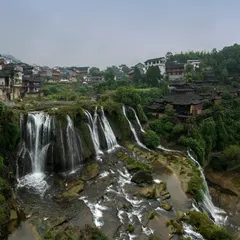
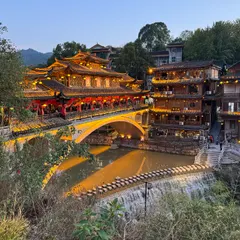
The pillar hall looks out on the Wangcun Old Wharf, where it arrived by boat, and on the Furongzhen Grand Waterfall, beside which the capital of Xizhou stood from 691. Very close, Liu Xiaoqing’s Rice Tofu Shop tells the town’s most recent chapter: the cinema one.
Eight bronze faces to end a war
Bronze column behind glass
Summary of this stop
From the hall’s entrance, the column is taken in at a single glance: about three metres of bronze in the middle of the room, enclosed in an illuminated case, with its upper part clearly eight-sided and its base more rounded. Its scale is human, almost discreet, and nothing about it announces that it holds the outcome of a war.
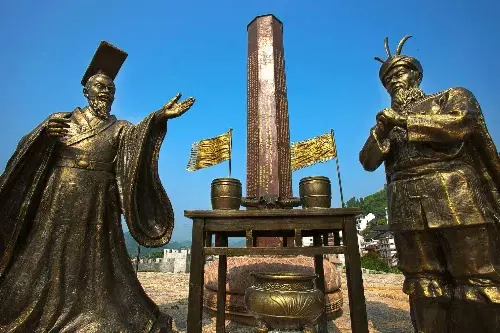
That war began in 939. The governor of Xizhou, Peng Shichou, allied with the prefectures of Jin and Jiang and attacked those of Chen and Li, territory of the kingdom of Chu. The following year, King Ma Xifan and the local chief concluded a ceasefire and an oath, and the text was engraved on this column, cast in the fifth year of the Tianfu era. What is striking is how the treaty itself presents the river’s people: as heirs of the “legacy of Panhu”, with six sons scattered who formed clans in the Five Streams. Panhu is the mythical dog who, according to legend, brought the king the head of his enemy, won the hand of a princess and had with her six sons and six daughters, origin of twelve clans. In front of the glass, the narration explains why an official document of the 10th century opens with a myth of origin.
The oath the defeated asked for
Columns of engraved characters
Summary of this stop
Up close, the surface becomes text: vertical columns of characters in regular script, between five and seven per face, spread over the eight faces. By the most quoted count they total 2,614 characters, 2,121 from the original engraving of 940 and 493 added in the Song period, although other sources give slightly different figures. Among those lines are very specific clauses: Xizhou kept its own taxes for its upkeep, its soldiers were exempt from conscription by Chu and Peng Shichou remained governor in the king’s name.
The text also records the scene before. Peng Shigao, son of Peng Shichou, appeared bound before the victor to offer submission on his father’s behalf, and the people of Xizhou handed hostages to the court. Afterwards, according to the engraved account itself, it was the officials of Xizhou who asked to raise a pillar to swear upon. Peng Shichou and the chiefs of five clans promised to “submit wholeheartedly to the king’s civilisation and serve the court forever”, and invoked mountains, rivers and spirits to protect their descendants for “a thousand and ten thousand springs”; whoever broke the oath, the text warns, would offend the spirits. The pact sustained the Peng’s hereditary power until the abolition of native chiefs in 1728. Before the engraved face, the audio guide turns those columns of characters into the exact words of the defeated.
The summit without its cap and the cut of 1991
Capless summit of the pillar
Summary of this stop
Beneath the column’s crown, the wounds of the journey can be read. The original cap that topped it was lost, and on the summit the octagonal joint with tenon and mortise where it was fitted is left in view. A small piece is also missing from the upper rim: in the spring of 1991 someone entered at night the pavilion where it was then kept and cut it off. After that theft, with the approval of the State Administration of Cultural Heritage, the pillar was moved to the folk museum at the Wangcun wharf. A travel blog has suggested that what is on display would be a replica, but Chinese Wikipedia and the provincial press place the original here.
Its arrival at the wharf had been another flight. In autumn 1969, facing the flooding of the Fengtan power station reservoir, a team of six led by the heritage official Xiang Yuanquan toppled and dug out the column at Huixiping; on lifting it they discovered that its hollow interior was filled with river pebbles. They loaded it onto a boat to Wangcun and carried it up Congshanbao hill, today Huaguoshan, under a new pavilion. Some sources place that move in 1971. Behind it all beats an older legend: in the engraved text, Ma Xifan presents this pillar as heir to the columns that his “ancestor”, the general Ma Yuan, is said to have planted in the year 42 after defeating the revolt of the Trung sisters, columns on whose firmness, so the story goes, the fate of a whole country depended and which as early as 1272 an envoy of Kublai Khan sought in vain. Beneath the summit, the narration reveals what that verse of the lost bronze said and why this one, unlike that one, still stands.