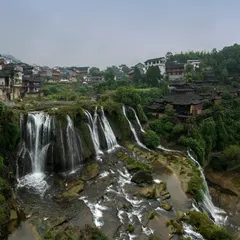
Qing-Era Trading Street
Five-Li Flagstone Street Audio Guide (Wuli Shiban Jie)
It was born to serve the boats waiting for the Youshui rapids and came to be known as a small trading capital. Today Furongzhen's flagstone street still climbs from the water between houses hung on the cliff, in the hands of its own residents.
- 40 min of audio
- Tujia stilt houses
In the 18th and 19th centuries, Wangcun, today's Furongzhen, grew around a single artery: the flagstone street rising from the Youshui landing stage, at the starting point of the Fengtan rapids, where boats stopped to rest and resupply. Rebuilt and enlarged under the Qianlong and Jiaqing reigns, the town reached its peak in the Daoguang era (1821-1850), when more than 300 inns and shops lined the street and its bustle earned it the nickname “Little Nanjing”. Its architecture still stands: shops with plank doors stepped down the slope and Tujia stilt houses whose building technique has been national intangible heritage in China since 2011.
Before the shops and before the film, the place appears in a song: the ancestral chants of the Tujia baishou dance preserve verses about forebears who, after a long and hard journey through mountain roads that the water seemed to cut off, past ancient trees, white cranes and bamboo groves, reached Wangcun and decided to stay. Much later, the decision was repeated: when the town's renovation began in 2018, not a single family was relocated, and today it is the residents themselves who run the street's shops, with the sales counter in front and the workshop behind.
Highlights
- The “Little Nanjing” — More than 300 inns and shops in the Daoguang era and over 2,000 merchants and travellers a day
- Steps up from the landing stage — The street begins at the Youshui wharf, at the foot of the Fengtan rapids
- Tujia stilt houses — A building technique declared national intangible heritage in China in 2011
- Carved hanging pillars — Finials shaped like silk balls and golden gourds beneath the overhanging floors
- A lived-in street — Over 2,000 households of original residents, with the shop in front and the workshop behind
Before it was called Furongzhen, the town was called Wangcun, and its reason for being lay below, in the water. Five-Li Flagstone Street, known locally as Wuli Shiban Jie (五里石板街), starts at the landing stage on the Youshui River and climbs the hillside over bluish stone slabs worn round at the edges, between shops closed up with wooden planks and Tujia houses that lean out over the cliff on stilts. Its name is a measure: five li is about 2.5 km, although no open source gives a real measurement and the figure may well be a round one. What is documented is its splendour: in the Daoguang era (1821-1850) it was lined with more than 300 inns and shops, and over 2,000 merchants and travellers passed along it every day.
The history of Five-Li Flagstone Street is that of a port of passage turned high street: the town was rebuilt and enlarged under the Qianlong and Jiaqing reigns (1736-1820), a film of the 1980s made it famous and, in time, gave it a new name, and its residents never left. It is sometimes credited with more than 2,000 or 2,300 years of age, but those figures refer to the founding of Youyang County in Han times; the documented form of the street belongs to the 18th and 19th centuries. Its architecture and what to see on Five-Li Flagstone Street fall into four beats, from the steps of the landing stage to the lanterns of the upper stretch, and are truly appreciated by climbing it with the audio guide.
The street begins at the Wangcun Old Wharf, at the foot of the Furongzhen Grand Waterfall. A few steps away is Liu Xiaoqing’s Rice Tofu Shop, tied to the film that made the town famous.
Steps where the street rises from the river
Steps up from the landing stage
Summary of this stop
The climb starts at the water. From the Youshui wharf, a flight of stone steps passes beneath a gallery of stilt houses until it joins the street, and that route explains the whole town. Wangcun stood at the starting point of the Fengtan rapids: boats going down or up the river stopped here to rest and resupply, and in the peak years the moored boats formed a line five li long, the same length as the street that climbed from the landing stage and crossed the whole town.
In Wangcun, stories are still told without names or dates: Tujia girls, beautiful and passionate, who stepped aboard the boats of the Youshui boatmen as they cast off and vanished downriver with them. They are the other side of a better-known image from the river’s memory, that of the women who stayed on the bank waiting for the men who risked their lives in the rapids. At the foot of the steps, the narration tells what each boat that cast off meant for the town.
High counters of the “Little Nanjing”
Plank fronts and high counters
Summary of this stop
Further up the slope, the street narrows between fronts of vertical wooden planks, many darkened by time and stepped to follow the incline: these are the banmen shops, “plank-door” shops. Some old shops, inns and taverns keep their tall wooden counters beside the street; between them hang small boards with the names of old trading houses and cloth banners, while Tujia stilt houses lean toward the water with their upturned eaves.
This stretch is the best place to imagine Wangcun at its height. Rebuilt and enlarged under the Qianlong and Jiaqing reigns, the town then completed its commercial and urban functions and reached its peak in the Daoguang era. Tea houses, theatres, gambling dens and brothels mingled in the street, and the daily traffic of more than 2,000 merchants and travellers earned it a surprising nickname for a town hanging over a mountain river: “Little Nanjing” (Xiao Nanjing). In front of the counters, the audio guide brings back the bustle of those years.
Timber houses that were once forbidden
Hanging pillars of the stilt houses
Summary of this stop
Beneath the overhanging floors, the eye travels up to the ends of the pillars that hang in mid-air. In the corner houses of Yongshun’s Tujia, these hanging pillars are octagonal, hexagonal or square in section and end in carvings of silk balls (xiuqiu) and golden gourds (jingua); the railings have lattices in the shape of the swastika and of the character ya. They are details of an architecture that was not always allowed: only when the Qing dynasty lifted the region’s ban on using beams, pillars and tiles, during the Yongzheng era (1723-1735), did corner houses on stilts (zhuanjiaolou) spread widely.
Today that technique is heritage: the building of Yongshun’s Tujia stilt houses entered China’s third batch of national intangible heritage in 2011, under number VIII-211, and Furong is among the few townships in the county where it still survives. Inside these houses a custom with a known origin also lives on. According to documented tradition, in the winter of 1554, the 33rd year of the Jiajing era, the tusi chiefs Peng Yinan of Yongshun and Peng Jinchen of Baojing answered the Ming court’s call with 3,000 Tujia soldiers each, bringing their own provisions and arms, to fight the wokou pirates on the south-eastern coast. The departure fell just before New Year’s Eve, and the commanders decided to celebrate the New Year a day early so as to say goodbye with their families without delaying the campaign. Hence the “guo gan nian”, the advanced New Year, which Wangcun, one of the soldiers’ departure points, still celebrates. Beneath the pillars, the narration returns to that farewell.
A street with no cables and no evictions
Strings of red lanterns
Summary of this stop
On the upper stretch, long strings of red lanterns hang on both sides, and above them something is missing that goes unnoticed: not a single cable is visible. The wiring was buried in the renovation begun after 2018, when the Yongshun County government set up a joint company with the Hunan Huaxia Investment Group to develop the town without relocating a single family. The site invested more than 200 million yuan in burying the cabling, separating rainwater from sewage and lighting up the stilt houses; it extended opening hours from 18:00 to 24:00 and made the flagstone street, together with the Tuwang Bridge and the waterfall wharf, one of its three night-time hubs.
The street is alive because people stayed. Over 2,000 households of original residents live in Furongzhen, running the old streets themselves on a “shop in front, workshop behind” model: they sell at the front and in the back room make traditional crafts or farm products. The turn began with cinema: in 1986 director Xie Jin shot “Hibiscus Town” (Furongzhen) here, tourism grew after its success and Wangcun ended up officially adopting the film’s name, in 2007 according to most sources, although CGTN places the change in 1997.
At nightfall, the flagstones become a film set. Ten or twenty travel-photography studios dress visitors in ethnic costumes and silver ornaments, and queues form to pose while the jingle of silver mixes with the clicking of shutters until midnight. In one of those studios, the make-up artist Xiao Xie works from 9 in the morning to midnight, prepares more than a dozen outfits a day and has watched group after group of Russian and Spanish tourists arrive. At the top of the climb, the audio guide closes the circle between the river that gave rise to the street and the residents who keep it standing today.