River Port of the Youshui
Wangcun Old Wharf Audio Guide (Wangcun Gu Matou)
At the foot of the waterfall, in a deep bend of the Youshui, moored the boats that linked Sichuan with Dongting Lake. From this landing stage went out tung oil and mountain timber, here salt and cloth came ashore, and from that coming and going was born the town that climbs the cliff.
- 30 min of audio
- Tujia river trade
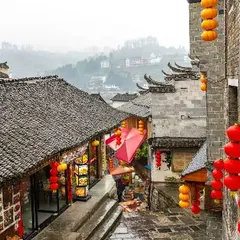
The Wangcun Old Wharf was the trading port of Yongshun district and the collection point for its farm and mountain products. Navigation on the Youshui, the largest tributary of the Yuan, linked it with Sichuan and Guizhou upriver and with Dongting Lake downriver, and earned it the nickname Chu Shu Tongjin, “the ford between Chu and Shu”. The old street grew up beside the landing stage as a result of that traffic, and even today one climbs from the water by a stone stairway and a gallery of Tujia hanging houses.
The contrast is in the water. At its height, under the Daoguang reign (1821-1850), boats moored bow to stern formed a line five li long, some 2.5 km, and all stopped here before facing the Fengtan rapids. The Fengtan dam, whose construction began in 1970 downstream, turned that wild river into a still mirror, and the songs with which the boatmen kept time at the oars have been left without boatmen to sing them.
Highlights
- The ford between Chu and Shu — A river port linking Sichuan and Guizhou with Dongting Lake
- Five li of boats — Under the Daoguang reign, a line of moored vessels some 2.5 km long
- The salt stairway — Stone steps and a gallery of Tujia hanging houses up to the flagstone street
- The boatmen's songs — The haozi of the Youshui, on China's national intangible heritage list
- Shen Congwen's wharf — The most beautiful and strange on his river, according to the western Hunan writer
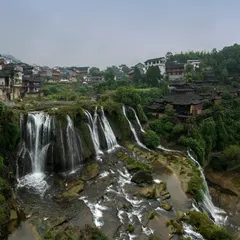
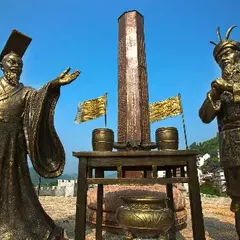
Furongzhen looks out over the river from the top of a cliff, but its reason for being lies below, at water level. The Wangcun Old Wharf, known locally as Wangcun Gu Matou (王村古码头), occupies a bend of the Youshui, a river more than 450 km long and the largest tributary of the Yuan, where the channel widens and becomes deep enough to anchor. Beside the fall of the waterfall, passenger and pleasure boats still dock today, and above the wharf a museum hall keeps the Xizhou bronze pillar and an exhibition on Tujia customs.
The history of the Wangcun Old Wharf goes back a long way. Neolithic sites and Han-dynasty tombs have been found around the town, and in Western Han times the place was the seat of Youyang County. From there come the figures that circulate about its age, “more than two thousand years” in some sources and “more than 2,300 years” in others, although neither dates the building of the wharf itself. Tradition adds episodes from the Ming dynasty: it is said that Tujia troops of the Peng tusi embarked at the Youshui wharf bound for the coast of Jiangsu and Zhejiang to fight the wokou pirates.
What to see at the Wangcun Old Wharf: the landing stage, the bend where the fleet anchored, the start of the stone stairway and the gallery beneath the hanging houses. Its architecture is not that of a building but of a road, the one that carried salt and cloth from the water to Five-Li Flagstone Street. What each stretch of that climb has to say is truly appreciated by walking it with the audio guide from the water’s edge.
Beside the landing stage is kept the Xizhou Bronze Pillar, which came here by boat, and from it rises Five-Li Flagstone Street. Above the bank falls the Furongzhen Grand Waterfall, which splits the town in two.
A landing stage between Sichuan and Dongting Lake
Boats moored at the landing stage
Summary of this stop
On the platform of the landing stage, with the waterfall falling alongside, the bustle of passenger boats is a reminder that this corner has never ceased to be a port. For centuries it was a junction of waterways: navigation on the Youshui joined Wangcun with Sichuan and Guizhou upriver and with Dongting Lake downriver, and the wharf was the trading port of Yongshun district. Hence the nickname that still accompanies it, Chu Shu Tongjin, “the ford between Chu and Shu”, a crossing between the territories of two ancient kingdoms.
From here went out tea oil, tung oil, tallow-tree seeds, timber and mountain products from eastern Sichuan and western Hunan, which then continued along the Yuan River. Tradition adds a more illustrious cargo: jinsi nanmu timber, the golden nanmu of these mountains, which is said to have floated down the Youshui on rafts bound for the imperial capital for the palace works of the Ming dynasty. At the landing stage, the narration follows the trail of those logs downriver.
Five li of boats, now still water
Bend of the Youshui
Summary of this stop
From the end of the landing stage, looking downstream, one understands why boats stopped precisely here. Wangcun lies in the middle reach of the Youshui, with Baojing and Longshan upriver and Chenzhou, Taoyuan and Changde downriver, and at this point the river forms a bend of deep pools and wide waters, suited to anchoring. The town also lies at the start of the Fengtan stretch, and all boats, going down or up, stopped here to rest and resupply. In the Daoguang reign (1821-1850), on the busiest days, the moored vessels bow to stern formed a line five li long, some 2.5 km.
Today what one sees is, above all, what is missing: neither the line of boats nor the current of the rapids. Downstream, the Fengtan dam closed off the Youshui. According to its technical sheet, work began in 1970 and the first generator went into service in 1978, although one popular sheet gives 1969 as the year the reservoir was completed. The arch-gravity wall measures 112.5 m and the reservoir has its normal level at 205 m.
That wild river left a saying among the boatmen, handed down as local custom: “Fengtan and Citan are not the fierce ones; further up still lies Raojilong”. Fengtan, Citan, Raojilong, Sanmen and Tuobei were the five famous rapids of a river where a boat that grazed a large rock in the channel was smashed to splinters, and where, upriver, one sometimes had to haul against the current with two bamboo towlines stretched from both banks. Facing this still water, the audio guide brings back the fear that went with the crews as they cast off.
Steps where the salt went up
First stone steps
Summary of this stop
At the start of the stone stairway, the way of seeing the town above changes. Cloth and salt were unloaded here and from Wangcun were distributed through the border strip between Hunan, Hubei and Sichuan; these steps, which climb the cliff slope, are the road along which they were carried on shoulders. In the era of river transport, the wharf was the collection centre for the farm and mountain products of Yongshun district, and the old street grew up beside it as a result of that traffic.
This same loading and unloading point had its own music. The boatmen of the Youshui kept time at the oars with work songs, the haozi, which at first were sung in the Tujia language and spoke of Tujia history, geography, beliefs and daily life. Each manoeuvre had its own: the towing song, when the boat met a dangerous rapid and the men jumped ashore to pull on the rope, and the loading and unloading song, on docking. The repertoire includes the “Song of the laosi”, the Tujia priest, and “The Big River Rises and the Small One Fills”. The songs of the Youshui boatmen, registered by Baojing, are on China’s national intangible heritage list.
The paradox is that they have outlived the trade that gave them meaning: in the Youshui basin there are no professional boatmen left, and the circle of those who still sing them has shrunk. At the foot of the steps, the narration returns those voices to the place where goods were unloaded with shouts.
The wharf Shen Congwen chose
Gallery beneath the hanging houses
Summary of this stop
The climb passes through a gallery beneath the Tujia stilt houses, the diaojiaolou, open to the river. From here, looking back, appears the landscape that Shen Congwen, the great storyteller of western Hunan, fixed in literature. The writer travelled the wharves of the Baihe, the “White River”, and in his essay on the landing places of that river gave his verdict: of all of them, the one with the most beautiful and strange scenery, of mountains, waters, trees and rocks, was Wangcun. He painted it in a few strokes: high mountains on both sides, peaks standing like walls, bamboo and green trees, dark, almost black rock, deep clear water and fish “as big as a person”.
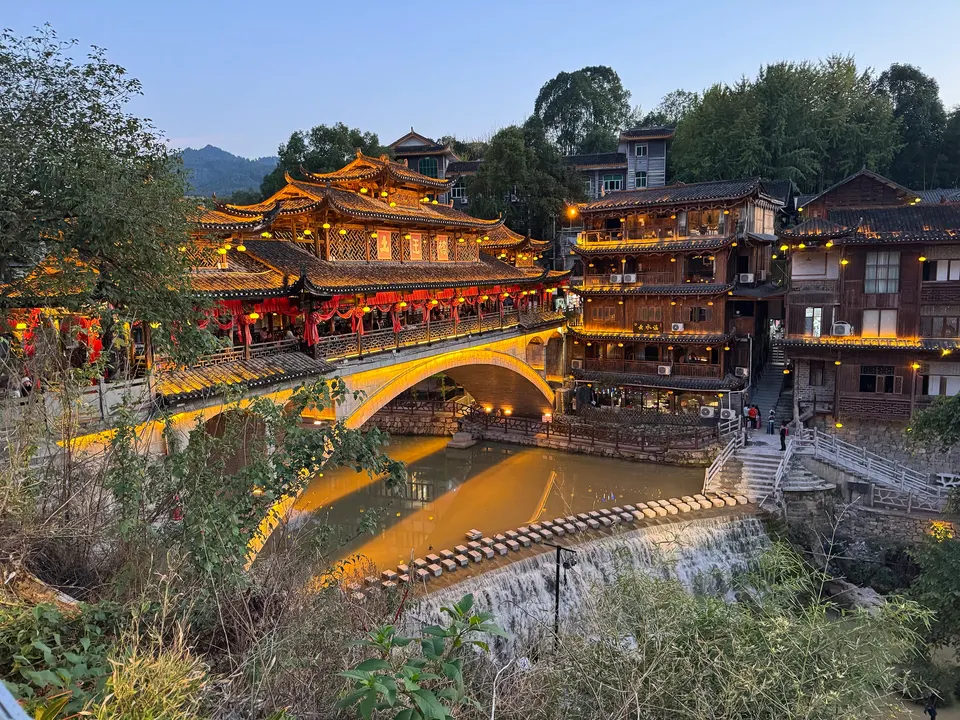
He added a winter scene: on clear days, wild songbirds came down from the bamboo to bask on the big dark stones of the bank and, only when a boat approached, took flight toward the forest, unhurried, all at once. The wharf, in any case, has not stayed on the page: passenger boats still dock at water level, and at night the wharf beside the waterfall, the Pubu Matou, is one of the three central points of the town’s night route, together with the Tusi King Bridge and Five-Li Flagstone Street. In this last look at the river, the audio guide seeks what the writer saw and leaves open the question of whether those man-sized fish still swim here.