Film Set
Liu Xiaoqing's Rice Tofu Shop Audio Guide
A rice tofu counter beside a small stone arch, which tradition identifies as Liu Xiaoqing's in “Hibiscus Town”. Xie Jin's film told of the punishment of a too-prosperous stallholder and ended up giving the whole town its name, fame and business.
- 20 min of audio
- Cinema and local food
Liu Xiaoqing's Rice Tofu Shop, at No. 113 in Furongzhen, is the doyenne of all the mǐ dòufu shops in the town and has been receiving media and celebrities for more than twenty years. Its fame comes from “Hibiscus Town”, Xie Jin's film based on Gu Hua's novel, Mao Dun Prize winner in 1982: the exteriors were shot in Wangcun, in Yongshun County, and the interiors on a set at the Shanghai Film Studio. In 1987 it won best film at both the Golden Rooster and Hundred Flowers awards, with Liu Xiaoqing as best actress at both, and in 1988 the Crystal Globe at Karlovy Vary. Its success brought tourism to a village of some 2,000 inhabitants, which in 2007 officially changed its name to Furongzhen, “hibiscus town”.
The paradox is served in every bowl. In the fiction, Hu Yuyin, the stallholder popularly known as the “Xishi of tofu”, is punished for prospering with her spicy rice tofu stall: a team from the Four Cleanups Movement demotes her to street sweeper. Off screen, that humble rice gel became the town's emblematic speciality, dozens of shops opened, and in May 2021 the owner of this one, Yang Yunchun, estimated more than 3,000 bowls a day, with a queue even on weekdays.
Highlights
- The No. 113 façade — The town's oldest rice tofu shop, pointed out by tradition as a filming location
- Stone chastity arch — A small paifang that serves as a landmark for finding the house in the film
- Wall of photographs — With Xi Jinping's 1997 visit in the most visible spot on the façade
- A bowl of mǐ dòufu — Cubes of rice gel in broth and red chilli oil, today cut into diamonds
- A street of rival shops — Signs bearing Liu Xiaoqing's name that each claim to be the authentic one
Beside a small stone chastity arch, a wooden house displays the sign 刘晓庆米豆腐, Liu Xiaoqing Mi Doufu, and the plaque of No. 113. This is Liu Xiaoqing’s Rice Tofu Shop, the doyenne of the town’s mǐ dòufu shops, and the one tradition identifies with the set where the actress sold rice tofu in “Hibiscus Town” (1986). When the film was shot, this place was not even called that: it was Wangcun, a village of some 2,000 residents in Yongshun County, in Xiangxi. Cinema brought tourism, and in 2007 the town officially adopted the name Furongzhen, “hibiscus town”, the same as the title of Gu Hua’s novel and of Xie Jin’s film.
The history of Liu Xiaoqing’s Rice Tofu Shop is, in large part, that of that film. The novel, published in 1981, won the Mao Dun Prize in 1982; in 1985, after the Beijing studio turned it down, Gu Hua took the screenplay to the Shanghai Film Studio, whose director, Xu Sangchu, commissioned the film from Xie Jin, who co-wrote the script with the writer A Cheng. The town’s gratitude was plain to see in 2008: when Xie Jin died, Furongzhen held a tribute attended by more than 10,000 residents. Even the geography is not entirely peaceful: the film sets its fictional town on the border between Hunan, Guangdong and Guangxi, and the novel describes the mountains of southern Hunan, far from Xiangxi, although one source maintains that Gu Hua set it in Yongshun County itself.
What to see at Liu Xiaoqing’s Rice Tofu Shop: the No. 113 façade and its photo wall, the stone arch that serves as a landmark, the street where several signs bearing the actress’s name claim to be authentic and, above all, the bowl of mǐ dòufu. Exactly which house was used in the shoot remains disputed: Chinese Wikipedia and one travel account point to No. 113, another guide places “the most authentic” near a paifang, and no shooting document or official source consulted fixes it. That play between fiction and reality is the thread the audio guide follows in three stops, from the door to the table.
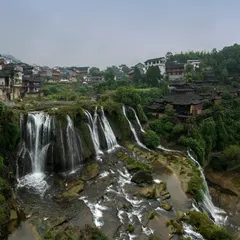
The stall is a few minutes from Five-Li Flagstone Street, the town’s old trading artery, and from the Furongzhen Grand Waterfall, the fall that gives Furongzhen its motto.
A stone arch that marks the film set
Stone chastity arch
Summary of this stop
The starting point is a small paifang, a stone chastity arch of modest height, which serves as a landmark for finding the shop. Beside it, the wooden house at No. 113 is, according to local tradition, the set where Liu Xiaoqing sold mǐ dòufu, held the banquet with the neighbours and was denounced alongside Jiang Wen. What is documented is that the exteriors of “Hibiscus Town” were shot in Wangcun, while the interiors were built on a set at the Shanghai Film Studio: the streets of this town were the film’s backdrop.
The façade holds another, more recent layer of history. Photographs hang on the outer wall, and the one in the most visible spot records the visit that Xi Jinping, then deputy Party secretary of Fujian Province, made to the shop in 1997; today it is a photo spot for visitors.
Nor is it clear how the actress came to that counter. One version holds that Liu Xiaoqing earned the role by sheer persistence, writing to Xie Jin four times with the same sentence, “believe me, I will surely be up to it”, until she convinced a director who never hired stars; another asserts that it was Xie Jin himself who sought her out in 1986 to play Hu Yuyin. Beneath the arch, the narration sets the two stories face to face, both still alive.
The prosperous stallholder turned street sweeper
The No. 113 counter
Summary of this stop
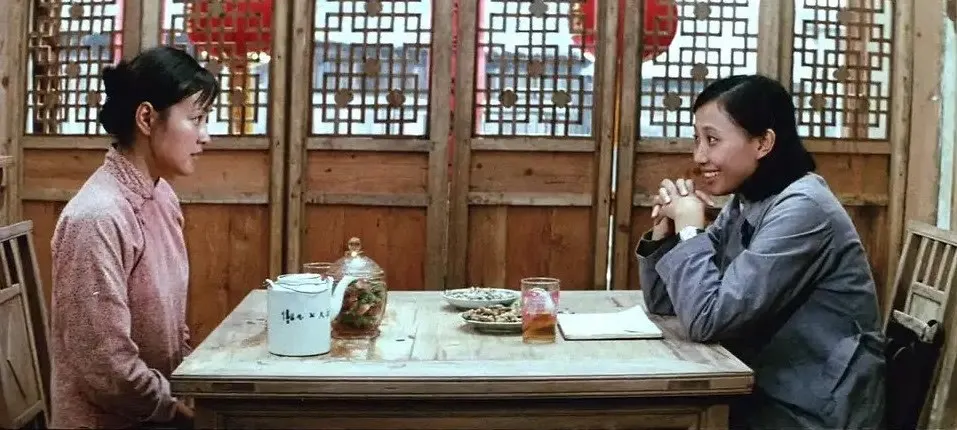
Before the No. 113 counter, fiction overlaps with the present. In Gu Hua’s novel, the town calls Hu Yuyin “Sister Hibiscus”, her mǐ dòufu stall is the most prosperous in the place and in 1964 she and her husband, Li Guigui, build a new house with her earnings. Outside the book she is known as the “Xishi of tofu”, a nickname comparing her to the legendary beauty of ancient China. In the film, Liu Xiaoqing plays her as a seller of spicy rice tofu: in 1964 a team from the Four Cleanups Movement arrives in the town, and she ends up demoted to street sweeper alongside Qin Shutian, played by Jiang Wen. At the origin of it all is a real woman: the novel was born in 1978 from the story of a Xiangxi neighbour who had been widowed twice and believed herself guilty of “killing husbands”.
The film almost never opened. On the eve of the 1987 Chinese New Year, the previews in Beijing and Shanghai set off accusations of “blackening socialism” and calls for a ban, and Xie Jin had to touch up sensitive shots for it to reach cinemas. There was also another daring moment on screen: the kiss of about four minutes between the two leads, which shocked audiences of the time.
That love was not only fiction. During the 1986 shoot, Liu Xiaoqing and Jiang Wen fell in love for real; as the actress recalled, Xie Jin noticed and, in the love scenes, asked each of them to imagine the other’s face, and those takes came out especially fluid. In front of the counter, the audio guide tells what this stall stood for in the fiction and why prospering could be a sin.
A bowl that renamed Wangcun
Bowl of mǐ dòufu
Summary of this stop
The last stop is at the low tables in the street, in front of the bowl: cubes of rice gel bathed in broth and red chilli oil, today cut into diamonds rather than the squares seen in the film. Mǐ dòufu is a grain gel: it is soaked, ground with water, filtered, cooked and left to cool until it sets. In 2007, Jishou University, in Xiangxi’s capital, developed a recipe combining rice and maize with 1% quicklime.
After the film, this humble dish went from street stall to Furongzhen’s emblematic speciality, and dozens of rice tofu shops opened in the town; along the street, several signs use Liu Xiaoqing’s name and claim to be authentic. It is the visible trace of an effect that turned Wangcun, with only about 2,000 inhabitants in 1986, into a tourist destination renamed Furongzhen in 2007.
In front of the No. 113 shop a queue forms even on weekdays. In May 2021, its owner, Yang Yunchun, estimated more than 3,000 bowls a day, and many visitors follow an almost fixed routine: a bowl of mǐ dòufu and then a mugwort cake. For many it is not a snack but a pilgrimage to the film’s set. With the heat of the chilli, the narration closes the circle between the stallholder punished for prospering and the town that prospered thanks to her.