National museum
China Three Gorges Museum Audio Guide
A national museum shaped like a dam, built to house what the Three Gorges reservoir was going to submerge: from the Wushan fossil to the bombs that fell on the wartime capital.
- 120 min of audio
- Yangtze archaeology
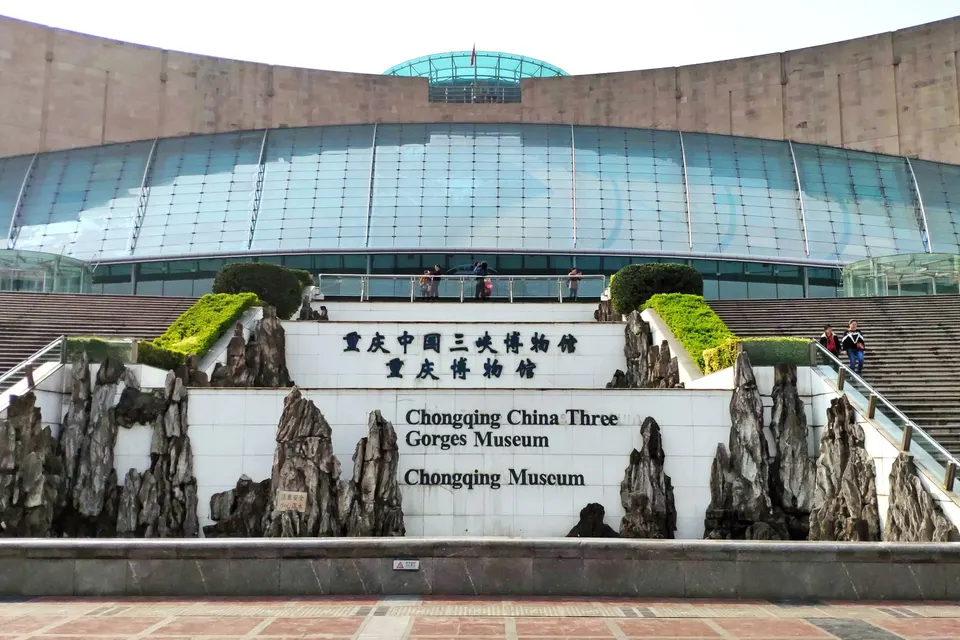
The China Three Gorges Museum opened on 18 June 2005 in front of Chongqing's Great Hall of the People, but its lineage begins in 1951 with the Southwest Museum. The State Council approved its name in 2000 and the building cost 650 million yuan. It is the first museum in China to bear the name of a regional culture and, outside Beijing, the only one of national rank with the word “China” in its name. Its facade reproduces the silhouette of the Three Gorges Dam and translates the city into two materials: blue glass for the water and sandstone for the mountain.
The paradox is plain to see: a building shaped like a dam keeps what the dam was going to drown. The reservoir threatened to leave many places under several metres of water, or under more than ten, and the State invested more than 1 billion yuan in rescue excavations; some 183,000 pieces came out of the Chongqing area, and this museum is their main repository. Among them, a Han-era gate pillar that a coal porter reburied by hand, flood after flood, for three years.
Highlights
- Dam-shaped facade — Blue glass for the water and sandstone for the mountain in front of the Great Hall of the People
- Wuyang Gate Pillar — The most complete Han-era one in China, guarded for three years by a porter
- Ancient Ba-Yu Hall — A collective tomb cut out whole and the bird-shaped zun of Xiaotianxi
- Wushan Man — A jaw about 2 million years old whose human status is disputed
- Great Bombing semi-panorama — A 10 × 37 m screen showing wartime Chongqing
In the centre of Chongqing, facing the Great Hall of the People, a wide, stepped building reproduces the silhouette of China’s most famous dam. It is not a decorative wink: the China Three Gorges Museum was born of that same project. The Three Gorges reservoir was going to leave many places under several metres of water, or under more than ten, and the State invested more than 1 billion yuan in rescue excavations. This museum became the main repository of what was recovered: from the reservoir, in the Chongqing area, some 183,000 pieces have come out.
The history of the China Three Gorges Museum begins before the building, with the Southwest Museum founded in 1951. The present name arrived in 2000, the main construction in 2002 and the inauguration on 18 June 2005, after a total investment of 650 million yuan. In 2023 the museum undertook a full renovation of its halls, and on 18 May 2024 it unveiled the “Majestic Three Gorges” hall, with a model of the dam, and an exhibition on the protection of artefacts that takes the restoration workshop inside the hall, in view of the public. A 360° circular cinema also projects the natural and human landscape of the Three Gorges as it was before the dam. Between January and August 2024, 2.34 million visitors passed through its halls.
To find out what to see at the China Three Gorges Museum and understand its architecture, the audio guide organises the visit in five stops, from the facade on the square to the hall of the war years, and follows a single thread: a building that is at once dam, ark and shelter, the form with which Chongqing decided not to lose what the river and the bombs wanted to take away.
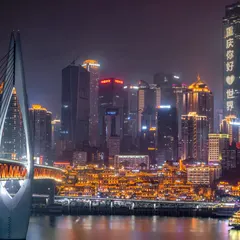
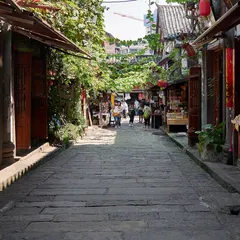
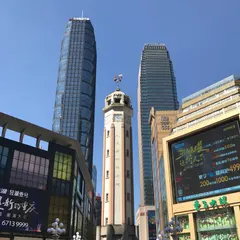
The wartime capital portrayed in its last halls is still in view in the centre: at Liberation Monument, the clock tower raised over the razed crossroads, and at Shibati, the stairway beside which the Great Tunnel of Jiaochangkou once opened.
A dam stranded before the Great Hall
China Three Gorges Museum
Summary of this stop
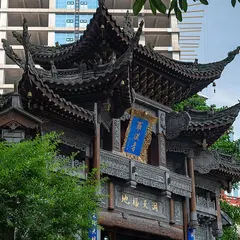
From People’s Square, the museum presents itself as a wide, stepped front on the slope that reproduces the silhouette of the Three Gorges Dam. It occupies the western end of Chongqing’s Great Hall of the People, the traditional-roofed building that rises on the other side of the square: museum, People’s Square and Great Hall form a “three-in-one” spatial ensemble.
The facade reads in two materials. A large curved glass curtain wall in blue symbolises the water; the solid sandstone walls, with straight lines, represent the mountain. It is the city of river and mountain translated into building materials.
This same square filled up on 18 June 2005, at 10:30, for the inauguration, which coincided with the eighth anniversary of Chongqing as a directly administered municipality: streamers, violin music, Mayor Wang Hongju presiding over the ceremony and Chongqing customs handing over pieces to the museum on the spot. The narration in front of the facade gives the key to reading the whole building before crossing the door.
A seal that dares to say “China”
Giant seal on the facade
Summary of this stop
At the foot of the access stairway, the gaze rises to the upper right of the facade. There, an enormous square seal gathers, in seal script (zhuanshu), the ancient calligraphy of seals, the nine characters of the museum’s name: 重庆中国三峡博物馆. They are read from top to bottom and from right to left.
Those characters sum up an unusual institutional history. The Southwest Museum, founded in 1951, was renamed Chongqing Municipal Museum in 1956, when the Southwest administrative region was abolished. On 27 September 2000, the General Office of the State Council approved the name China Three Gorges Museum, and the main construction of the new building began on 20 October 2002.
The result was doubly singular: the first museum in China to bear the name of a regional culture and, outside Beijing, the only national-rank museum whose name includes the word “China” (中国). The audio guide goes through the seal character by character and explains what that name means for an inland city.
The stone giant a porter saved
Wuyang Gate Pillar
Summary of this stop
From the sultriness of the square one steps into the cool air of the lobby, lit from above by a funnel-shaped circular glass dome. It was conceived as a gigantic “dew-collecting plate” (承露盘) evoking the idea that “the water of the Three Gorges comes from the sky”; the water then descends through a three-tier cascade to People’s Square.
In the atrium stands the Wuyang gate pillar, a Han-era pillar gate cited as the most complete of its kind in China. Its rescue is an episode that local tradition preserves in detail. One afternoon in August 1998, Wang Hongxiang, a coal porter, was gathering medicinal herbs on the bank of the Yangtze, in the hamlet of Jiangjun (Wuyang village, Zhong county), in a spot called Gouzuandong, “the cave where the dog slips in”. The earth, softened by the flood, crumbled and two carved stones appeared; the next day a vermilion bird on the cord of a bow and a white tiger some three metres long emerged. He called the county heritage office and nobody answered. As the stones were too heavy to carry off, he covered them again, and every time the river rose he returned in the rain to bury what the water had uncovered. So it went for three years, until the excavation began at the end of June 2001.
The pillar bears not a single written character, so nobody knows for whom it was raised. Local tradition points to Yan Yan, the governor of Ba who, it is said, refused to kneel before Zhang Fei; but the Huadengfen family cemetery, excavated behind the site to find the owner, had already been looted and the enigma remains open. When the museum opened in 2005, the pillar was among the twenty or so pieces shortlisted, out of more than 170,000, for the public to choose ten “museum treasures”. In the atrium, the narration takes up the porter’s story again, and the sentence with which he himself explained why he never stopped looking after those stones.
A tomb under the floor and a doubtful fossil
Ancient Ba-Yu Hall
Summary of this stop
The Ancient Ba-Yu Hall tells the ancient history of Chongqing with bronzes, carved stones and finds from the reservoir’s rescue excavations: a good part of what is displayed here was taken out against the clock from a valley that was going to end up under water. In 2005 a collective tomb of five people from Daxi (Wushan), cut out whole at the site, consolidated and moved to the museum, was installed in this hall, where it was shown beneath a glass floor so it could be seen from above.
Among the bronzes from the Ba tombs, the bird-shaped zun from the Xiaotianxi cemetery in Fuling stands out, taken from one of its three Ba royal tombs. It appeared as a lump of copper covered in green rust, with no recognisable shape; in the laboratory, as the earth was removed and it was bathed in dilute acid, an animal impossible to classify gradually emerged: fish beak, eagle nose, dove body and duck feet, inlaid with turquoise. It is a wine vessel that, apart from the fish mouth, has not a single opening.
The hall also holds the left fragment of the lower jaw of “Wushan Man”, found in 1985 at Longgupo (Wushan county) and dated to around 2 million years ago. The museum counts it among its treasures as the oldest human fossil found in China, but its human character is disputed: Milford Wolpoff doubted it in 1995, and Russell Ciochon, who had published it as a hominid that same year, retracted in Nature in 2009 and attributes it to an unknown ape. The narration in the hall lays out the debate without closing it.
The wartime capital under the bombs
Chongqing Great Bombing semi-panorama
Summary of this stop
The “War of Resistance Years” hall reopened in September 2014 after two years closed. Its centrepiece is the semi-panorama of the Great Bombing of Chongqing: a curved screen 10 metres high by 37 wide, projected seamlessly with four projectors, showing the city under the Japanese bombings with light and sound, accompanied by audio and video of civilian resistance.
Beside it, a reconstructed scene recreates the tragedy of the Great Tunnel of Jiaochangkou, the air-raid shelter where protection turned into catastrophe. It is the wound of Chongqing as provisional capital, and it helps in understanding a good part of the present city.
The route thus ends by joining the museum’s two threads: the river that threatened to submerge the past and the sky that bombed the city. The final narration closes the thesis of a building that is dam, ark and shelter at once.