Historic port
Chaotianmen Audio Guide
At the stone prow of Chongqing, the green Jialing merges with the brown Yangtze in front of the site of the old first gate of the wall: the quay where the city received edicts, refugees, steamers and cruise ships.
- 40 min of audio
- Confluence of two rivers
Chaotianmen was the first of the nine open gates of the wall that Commander Dai Ding rebuilt in 1373 and the largest of Chongqing's seventeen, as well as the city's great quay on the Yangtze. Its name, “gate for paying homage to Heaven”, is associated with the imperial envoys who arrived by river with the throne's edicts. Today it is a square at the tip of the Yuzhong peninsula, with stairways descending to the cruise pontoons and, behind, the eight curved towers of Raffles City, designed by Moshe Safdie.
The contrast lies in what is missing. The Ming gate was demolished in 1927 and the 1998 square gate began to be dismantled in 2021; beneath the skyscrapers a stretch of Southern Song wall reappeared in 2015, and beneath the water of the confluence, according to a documented tradition, lies a stone with inscriptions almost two thousand years old that only showed when the river nearly dried up.
Highlights
- Confluence viewpoint — The green Jialing and the brown Yangtze run side by side for a stretch without mixing
- Site of the great gate — The first of the nine open gates of the 1373 Ming wall
- Stairways to the river — The quay where refugees from the war against Japan disembarked
- Cruise pontoons — Starting point of the journey through the Three Gorges
- Raffles City and The Crystal — Eight towers like sails and a 300-metre glass walkway
Chongqing ends on a point of rock. At the tip of the Yuzhong peninsula, where the green Jialing enters the brown Yangtze, the city stops being a slope and becomes water: that is Chaotianmen (朝天门), the old main gate of the wall and the river’s great quay. For centuries imperial edicts arrived this way; later, customs officers and steamers; in the war, refugees; and today, the Three Gorges cruise ships, beneath the curved towers of Raffles City.
The history of Chaotianmen is a succession of demolitions. The gate that Commander Dai Ding raised in 1373 when rebuilding the Ming wall was demolished in 1927; the 1998 square had its own, on 128 steps, and that one too began to be dismantled in 2021. In between, the district of wooden houses burned in the great fire of 1949, and on its slopes for decades worked the bangbang, the porters who carry bundles hung from a bamboo pole: in this area there were once more than ten thousand, and in 2021 a few hundred remained. On these same banks, between Chaotianmen and Chuqimen, popular tradition places the birth of huoguo, Chongqing’s spicy hotpot, although that origin remains disputed and the city has at least five rival versions.
To find out what to see at Chaotianmen and read its architecture, from the absent gate to Moshe Safdie’s glass sails, the audio guide walks through the square in four stops and follows one idea: here each era has erased the previous one to better receive what arrived by the river.
Going up the Jialing bank appears the lit facade of Hongyadong, and inland, among skyscrapers, Luohan Temple keeps almost a thousand years of Buddhism.
Chongqing’s greatest gate, without a stone
Chaotianmen Square
Summary of this stop
In the centre of the square no Ming arch or barbican remains, and yet this is the site of the largest of Chongqing’s seventeen gates. In 1373, the sixth Hongwu year of the Ming, Commander Dai Ding rebuilt the wall with nine open and eight closed gates, arranged after the nine palaces and the eight trigrams, and Chaotianmen headed the list of the open ones. It had a barbican with its name inscribed and, above the main gate, four characters: “Gu Yu Xiongguan”, the “formidable pass of ancient Yu”. Its exact origin is disputed: a 2018 press report even dated it to 314 BC, while the history of the wall dates it to Dai Ding’s work, with a possible precursor in the Canglong Gate of the Shu-Han period.
The popular refrain of the seventeen gates summed it up in two formulas, “great quay” and “receive the officials and welcome the imperial edicts”. In 1927, the year Chongqing was constituted as a municipality with Pan Wenhua as first mayor, the gate was demolished to open a passage between the walled city and the outside, and on its site the Chaotianmen and Jialing quays were later built.
The 1998 square raised a new gateway with the name in large red characters above a stairway of 128 steps; on 30 May 2021 it began to be demolished under the “Two Rivers and Four Banks” plan, with the idea of replacing it with a gate of more ancient appearance. At this stop the absence is the monument, and the narration on site explains what everything that is missing says about the city.
Two rivers of two colours at the prow
Confluence viewpoint
Summary of this stop
At the railing on the point, with the Jialing on the left and the Yangtze on the right, appears what gives the place its fame: the green water of the Jialing enters the brown-yellowish current of the Yangtze and the two colours run side by side for a stretch without mixing. The line is sharp at low water and blurs in floods. Along this same water, in Southern Song times, the imperial envoys arrived with the throne’s edicts, and from that the name Chaotianmen, “gate for paying homage to Heaven”, would come; another explanation attributes it to the Ming gate facing the capital, Nanjing. From the river the Qing-era poet Wang Shizhen saw it, remote on the horizon, with the battlements winding along the mountain crest.
Beneath the confluence there also hides one of Chongqing’s most curious traditions. On a slab of the rocky spur where the two rivers meet lies the Lingshi, the “spirit stone”, also called the “stele of the year of abundance”, which according to tradition only showed in winters of extremely low water: barely a dozen times since the Jianwu era of the Eastern Han (25-56 AD). In the Upper Yangtze it was believed that, when it came to light, the following year brought timely rains and a good harvest, and each appearance left a new inscription, until they numbered eleven, almost all by prefects of Yuzhou.
It is held to be the oldest hydrological inscription in China, but nobody knows when it was last seen: some say in 1754, others in 1937. What happened in 2003, when a team of Chongqing archaeologists went out to look for it, the audio guide tells beside the railing.
Stairways of refugees and of fire
Chaotianmen stairways to the river
Summary of this stop
Stone stairs descend from the square to the pontoons. They inherit the function of the old natural stairways that climbed from the river, but of those only a stretch on the Jialing side was preserved: those on the Yangtze side disappeared when, after Chongqing became a municipality directly subordinate to the central government in 1997, the square was built. Here the city is earned step by step.
Through this quay entered the human flood of the war against Japan. During those fourteen years (1931-1945), the Minsheng shipping company took 2.705 million soldiers out of Sichuan, and most of the refugees who made Chongqing grow from some 300,000 to more than 1.2 million inhabitants disembarked at Chaotianmen.
Four years later came the fire. On 2 September 1949 a blaze broke out in the poor district of low wooden houses and shacks that spread on both sides of the wall; it advanced from 16:00 street after street and was not put out until 10:00 the next day. The tolls cited speak of some 42,000 people affected and some 2,000 dead, although counts range from 1,700 to 2,568, and the origin of the fire was never clarified: the Nationalist government arrested suspected Communists and ended up executing one as an arsonist. Almost three months later, the Communists entered Chongqing. How many families were saved, according to the memories gathered from a resident of the district, is one of the scenes the narration keeps for these stairs.
From the seven-tonne steamer to the cruise ships
Cruise pontoons
Summary of this stop
At the foot of the square barges float and ships moor: the Chaotianmen quay still dispatches passenger boats, hydrofoils and cruise ships to Fuling, Wanzhou and Yichang, and is one of the departure points of the journey through the Three Gorges. That route has a precursor. At dawn on 9 March 1898 the “Lichuan”, a seven-tonne steamer captained by the Briton Archibald Little, aged 58, who had set out from Yichang on 15 February, presented itself at this quay: it was the first to take a steamship through the Gorges to Chongqing, a city whose customs house had opened in 1891 beside Chaotianmen’s Shuncheng Street.
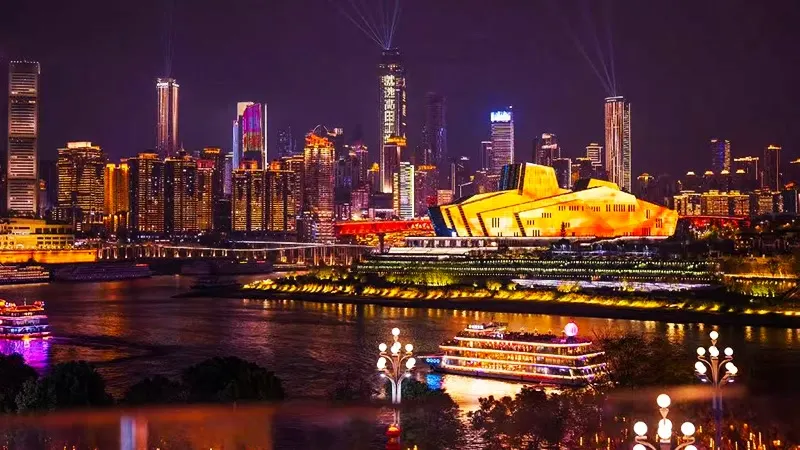
Behind rises the latest version of the prow. Moshe Safdie designed Raffles City by comparing the Yuzhong peninsula to a great ship sailing between the rivers, with Chaotianmen as its prow: hence the slogan “Chaotian hoists sails” and its eight curved towers facing the water, four of them crowned and joined by The Crystal, a horizontal glazed walkway of 300 metres. The complex replaced the port’s passenger terminal and the Three Gorges Hotel, blown up on 30 August 2012, and opened on 6 September 2019. It does not convince everyone: some residents and specialists accuse it of breaking the skyline and crushing the historic character of the place, and in 2018 some 200 heritage volunteers sent an open letter to the municipal government; the developer and authorities defend its inspiration in river navigation.
Beneath those towers there appeared in June 2015, during the works, the first known stretch of Southern Song wall, beside Ming masonry. The most cited figure is 140 metres, although other counts speak of about 160, of which only 52 would be preserved. The audio guide closes the route at this point and joins the 1898 steamer, the buried wall and the glass sails in a single story.