Stilt houses
Hongyadong Audio Guide
A wall of stilt houses hanging from the Jialing cliff that lights up every night: a 2006 set built on the rock where a famous waterfall once fell and a blind gate of the old city wall once opened.
- 60 min of audio
- Diaojiaolou architecture
Hongyadong is the cluster of stilt houses, the diaojiaolou, that steps up the cliff of the Jialing River in Yuzhong district. The Little Swan (Xiao Tian'e) group built it in the traditional style of those dwellings and, according to the most widely cited date, officially opened it on 29 September 2006. Beneath its floors lies a rock face with centuries of memory: the Hongya Dicui waterfall, one of the Twelve Landscapes of Bayu; inscriptions from the Yuanfeng era bearing the names of Su Shi and Huang Tingjian, and the Hongya Gate, which the Ming wall left as a blind gate.
Before the lights, this was one of the poorest districts of Chongqing, remembered in the city as a shantytown of ruined houses, and the complex that replaced it lost almost a million yuan a month in its first months. Since 2016, videos of the lit-up facade on Douyin have made it a viral phenomenon: designed for 5,000-8,000 visitors a day, by 2018 it was receiving 50,000-80,000 over the May Day holiday.
Highlights
- Hongya Dicui waterfall — The dripping green of Hongya, one of the Twelve Landscapes of Bayu, lit up at night
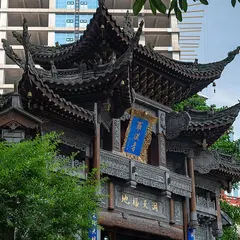
- Stepped facade — Curved roofs, wooden balconies and layered eaves hanging from the Jialing cliff
- Fourth-floor food market — Food stalls and mala spice shops where a shantytown once stood
- Upper viewpoint — The blind gate of the Ming wall, a Mongol siege and the trackers' rooster
- Qiansimen Bridge — The switching-on of thousands of lamps and the photo studios that use the facade as a set
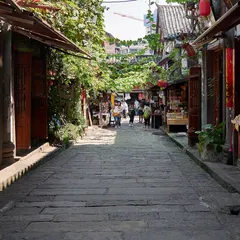
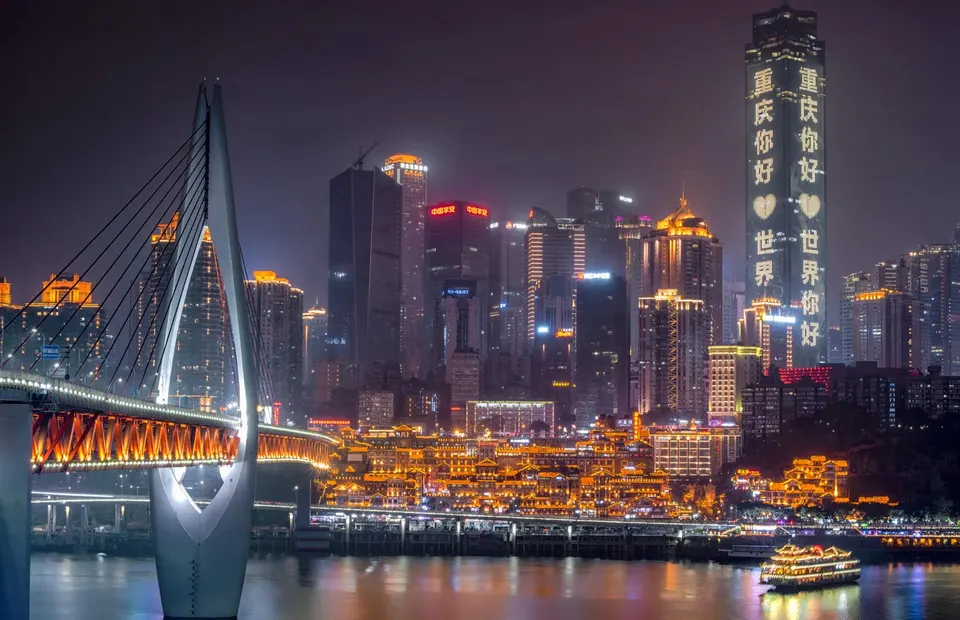
As night falls, the bank of the Jialing fills with people waiting for the same thing: for Hongyadong (洪崖洞) to light up. It is a wall of stilt houses climbing the cliff, floor upon floor of curved roofs, wooden balconies and layered eaves, until it peeks out at the top at the level of Cangbai Street. Several sources count eleven floors and the 2025 press speaks of thirteen; either way, seen from the riverbank or from Qiansimen Bridge, the golden facade has become the most photographed image of Chongqing, and many compare it to the bathhouse in Spirited Away (2001).
The history of Hongyadong is older and rougher than its set. Tourism promotion speaks of more than 2,300 years of history and of a fortress said to go back to the ancient state of Ba; what is documented is a Hongya Gate already in the Song period and its role as a blind gate in the Ming wall. On the rock there was once a cave, a famous waterfall and inscriptions by poets. In the 1940s, river trade filled the slope with stilt houses; after 1949 the district decayed into ruin, and in 2002 Yuzhong district began to demolish it. Sources do not agree on the construction of the present complex: some place it in 2005, others give 2006 as the start of works, and the project’s head speaks of three years of work until the 2006 opening.
The architecture of Hongyadong is therefore a 2006 reconstruction that imitates the dwellings that once stood there, and that is precisely why the place has come back to life. Since 2020 it even has a “partner”: Chongqing and Chengdu present Hongyadong and Chengdu’s Kuanzhai Alley online as the duo “Kuan Hong Da Liang” (宽洪大量), a pun on the expression meaning “generous, big-hearted”, which in 2024 featured again as a joint tourism brand in the Chongqing government work report. To find out what to see at Hongyadong beyond the postcard, the audio guide walks through the complex from bottom to top in four stops, from the waterfall at the riverbank to the bridge from which the whole facade can be seen lighting up.
Downstream, this same bank of the Jialing ends at Chaotianmen, where the river merges with the Yangtze. The stilt houses rebuilt here have their port-village version in Ciqikou Ancient Town, and the city stacked against the slope has its other postcard at Liziba Station.
The dripping green of the Hongya rock
Hongya Dicui waterfall
Summary of this stop
At the foot of the complex, beside the living rock, an outdoor waterfall recreates a landscape with a name of its own: Hongya Dicui, “the dripping green of Hongya”, which was among the Twelve Landscapes of Bayu. At night the waterfall is lit, but its origin is far less theatrical. In the 18th century, in the time of the magistrate Wang Erjian, water from inside the city overflowed the battlements and fell down the rock: a waterfall in summer and autumn, a trickle in winter and spring, until it formed a small pool that spilled into the river.
The rock kept something else. In the Ming period, inscriptions from the Yuanfeng era (1078-1085) with the names of Su Shi, Ren Zhongyi and Huang Tingjian could still be seen on it; they are no longer visible. And according to tradition, a great cave opened in the rock, also called Hongyan Dong or the “cave of the immortals”, because Hongya Xianren, “the immortal of Hongya”, lived in it, and the cave would have taken its name from him. The name already appears in a line by the Jin-dynasty poet Guo Pu, who treats him like a person: “with my right hand, I pat Hongya on the shoulder”. The narration beside the waterfall tells what remains of that immortal in the name that now shines over the Jialing.
From shantytown to the fourth-floor set
Fourth-floor food market
Summary of this stop
The fourth floor is the food market: stalls, aromas and shops selling mala spices and condiments. Its galleries imitate stilt houses that really existed. In the 1940s, the boom in river trade attracted many residents, who hung their diaojiaolou from the slope. After 1949, with the decline of river traffic, the district collapsed: the houses fell into ruin, many became dangerous and unstable rocks threatened the residents below. In the city Hongyadong is remembered as a shantytown, with sewage running down the street and so little firefighting capacity that people feared a fire would leap from house to house, “like a camp in flames”.
One of those residents, Mr Liu, lived on Zhiyanhe Street from the early 1960s until the beginning of this century. When Yuzhong district began the demolitions in 2002, with the compensation and his savings he bought a spacious flat in Jiangbei, on the opposite bank. His summary: “The changes of Hongyadong tell the changes of the whole city of Chongqing.”
In 2003 the competition to remake the place was won by a company famous for its hotpots, and the complex, built by the Little Swan group, officially opened on 29 September 2006, the most widely cited date, although the press in June of that year already reported a street opening on 18 June. The start was not easy: in its first months it lost almost a million yuan a month. On this floor, the audio guide explains how a failing business ended up as the image of the city.
The blind gate above the river
Hongyadong upper viewpoint
Summary of this stop
At the very top, at the level of Cangbai Street, a viewpoint looks out over the Jialing and the opposite bank. That roof is, in fact, the edge of the old walled rock. The Hongya Gate stood there, about 400 metres east of the Linjiang Gate; it took its name from the cave and remained a “blind gate”, with no passage, in the wall that Dai Ding raised in the Ming period.
A gate with no passage did not escape war. During the Mongol siege of Chongqing, the Yuan general Wang Weizheng took the Hongya Gate and captured a Song commander surnamed He. And the river below had its own rites: in the songs of the Upper Yangtze trackers, the chuanjiang haozi, the Hongya Gate was the point where a rooster was sacrificed to honour the river gods. The narration at the viewpoint brings soldiers and trackers together on the same edge of rock.
Thousands of lamps before Qiansimen Bridge
Qiansimen Bridge
Summary of this stop
From the walkway of Qiansimen Bridge the whole complex can be seen, and this is where the phenomenon makes sense. Since 2016, videos of the lit-up facade on Douyin and other short-video platforms turned Hongyadong into a viral hit in China. The complex was designed for 5,000-8,000 visitors a day, but by 2018 it was receiving 50,000-80,000 over the May Day holiday, some ten times the planned figure, and the lighting went from being renewed every five years to every two, at a cost of about 3 million yuan per renewal. On 1 October 2025 the bridge was closed to traffic and, at 19:00, thousands of lamps lit up one after another before the waiting crowd.
Among the public, another ritual repeats every night: photographers from “lǚpāi” studios, travel photo shoots, direct visitors dressed in rented costumes, for example of the Miao ethnic group, to portray them against the facade: “turn your head and look at me… that’s it, that face.” Since 2023 more than 180 such studios have appeared at Hongyadong, and one of those photographers, Nie Feng, would take seventy or eighty commissions in a single night in high season. Before, the typical souvenir was a quick 10-yuan photo that mostly older people bought. The final narration, in front of the lit facade, closes the route by explaining why this set has become a living place again.