Buddhist temple
Luohan Temple Audio Guide (Luohan Si)
A nearly thousand-year-old Buddhist monastery wedged among the skyscrapers of Yuzhong: it burned under Japanese bombs, was wrecked by the Red Guards and rose again twice beside the same rock face of Buddhas carved in stone.
- 40 min of audio
- Chinese Buddhism
Luohan Temple was born in the Zhiping era (1064-1067) of the Song dynasty, founded by the monk Zuyue beside a rock face with more than 400 carved figures, and for centuries it was called Zhiping Temple. In 1885 the monk Longfa restored it, added a hall with five hundred clay arhats copied from that of the Baoguang monastery in Xindu, and gave it the name it keeps: Luohan Si, the Temple of the Arhats. Today it is a small compound, squeezed by the towers of central Chongqing, that holds Ming-era steles, the Guofoyan rock face and a hall of 524 arhats.
The contrast defines everything: curved roofs surrounded by skyscrapers and a history of serial destruction. Japanese bombs reduced it to ashes and left standing only the great gate and the carved rock; in 1966 the Red Guards smashed the five hundred figures of the arhat hall to pieces. Each time, monks and worshippers rebuilt it, and today devotees count the arhats in silence to read their fortune.
Highlights
- Great gate (shanmen) — The arch gate with five small roofs that stayed standing after the Japanese bombings
- Ming Stele Pavilion — The 1623 Xihu Guji tablet and Wu Gao's three poems on Chongqing
- Guofoyan rock face — More than 400 figures carved in the rock, with the sleeping Buddha and a Guanyin
- Arhat hall — 524 lacquer figures that worshippers count to read their fortune
- Mahavira Hall — Shakyamuni with Ananda and Kashyapa, Ming-era bronzes and a Burmese jade Buddha
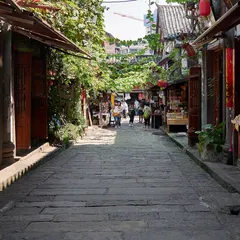
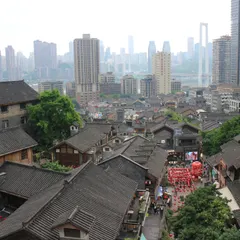
In the heart of Yuzhong district, where office towers peek over every roof, a stone gate with five stacked small roofs opens onto a nearly thousand-year-old Buddhist monastery. Luohan Temple (罗汉寺, Luohan Si) occupies a tiny compound for all it has lived through: it was born beside a wall of Buddhas carved in the rock, changed its name, burned in the war, was wrecked in the Cultural Revolution and rebuilt itself each time on the same stones.
The history of Luohan Temple begins, according to the most accepted version, in the Zhiping era (1064-1067) of the Song dynasty, when the monk Zuyue founded it under the name Zhiping Temple; an inscription bearing his name supports that date, although a Qing-era text speaks of pavilions “since the Tang dynasty” and the temple itself came to present itself as founded in Tang times. In 1885 the monk Longfa restored it, raised a hall of five hundred clay arhats and renamed it the Temple of the Arhats. Japanese bombs of the Second Sino-Japanese War reduced it to ashes; the monks rebuilt it around 1947, the Red Guards smashed its arhats in 1966 and the hall reopened in 1986. In 2009 new arhats arrived, in lacquer, and in 2006 the black comedy “Crazy Stone”, by Ning Hao, shot partly here, made it a must-see stop for anyone visiting Chongqing.
To find out what to see at Luohan Temple and read its architecture and layers of memory, from the great gate to the Mahavira Hall, the audio guide walks through the compound in five stops and follows the thread of a temple that returns again and again thanks to a carved rock and the stubbornness of its monks and worshippers.
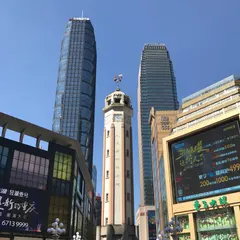
A short walk away, the Liberation Monument marks the modern heart of the city, and at the tip of the peninsula Chaotianmen looks out on the confluence of the Jialing and the Yangtze.
The gate that survived the bombs
Luohan Temple (罗汉寺)
Summary of this stop
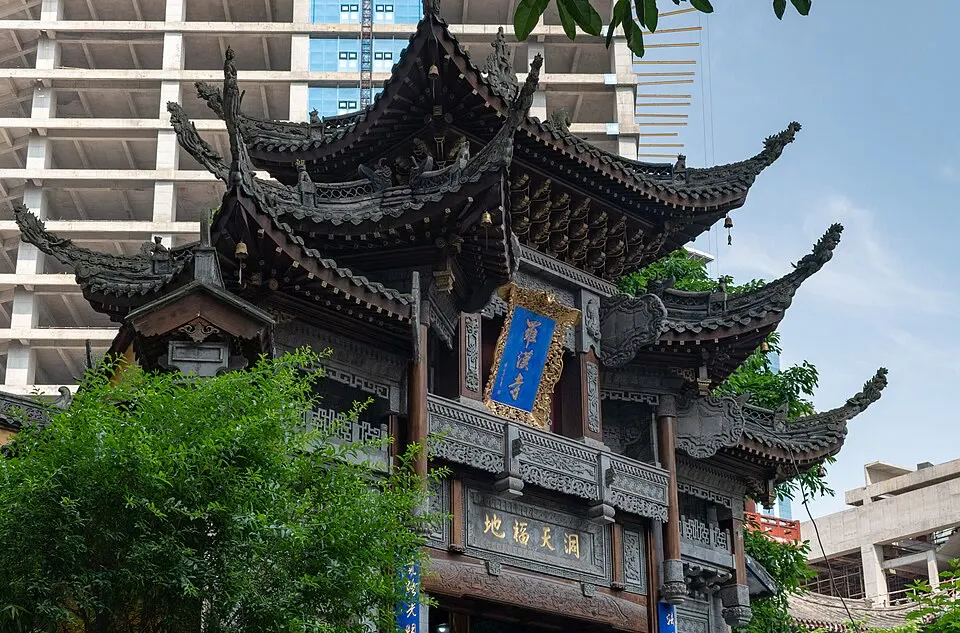
The great gate, or shanmen, is an arch gate of four pillars, three bays and five small roofs with stacked eaves. At the top, a vertical tablet with the characters 罗汉寺 bears the calligraphy of Ji Yingxiong, prefect of Chengdu in the time of the Kangxi Emperor; below, a horizontal one reads 洞天福地 and a couplet runs down the columns. When the Japanese bombings left the temple in ashes, this gate and the rock face of reliefs were the only things left standing.
On the other side waits an open pavilion of carved stone, the Hall of the Heavenly Kings, with a standing Maitreya, also of stone, and from the first step one notices that the city presses on the compound from every side. The contrast has a daily rhythm too: around 2010 the day began at 5:30 with the first bell stroke, with Chongqing still dark, and at 21:00 two monks pushed the two leaves of the great door shut by hand while the traffic of the centre carried on outside. The film “Crazy Stone” did the rest and filled this threshold with visitors; the narration on site tells what a black comedy has to do with a Buddhist monastery.
A tablet for a vanished lake
“Xihu Guji” tablet in the Ming Stele Pavilion
Summary of this stop
In the small Ming Stele Pavilion the temple before the temple is preserved. A tablet with worn strokes bears the words “Xihu Guji”, “Vestige of the West Lake”, engraved in 1623 by Yu Xinmin, prefect of Chongqing: it is all that remains of the pond-garden of the original temple, the one Zuyue founded in Song times when it was still called Zhiping Temple.
Beside it, the Stele of the Three Poems, erected in 1552, engraves the verses of Wu Gao, a Ming official who rose to vice-minister of revenue in Nanjing; one of them is titled, simply, “Chongqing”. And among these stones a custom documented by local tradition is told: in the Xuande era of the Ming dynasty (1426-1435), a monk named Xi’an settled on the abandoned ground of the Western Buddha Rock, built cells and a lotus pond to receive visitors and planted behind his cell a single clump of kui, a mallow so clean and elegant that people ended up calling him “the monk of the White Kui”. The audio guide explains why one flower was enough for the city to remember him.
The sleeping Buddha who watched the city burn
Guofoyan rock face
Summary of this stop
Beneath the side corridors runs the Guofoyan rock face, the Rock of the Ancient Buddhas, formerly known as the Luohan Cave: a wall more than 20 metres long with more than 400 figures carved in the rock. Among them stand out a reclining Buddha they call the “sleeping Buddha”, a Guanyin and donor figures, in a style close to that of the carvings of Baodingshan, in Dazu. The temple was born beside this rock face, which is why it is held to be its root. Its dating, however, remains disputed: some speak of Song reliefs, some place them “from the Southern Song”, some date the building of the Guofoyan to 1522, and a foreign visitor even described them as imitation grottoes.
The rock face is also the witness of the temple’s darkest episode. According to the most repeated account, on the night of 4 May 1939, when Japanese incendiary bombs set alight a city of bamboo and wooden houses, the temple collapsed amid the flames; sources, in fact, do not agree on the date and also speak of 1940 or 1942. The American journalist Theodore H. White left written the image of that night, with the temple fallen and a great stone Buddha gleaming in the light of the fire. The narration beside the rock recovers what White saw in that stone face while the city burned.
Five hundred arhats that are really 524
Arhat hall
Summary of this stop
The arhat hall was born in 1885 as a copy of that of the Baoguang monastery in Xindu, with five hundred clay figures. In 1966 the Red Guards burst into it, smashed all the statues to pieces and tore out even the pedestals. The hall was rebuilt and reopened on 1 May 1986 with a consecration presided over by Kuanlin, abbot of the Wenshu monastery in Chengdu, although the dates of that reconstruction vary by source. And the number in the name deceives: the two galleries hold 524 arhats, all different in gesture and body.
The present ones come from a documented tradition that has much of a craft feat. In September 2009, after a year and a half of work, the temple unveiled arhats made of raw lacquer using the almost lost “dry-lacquer” technique, to withstand Chongqing’s damp and insects; the work used up a whole year of Shaanxi province’s raw lacquer and more than a thousand pieces of ramie woven in Jiangxi. Each figure measures about a metre and a half, weighs between 35 and 40 kilos and is hollow, with sutras, medicinal herbs and small precious objects inside. Arranged according to the nine palaces and the eight trigrams, on the columns and above the visitor’s head, they turn the hall into a labyrinth.
Among them, tradition recognises Jidian, the mad monk, with drunken eyes, a wine jar and a leaf fan, and an arhat who holds a mirror while opening the skin of an old face to reveal a young one. On the floor and on the pedestals the coins of devotees gleam, as they count the figures in silence to ask for protection or read their fortune; according to popular belief, counting by following a rule leads to the very “arhat of destiny”, and at the door a master helps interpret it. Photos cannot be taken inside, so the audio guide takes care of telling what these figures hide.
The broken ladder before the Mahavira Hall
Mahavira Hall
Summary of this stop
The Mahavira Hall, the main hall, rises on a stone plinth shaped like Mount Sumeru, with seven bays of facade and a double-eaved roof. Inside presides Shakyamuni between Ananda and Kashyapa, with the sixteen arhats painted on either side, a trio of the Three Sages of the West in Ming-era bronze, a Burmese jade Buddha and the copy of an Indian mural of Siddhartha’s departure. It is the fruit of the post-war reconstruction: more than twenty monks began to raise the temple among the ruins in the midst of the war, and around 1947, under Master Zongxian, this hall, the sutra library, the arhat hall and the arch gate were standing again.
Before this facade is set the story that worshippers tell as a small miracle: according to the temple’s tradition, when in 1966 the Red Guards propped up a ladder to wreck the Mahavira Hall too, the ladder broke and someone arrived in time to prevent greater destruction, something devotees take as a manifestation of the bodhisattva. The fire left another legacy too: in 2011 the temple displayed for the first time paintings that survived the great bombing, among them the lower scroll of a “Painting of the 500 Arhats” showing them crossing mountains and rivers on their way to Vulture Peak; of the dozen or so scrolls found only two were shown, and the rest were kept in wooden boxes because of their deterioration. The final narration gathers these stories and closes the portrait of a temple that never quite disappears.