Historic district
Ciqikou Ancient Town Audio Guide
A flagstone street running down to the Jialing River holds the whole history of a port: the porcelain that gave it its name, the emperor who, according to legend, hid on its hill, and the three hundred boats a day that made it “little Chongqing”.
- 90 min of audio
- Ming-Qing port village
The settlement begins in the Xianping era of the Song dynasty (998-1003) under the name Baiyachang, the “white cliff market”, after a white rock face on the neighbouring mountain. Tradition later renamed it Longyin, “hidden dragon”, after a fugitive emperor. In the Kangxi era (1662-1722), three Jiang brothers from Fujian opened kilns on the Qingcaopo slope, and the blue-and-white porcelain bowls leaving by the quay ended up giving the place its present name: Ciqikou, “porcelain port”. Today it is a historic district of Ming-Qing-style wooden houses, protected by a municipal plan since 2000 and with 18.43 million visits in 2024.
Behind the bustle of the main street another Ciqikou appears. In a village of boatmen and potters, a private alley school trained two members of the Hanlin Academy during the Qing, to the point that locals called it “the Hanlin”. And in front of an antiques shop on a back street, a granite base shows carved crosses that a Syriac priest identified in 2011 as 9th-century Persian crosses, a dating not everyone accepts.
Highlights
- Main street — Stone flagstones descending toward the Jialing between Ming-Qing wooden houses
- Baolun Temple — The surviving 1432 hall and its two dragons, one with its mouth open and one closed
- Jianwen statue — A pensive monk from the front, an emperor in profile
- Baoshan Gong — The Taoist temple that was the school of the future Nobel laureate Samuel Ting
- Quay and Longyin Men arch — The port of more than 300 boats a day of “little Chongqing”
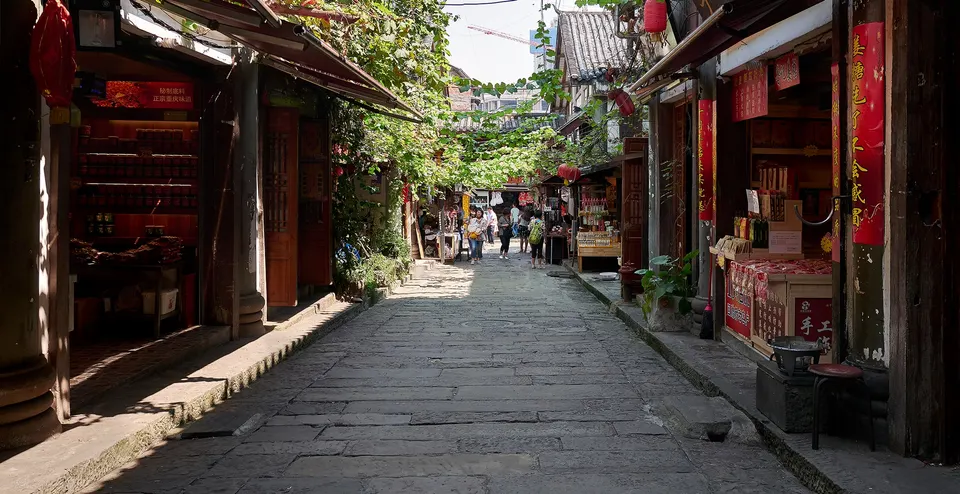
On a bend of the Jialing River in Chongqing, Ciqikou Ancient Town (磁器口古镇) unfolds a flagstone street that runs down to the water between wooden houses, teahouses and steps at every door. Every name the place has had tells of an era: Baiyachang, the Song-era “white cliff market”; Longyin, the “hidden dragon” of the legend of a fugitive emperor; and Ciqikou, the “porcelain port” of the potters who shipped their bowls from this quay.
The history of Ciqikou is that of a town that lived off the river. In the 1940s more than 300 boats of over 10 tonnes came and went from its quay every day; during the war against Japan it surpassed 60,000 inhabitants, and the cultural district it formed with Shapingba gathered one eighth of China’s university teachers and students. From 1958 the cargo quay moved away, road and rail took over and, in the 1970s and 1980s, the population fell to little more than 10,000 people. The protection plan approved in 2000 brought it back to life as a tourist district: in 2024 it received 18.43 million visits.
To find out what to see in Ciqikou Ancient Town and read its hillside architecture, from the stilt houses to Baolun Temple, the audio guide walks through the town in five stops, from the main street to the old quay, following the thread of the river that dictated each of its names.
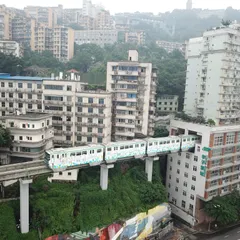
The stilt houses of this bank of the Jialing reappear, rebuilt and on a grand scale, at Hongyadong; downstream, the monorail passes through a residential tower at Liziba Station.
Flagstones downhill to the porcelain port
Ciqikou Ancient Town (磁器口古镇)
Summary of this stop
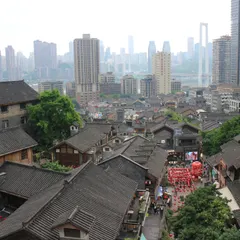
The start of the main street already shows the logic of the town: an axis of stone flagstones descending toward the river between Ming-Qing-style wooden houses, with alleys branching off it. On the slopes, dwellings hung on stilts, like those on Ciheng Street, show how building here followed the incline.
The name of the place works almost like a cargo manifest. In the Kangxi era (1662-1722), the brothers Jiang Shengli, Jiang Shengxian and Jiang Shengbao, emigrants from Liancheng (Fujian) who came with the repopulation of Sichuan, opened kilns on the Qingcaopo slope and began to produce household ceramics. Their blue-and-white porcelain bowls went down to the Jialing quay, and the town ended up being called Ciqikou, “porcelain mouth”. In 1918, the Shuci factory cemented that name over the old Longyin; sources do not agree on whether the renaming goes back to the Jiang kilns or to this factory.
There is also a detail of writing: porcelain is written 瓷, but the name was fixed with 磁, “magnet”, by homophony. The narration on the street explains how a white rock, some immigrants from Fujian and a play on characters ended up summed up in two syllables.
A future Nobel laureate and Cixi’s steward on the main street
Baoshan Gong (宝善宫)
Summary of this stop
A wall away from the bustle, the Baoshan Gong is a former Taoist temple that between 1943 and 1945 operated as the Jialing experimental primary school. Ding Zhaozhong, known outside China as Samuel Ting, future Nobel laureate in Physics, studied there as a boy. It was not an isolated case: in 1938 the Shaci (Shapingba-Ciqikou) cultural district was created, gathering one eighth of the country’s university teaching staff and students, and the painter Xu Beihong painted Bayu People Carrying Water here, by the river.
The same town preserves the Zhong family courtyard, built around 1890 by Zhong Yunting, steward of the Empress Dowager Cixi. The house blends two traditions: a symmetrical, axial northern-style plan with the small grey tile and timber-frame chuandou construction of the south, around a wide central courtyard where old beds and furniture are displayed.
The street also holds a memory of the quay. According to what is told, maoxuewang, one of the town’s culinary “three treasures”, was born around the 1940s from a butcher’s leftovers and a woman who did not want to throw them away. The audio guide reveals why the dish boasts, from its very name, of being “slapdash”.
Unequal dragons in the surviving hall of Baolun Temple
Baolun Temple (宝轮寺)
Summary of this stop
High on the hill, past an arch inscribed “龙隐禅院” (a replica from after the Reform era), rises the main hall of Baolun Temple, with the ever-smoking incense burner in front. The hall dates from 1432, the seventh year of the Xuande era of the Ming, covers about 400 m² and bears a plaque calligraphed by Zhao Puchu. The date of the temple’s founding is another story: popular tradition attributes it to Yuchi Gong in the Tang period, the temple itself adopts that of the Western Wei (535-556) and other sources place it in the Song.
This hall is the only thing that survived of a complex that at its height had 16 halls and 372 images. The wars at the end of the Ming razed it, bombs from the war against Japan destroyed rear cells and, after 1949, it was a school and housing, until it reopened for worship in 1988. On the beam, two carved dragons face each other, one with its mouth open and one closed; below, one column base sticks out of the floor and another is sunk into it.
Beneath the main image of the Buddha, popular belief places two cavities: a “rice-flowing cave” for the monks and a “cave of liberation” that would run through the mountain to the bed of the Jialing. What is told of the ducks put through it is kept for the narration in front of the hall.
A statue with two faces: monk and emperor
Jianwen statue at Wenchang Gong
Summary of this stop
At the fortified gateway of the Wenchang Gong waits the statue of Zhu Yunwen, the Jianwen Emperor: from the front, a pensive monk; in profile, an emperor. Beside it, the Jianwen pavilion looks out over the river. According to tradition, the emperor, dethroned by his uncle Zhu Di, hid for four or five years in the Baiya temple, and because of that “hidden dragon” the temple came to be called Longyin and the town Longyin zhen. It is a local legend with no direct documentary support, and its versions disagree on both the length of the stay and its settings.
Tradition adds that, while living in hiding, the emperor came down to pray at this temple, dedicated to Wenchang Dijun, the god who decides people’s posts and fortunes, and that here he is said to have decided not to return to war for the throne, to spare the people further battles. Nearby, the deep well (Shenshuijing), also called the “monk’s well”, is linked to the same story. The audio guide tells how an emperor hidden in a dry well explains the three names that well has had.
The “little Chongqing” the river made and unmade
Ciqikou quay (磁器口码头)
Summary of this stop
The route ends under the Longyin Men arch, the tall, narrow stone gateway that marks the entrance to the old quay. Beside it, a stele bears the inscription “小重庆”, “little Chongqing”, attributed to Lin Sen, chairman of the National Government. The nickname was earned in the 1940s, when more than 300 boats of over 10 tonnes docked and sailed from here every day.
The river gave, and it also threatened. At the Huatuozui rapid, a tongue of rock nearly a hundred metres long deflects the current against a cliff face where “架高来”, Jia gao lai, “steer high”, is carved: the order for the helmsman to keep the rudder toward the wall and let the eddy carry him out to the middle. The cliff, with an image of Guanyin taming the waters, lies about 200 metres upstream of the Jianwen statue, across the Fenghuang stream. Downstream, the Jiushigang rapid, with its nine jar-shaped rocks, was so feared that boatmen threw coins into the riverbed to appease the river god; it became known as the “money beach”, with pieces from the Warring States to the Republic.
From 1958 the cargo quay moved to Hanyu Lu and, in the 1970s and 1980s, banks, offices and businesses left. The 2000 protection plan opened the tourist stage that now fills the street again. The final narration, in front of the water turning slowly in the bend, joins the crowded port, the silence that came after and today’s crowd.