War memory
Liberation Monument Audio Guide (Jiefangbei)
At the crossroads razed by incendiary bombs in 1939 rises Jiefangbei, an octagonal clock tower from 1947 that changed its name in 1950 and that today, boxed in by skyscrapers, is still the place where Chongqing meets.
- 30 min of audio
- 1947 clock tower
The People's Liberation Monument, known in Chongqing simply as Jiefangbei, began as the Monument to Victory in the War of Resistance: it was designed by the architect Li Lunjie, received its foundation stone on 31 October 1946 and was paid for by a popular collection. It occupies the exact site of the Spiritual Bastion, the 1941 wooden tower raised on Duyou Jie after the bombings. Its octagonal reinforced-concrete shaft measures 24 metres, the whole structure 27.5, and inside a 140-step spiral staircase climbs to a circular viewing platform.
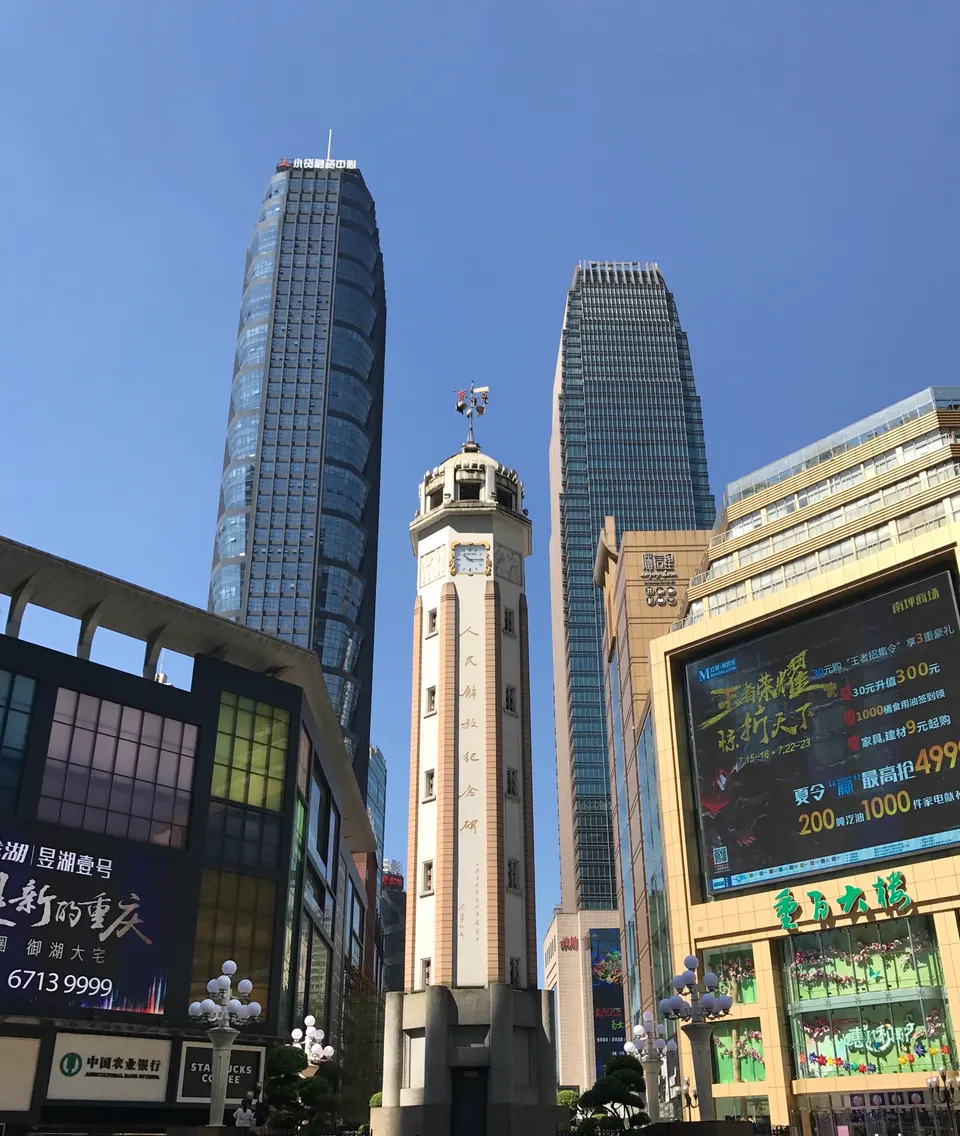
The contrast lies in the scale and in the names. In 1950 the stone that celebrated victory came to commemorate liberation, with calligraphy by Liu Bocheng; for decades no building around it dared to rise above it, until in 1974 a department store did. Today the tower looks tiny beneath a wall of skyscrapers, but its name designates the whole district and presides over the first pedestrian street in western China.
Highlights
- Circular base — The site of a 1941 wooden tower, on a street razed by bombs in 1939
- Liu Bocheng inscription — Seven characters from 1950 and a “碑” missing one stroke
- Octagonal shaft — 24 metres of reinforced concrete and a 140-step spiral staircase
- Four clocks — Heirs of those of a bombed church and the origin of a local saying
- Chongbai department store — The building that in 1974 broke the rule of not outdoing the monument
In the heart of Chongqing, at the point from which the three streets of the pedestrian cross start, an eight-sided column with four clocks looks almost like a lost object among office towers. It is the Liberation Monument, Jiefangbei, and its site is no accident. On 4 May 1939, the day after the first great attack on China’s wartime capital, Japanese incendiary bombs hit 38 streets; Duyou Jie, the street where the stele now stands, was one of the ten main ones razed in the deadliest bombing of the entire campaign, with 3,318 dead.
The history of the Liberation Monument has several layers superimposed on the same crossroads. First came the Spiritual Bastion, a wooden tower finished at the end of 1941 that rotted in the damp; then the Monument to Victory in the War of Resistance, in reinforced concrete, raised between 1946 and 1947 with donations from residents; and since 1950, the People’s Liberation Monument. Its first inscription bore the signature of Mayor Zhang Dulun and popular tradition attributed it to the poet Zhao Xi, although an archive document with the payment to the calligrapher Xu Xueyuan, countersigned by the mayor himself, points to him as the real author. Nor is there agreement on its primacy: the historian Zhou Yong presents it as the only monument in the country dedicated to the liberation of all China, while other descriptions call it the only Chinese monument to victory over Japan, two readings that stem from its two successive names.
Modern legends also circulate around the stone. On social media it is repeated that beneath the monument lie Roosevelt’s letter to Chongqing and captured Japanese swords; the 2024-2025 research commissioned by the Chongqing History Society found no record of any burial: the Roosevelt scroll existed and was delivered to the city council, but its whereabouts are unknown, and the base is solid. Only a commemorative steel tube with newspapers, photos and plans in the wall is on record.
To find out what to see at Jiefangbei and read the architecture of the Liberation Monument, from the stepped base to the inscription, the clocks and the building that outgrew it in height, the audio guide walks through the square in four stops and follows the thread of a small tower that has changed name, owner and clock without ever ceasing to be the point where the city meets.
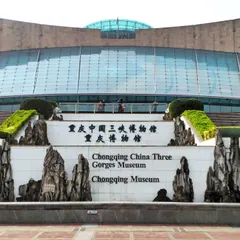
A few steps away, in Jiaochangkou, begins the stairway of Shibati, which descends toward the Yangtze; the full story of the bombings is told in the China Three Gorges Museum, and a few streets away Luohan Temple endures, almost a thousand years old, among skyscrapers.
The street that burned beneath the stepped base
Jiefangbei
Summary of this stop
The first stop is on the steps of the circular stone base, in the middle of the crossroads. Nothing in view recalls that a whole street burned here, nor that this very point was chosen by the Nationalist Government in 1939, after the great oath-taking rally of the “National Spiritual Mobilisation” on 1 May, to raise a Spiritual Bastion (Jingshen Baolei) at the corner of Duyou Jie and Xiaoliangzi.
That bastion, finished at the end of December 1941, was a wooden tower of seven zhang and seven chi, about 26 metres. The figure was not innocent: the repeated 7-7 evoked 7 July 1937, the Marco Polo Bridge incident with which the war began. And its end was not the one usually told either. It was not brought down by Japanese bombs but by the damp of Chongqing: the cement plaster came off, the boards rotted and the tower ended up collapsing. Around October 1943 it was removed and the crossroads was left as a flowerbed with a flagpole and the national flag.
The dates of the bastion do not agree between sources: some place the start of works in March 1940 and others in November, and some push the demolition back to October 1946. What is clear is that its absence explains the exact location of the present monument, and the narration at the base tells what was learned from that fallen tower.
Seven characters and a missing stroke
Liu Bocheng inscription
Summary of this stop
In front of the shaft, seven vertical characters announce “人民解放纪念碑”, People’s Liberation Monument, with a date line: “first National Day of 1950”. The story of that stone begins with a refusal. After the victory of August 1945, the city council proposed several works, among them a full-length bronze statue of Chiang Kai-shek in the square of Duyou Jie and a victory monument. Chiang noted “not appropriate” beside his statue and “may be done” beside the monument, which was moved to the site of the Spiritual Bastion.
Five years later the stele changed hands. On 18 September 1950 Mayor Chen Xilian proposed renaming it a monument to the liberation of the Southwest or of Chongqing; the Southwest Military and Administrative Commission chose “People’s Liberation Monument” and set the change for 1 October 1950, the first National Day after the city’s liberation on 30 November 1949. The inscription was written by Liu Bocheng in regular script, and in it the character “碑”, stele, lacks one stroke: it is not a mistake, but a variant already used by the great calligraphers Yan Zhenqing and Liu Gongquan.
The liberation also left a domestic scene here, recorded by documented tradition. In November 1949, the head of a primary school in Hongyan and his family sewed a five-star flag before dawn from a red silk quilt and some old trousers, and on 1 December about 200 people marched with it to the monument. What happened to it after the celebration, and where it is kept today, the audio guide reveals in front of the inscription.
Clocks from a bombed church
Monument clocks
Summary of this stop
From the edge of the square the four faces can be seen, at about 23 metres high, oriented to the streets just below the viewing platform. The shaft that holds them was conceived against war: warned by the wooden tower, the builders made it of reinforced concrete with 20 tonnes of steel and 950 barrels of cement, and its engineer Li Lunjie claimed that a 500-pound bomb falling less than 10 metres away would not bring it down.
The curious thing is that the 1947 monument had an alarm bell, searchlights and a weathervane, but no clock. Mayor Zhang Dulun asked the Catholic diocese for four clocks, which came from the Zhenyuan Tang church, destroyed by bombs. Their first caretaker, Hu Mingfu, was 21 and every morning hauled up 100-kilo weights on ropes as thick as an egg, half an hour per clock. Those machines ran slow and stopped so often that they left a saying in Chongqing: “the Jiefangbei clock: it doesn’t move any more.” Four more generations followed: quartz in the 1980s, computerised in 2000, a set donated by Rolex in 2007 and the present one, installed on 5 February 2018.
Those faces also mark the hour of meetings. Popular custom makes Jiefangbei the city’s default meeting point, with a phrase repeated among friends, “at such an hour, at Jiefangbei, don’t be late”, and a saying that not having been to Jiefangbei is like not having been to Chongqing. The narration in front of the clock explains how a monument ended up giving its name to a whole district.
The store that outdid the stele
Chongbai department store
Summary of this stop
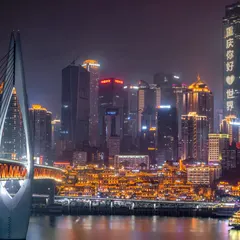
The last stop faces the Chongbai department store, and not by chance. For years an unwritten rule held: no building in the surroundings could outdo the monument. It was broken in August 1973 by the Sanba store, which, with the signature of vice-secretary Qian Min, raised a building finished in December 1974 more than 10 metres above the stele; from it the Chongbai department store was born in 1975. Today the square is ringed by a wall of skyscrapers, among them the World Financial Centre, with a viewing platform on the 74th floor.
On 27 December 1997, with Chongqing newly made a municipality under the direct administration of the State, the cross of streets Minzu Lu, Minquan Lu and Zourong Lu that starts from the monument became the first commercial pedestrian street in western China, the so-called “golden cross”. Every 1 January at 0:00 the tower sounds the New Year chimes before a crowd that waits up to five hours; on New Year’s Eve 2025 the inner circle operated on an entry-only basis from 21:00.
The square of the war monument has also seen less solemn nights. According to a well-documented local custom, Christmas Eve became here a mass festival of foam “snow”, inflatable bars, long human queues and surges of people, to the point that in December 2011 Yuzhong police had to intervene. What exactly it asked for and how that contrast closes the portrait of Jiefangbei is left for the final narration, in front of the building that dared to look down on it.