Historic district
Shibati Audio Guide
It is called “the Eighteen Steps”, but it descends more than 200 greenish stone steps from Chongqing's upper city to the lower: a soldiers' path since 1189, a porters' district and a wartime shelter, emptied by a vote of its residents and rebuilt stone by stone.
- 45 min of audio
- Song-era stairway
Shibati (十八梯), the Eighteen Steps, is a stairway street of some 400 metres and more than 200 steps of greenish stone that links, from north to south, the upper city, at Jiaochangkou, with the lower city facing the Yangtze. It began in 1189, under the Southern Song emperor Guangzong, as an official stepped path for the garrison stationed halfway up the slope to go down to the drill ground. When in 1371 Dai Ding raised the 17 gates of the wall for the Ming, the stairway ended up beside Nanjimen, Jinzimen and Chuqimen, stitching together a city split by a drop of tens of metres.
The contrast lies in its ending. In June 2010 more than 7,000 households voted on whether to agree to leave their ruined homes, the first residents' vote on a demolition in Chongqing, and 96.1% said yes. Works began in 2017 and the district reopened on 30 September 2021 with its old buildings remade in their original position, height, scale and materials, and with the old steps and trees preserved: a memory rebuilt on a fabric that never stopped existing.
Highlights
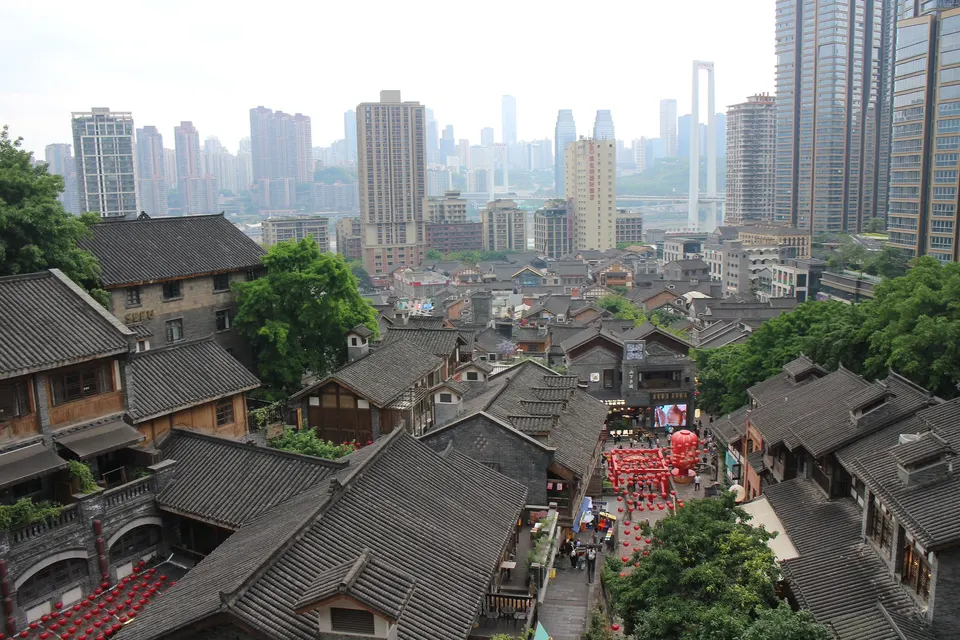
- Jiaochangkou urban balcony — The whole descent of grey-brick and black-tile roofs at a glance
- Greenish stone stairway — About 400 metres and more than 200 steps of a military path from 1189
- Great Tunnel site — The air-raid shelter of the tragedy of 5 June 1941
- Jiaopu Alley — Where the sedan chairs of the whole city were piled up every night
- Yu Youren's house — The house bombed in the war that was raised again on its plot
In Chongqing the city does not spread out: it piles up. And for more than eight centuries the point where the upper and lower halves touched was Shibati, in Chinese 十八梯, the Eighteen Steps: a stairway street of some 400 metres and more than 200 steps of greenish stone that descends from the Jiaochangkou roundabout toward the Yangtze quays. Soldiers, sedan-chair porters, day labourers and refugees climbed it, and in its seven streets and six alleys people lived, suffered and, in the end, voted on the demolition of the district itself.
The history of Shibati begins in 1189, when the Southern Song set up a military command office and a camp halfway up the slope, and laid a stone path to the drill ground. The name, however, remains open: one explanation attributes it to a freshwater well exactly eighteen steps from the stairway; another, to the division of the descent into eighteen sections in the Ming and Qing periods. The signs preserve the old fabric, and each name keeps an era: Shoubei Street recalls the garrison officer who lived there in Qing times; Huajiezi, near the river, gathered taverns, small theatres and brothels until in 1968 it was renamed Red Star Street; and Houci Street, according to local tradition, was once “the street of eating well” and then “the street of the big pond” against fires, three names that sound almost alike.
The district’s chronicles also keep their dark episodes. According to the account preserved, in May 1930 the police burst into the upper floor of a pickle shop on that same street, where the clandestine Communist leadership of Sichuan met, following a denunciation. And those who lived through the Shibati of the 1990s remember it as a district of daylight thefts and knife fights in mahjong parlours, where not even cured sausages could be hung outside the house.
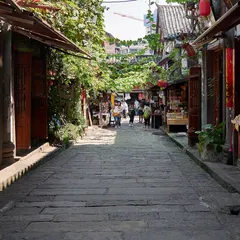
The architecture of Shibati that can be walked today is that of the district rebuilt and reopened in 2021: grey-brick, black-tile houses stepped down the slope, wooden stilt houses (diaojiaolou) hanging from the incline, old huangge fig trees beside the ancient steps and the Mountain City Memory Museum, four floors of photos, videos and projections of old Chongqing. To find out what to see in Shibati and understand why this stairway matters so much to the city, the audio guide descends it in five stops, from the viewpoint at the top to the house of a calligrapher that the bombs erased.
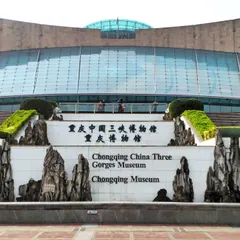
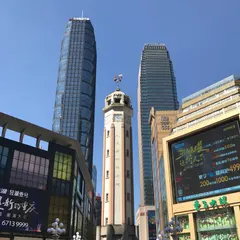
Above, beside Jiaochangkou, stands Jiefangbei, the clock tower of the wartime capital; the district’s air-raid tunnel has its recreation in the China Three Gorges Museum.
A soldiers’ path between two cities
Shibati (十八梯)
Summary of this stop
The route starts at the top, on the Jiaochangkou urban balcony, the viewpoint from which the whole descent is taken in at once: a sea of grey-brick and black-tile roofs spilling down the slope. From that point one understands why the stairway exists. The drop of tens of metres split the walled city into an upper half and a lower one; the steps were the seam between the two.
That seam has a date. In 1189, under the Emperor Guangzong (Zhao Dun), the Southern Song raised a military command and a garrison camp halfway up the slope, and for manoeuvres an official path of stone steps was laid to the drill ground: it was the first Shibati. Almost two centuries later, in 1371, Dai Ding gave the Ming wall 17 gates, “nine open and eight closed”, and the stairway ended up in the area of Nanjimen, Jinzimen and Chuqimen. What that soldiers’ path came to mean for the city is told in the narration, in front of the entire view of the descent.
The airless tunnel of June 1941
Great Tunnel tragedy site (重庆大轰炸惨案遗址)
Summary of this stop
In the rock wall on the north side of the district opens the mouth of the Great Tunnel, the former air-raid shelter now turned into an exhibition space on Chongqing’s shelters, with a stretch kept unaltered. The war against Japan came down these steps too: when Japanese aircraft destroyed the French consulate general on Consulate Street, the legation moved to number 35 Fenghuangtai, right in the district. That former consulate is now a nationally protected monument.
The Shibati shelter, part of the Great Tunnel, was about 2 kilometres long, 2 metres high and 10 deep, with three exits and no water supply or ventilation. On 5 June 1941, during a bombing of more than five hours, at least 461 refugees died there, suffocated or crushed. How many there really were is still in dispute: the air-defence command gave that figure the next day, the investigating commission fixed 992, among them 151 children, the garrison counted 1,115 bodies and later estimates speak of several thousand. In the tunnel itself the audio guide reconstructs how a shelter became a trap.
From the neighbourhood well to the love blackboard
Old Well Square
Summary of this stop
Halfway down the stairway, Old Well Square recalls the well from which the district drank. Where there is now a large screen there once hung an L-shaped blackboard, of about 2 m², with neighbourhood notices. From the 1990s those notices spoke of an increasingly ruined Shibati: migrant day labourers waited for work around Chuqimen, a labour market opened beside Nanjimen, many outsiders settled in the district and on 14 April 2009 a fire in the Qujiagou area burned between 20 and 30 homes.
A year later, on 19 and 20 June 2010, more than 7,000 households voted on whether to accept the redevelopment: it was the first residents’ vote on a demolition in Chongqing, and 96.1% accepted relocation. The cameras arrived in time to film the end. The French documentary “Derniers jours à Shibati” (2017), by Hendrick Dusollier, followed for months a boy, Zhou Hong, who dreamed of the nearby Moonlight City shopping centre, and the elderly Xue Lian, who had to leave her “house of dreams”.
And then came the unexpected. According to chronicles of those years, in 2016 the director Zhang Yibai shot the romantic film “I Belonged to You” here, and after its release young people from all over China began to make pilgrimages to the half-demolished district to write love phrases in coloured chalk, layer upon layer, beside the street sign. Even a pop star ended up flying to Shibati because of one of those blackboards; who it was and why, the narration in the square tells.
Sedan chairs, oil lamps and the first radio
Jiaopu Sedan-Chair Alley
Summary of this stop
The district is read in the names of its alleys. At the mouth of Jiaopu Alley, between Qingzhen and Yongxing alleys, the “small guild” had its seat, one of the three sedan-chair porters’ guilds of Chongqing: every night, at the end of the day, the chairs of the whole city were gathered there, piled from one end of the alley to the other. Its walls now recreate in art the story of the chairs and of the huagan, the bamboo litters of the mountain city.
Very close by, Shanguo Alley, formerly called Taishanfang, owes its name to Buddhist neighbours who collected money and oil to light lamps every night to light the way for passers-by, a custom recorded in the chronicle of Ba county. On the rock wall on its left side bodhisattva figures appear, the scene the district calls “sunset on the Buddha rock”.
Documented tradition adds a leap of era in the same handful of steps: in 1932 the warlord Liu Xiang, who governed Sichuan, installed a wireless radio station in this alley, considered the first in all of western China. From the oil lamp to the radio waves, the audio guide joins the two stories on the spot.
The bombed house that returned to its plot
Yu Youren's house
Summary of this stop
Opposite number 5 Xiangshuiqiao stands the house of the politician and calligrapher Yu Youren: two floors of brick and wood in the mixed Chinese-Western style of the treaty-port era. What looks old deserves a second look, because Japanese bombings destroyed it and the redevelopment raised it again on its plot. The same goes for the Yanbang building and other constructions in the district, remade since 2017 with their original position, height, scale and materials.
The rebuilt Shibati is also a district of living crafts: in 2023 it gathered 22 intangible heritage items of various levels and 12 resident bearer masters, and in November 2022 it was the only district in Chongqing distinguished as an intangible-heritage tourist district. Today it receives more than 20 million visitors a year. What did not come back was the people of before: a 2011 photo report portrayed the last residents of the steps, from a teahouse that in more than twenty years had barely changed its cups to an herbalist everyone called by his trade. Who else appeared in that portrait, and why it closes the descent, is left for the final narration.