Urban engineering
Liziba Station Audio Guide
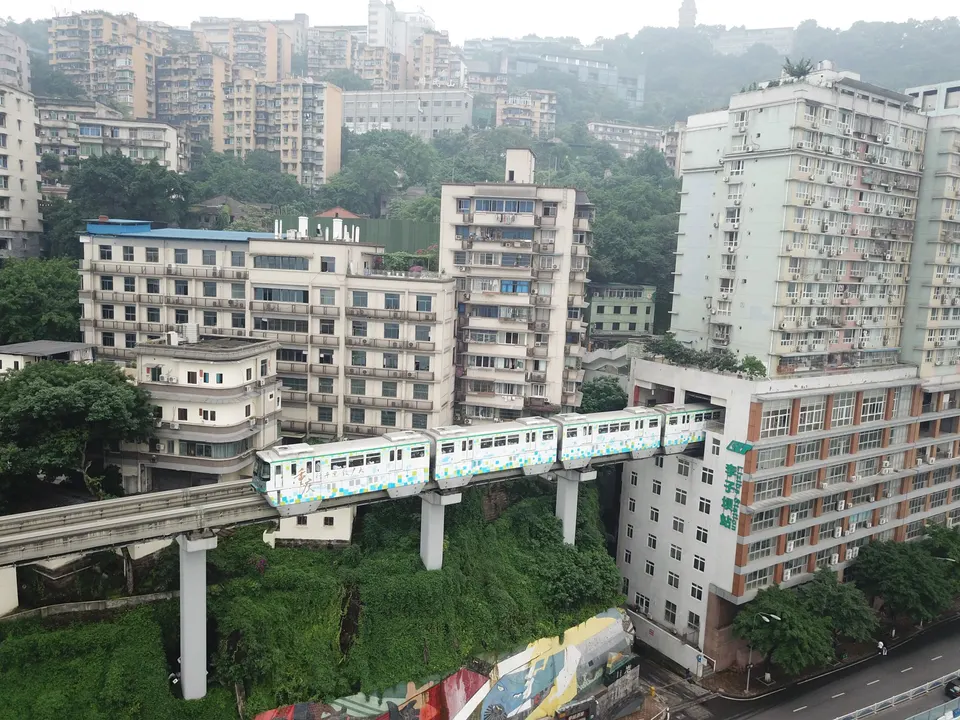
A train that passes through a residential building: at Liziba, Line 2 of the monorail stops on the eighth floor of a 19-storey tower, and no stubborn resident was to blame.
- 40 min of audio
- Vertical urbanism
Liziba Station occupies floors 6 to 8 of a 19-storey residential tower beside the Jialing River. It was planned in 1998 in a corridor with no way out, between a 20-to-30-metre embankment and the riverbank, and Professor Ye Tianyi of Chongqing University solved the fit by having the building and the station born together: shops below, platform at 26 metres and homes above. Line 2 passes through it, the first urban rail transit line in Chongqing and in western China, and the first in the country with a straddle-type monorail.
The contrast lies in the use: what was designed as an engineering solution for an impossible plot has become the most photographed postcard of Chongqing's vertical urbanism. In front of the tower, a viewing platform built in 2018 fills with open-mouthed people pretending to swallow the train, while eleven floors above, residents say they barely hear it pass.
Highlights
- Liziba Zhengjie viewpoint — The Line 2 train entering and leaving a 19-storey tower
- Three stacked uses — Shops on floors 1 to 5, station on 6 to 8 and homes up to 19
- Floor 8 platform — 26 metres above the street, with eleven floors of homes on top
- Twenty centimetres — The gap that keeps the track and the homes from touching
- Eating the train — The photo ritual of swallowing the train in forced perspective
In a city built on a slope, in layers, where streets pass over rooftops, Liziba is the image that sums it all up: a train that passes through a building. The Line 2 monorail comes out of a curve beside the Jialing River, enters the central strip of a 19-storey residential tower, stops on the eighth floor and comes out again on the other side. Liziba Station (李子坝站) is not an improvised curiosity: it is the result of a space problem that had no other way out.
The history of Liziba Station begins in 1998, when a light-rail stop was planned between the foot of the Guihuayuan slope and the Jialing riverside road. According to the most widespread version, works began in 2001, and the first phase of Line 2 entered service on 18 June 2005; sources do not agree on the exact date the station began operating, which some push back to 2006. The tourist phenomenon came later, with a chronology also disputed: some sources place it around 2012 or 2013, others in the viral explosion of 2018. What nobody disputes is its reach: on 1 May 2026, the first day of the Labour Day holiday, Liziba received more than 180,000 visits in a single day. Months later, on a rainy October afternoon, the viewpoint was still full, and an Italian tourist, Marco, needed four trains to get the video he wanted.
To find out what to see at Liziba Station and understand its architecture, from the street viewpoint to the eighth-floor platform, the audio guide walks through the place in four stops and dismantles the question almost everyone arrives with: whether the train drilled through a house that was already there.
Downstream, the stilt houses of Hongyadong carry the same idea of a city stacked against the Jialing cliff, and upstream, Ciqikou Ancient Town preserves the port this bank lived from.
The tower that swallows the train
Liziba Zhengjie viewpoint
Summary of this stop
The route begins across the way, at the viewpoint on Liziba Zhengjie, the only point from which the tower reads whole. At a glance the building’s three stacked uses appear: shops from floor 1 to 5, the Line 2 station from 6 to 8 and homes from 9 to 19. When a train passes, the central strip lights up with movement and the block seems to engulf it. The viewpoint exists precisely because of that image: it was built between May and August 2018, in the face of the flood of visitors, with an area of about 1,500 m² according to some sources (others speak of about 1,367 m²) and a zone reserved for photography. Beside it, on the embankment, stretches a large relief of about 42 metres, “Yan zhi Hun” (Soul of the Rock), which mixes realistic figures with stone forms.
Here the customary gesture before this building is practised, a documented tradition: “eating the train” (吃轻轨). In forced perspective, the visitor opens their mouth to coincide with the building’s mouth and someone shoots just as the train appears. The game is repeated, above all, at the Beibin Yilu viewpoint, on the opposite bank, where queues form of people with open mouths looking across the river. In February 2025 the joke even slipped the Liziba train into the list of things to eat in Chongqing, and netizens asked whether the monorail was spicy too.
The side facade of the plinth also holds an absence: in April 2020 an LED screen began to be installed there, but the project was cancelled after criticism over safety and advertising. The narration at the viewpoint explains what to look at on the tower to understand, before crossing the street, why the train could not pass anywhere else.
Wedged between the hillside and the Jialing
Guihuayuan embankment
Summary of this stop
At the foot of the tower, the reason for it all can be seen without plans. To the north, an embankment 20 to 30 metres high closes the way; to the south runs the Jialing River. Between them is left a very narrow corridor, and at that exact point a light-rail stop that could not be shifted had been fixed in 1998. That same year, Ye Tianyi, professor at Chongqing University, took over the direction and structural calculation of the project.
The route explains how the track got here. On the Yuzhong peninsula, Line 2 avoids the major avenues Zhongshan Lu and Changjiang Lu, drops to the Jialing riverside road and continues along Liziba Zhengjie before entering a tunnel toward Daping. That detour toward the bank is what pushes it against the hillside. At this stop, the audio guide shows how the terrain, and not a design whim, dictated the shape of the building.
Which came first, the house or the train?
Floor 6 concourse
Summary of this stop
Now inside the tower, the floor 6 concourse is the place to answer the question everyone brings. Since Line 2 began operating, an explanation with a protagonist has circulated: legend has it that the residents of a block refused to move out, as a “nail house” (钉子户, the families who resist expropriation in China), and that the train had no choice but to pass through their home. The story resurfaced in August 2014, when a photo of the train entering the building passed ten thousand reposts on Weibo. Ye Tianyi himself dismantled it then: in building Liziba they never came across any nail house.
What happened was the opposite of a drilling. Ye Tianyi’s team weighed two alternatives: diverting the track or having the developer raise its block on another plot, and either would have made the present image impossible. Finally, building and station were designed as a single structure; the plans were redrawn at least six times in two years and, according to the most cited chronology, works on both began together in 2001. Inside, floor 6 is the concourse, 7 houses the technical equipment and 8 is the platform. The concourse, expanded in 2018, displays photographs of Chongqing and since March 2019 hosts the Bayu Old News Room, with facsimiles of newspapers from 1891 to 1954. The narration in the concourse tells how a legend so convincing was born that it is still alive.
Twenty centimetres beneath the kitchens
Floor 8 platform
Summary of this stop
The floor 8 platform, 26 metres above the street, is the point where coexistence becomes tangible. From its side platforms the city and the river can be seen through the facade, and above lie eleven floors of homes. Track and homes, however, do not share a structure: between the viaduct pillars and the building’s walls there are 20 centimetres of separation, to the point that the residential block could be demolished without affecting train service. To coexist with the residents, materials that absorb noise and vibration were installed and the building was reinforced; the maximum noise of the train passing stays below 60 decibels.
The train that stops here is part of the history of transport in China: Line 2 was the first urban rail transit line in Chongqing and in the west of the country, and the first in China to use a straddle-type monorail, with technology transferred by Hitachi. It even has its musical joke: in 2014 a netizen celebrated that a Line 2 that stopped on the eighth floor really existed, as in Dao Lang’s song “The First Snow of 2002”, which actually spoke of a stop in Ürümqi.
In August 2014, in the midst of the viral fever, a journalist went up from the platform to the ninth floor, right above the tracks, and found Mrs Mo cutting meat in her kitchen: she had been there four or five years and said she neither heard noise nor felt tremors. The audio guide closes the route on this platform with the testimonies of the residents who live above the train.