
Tombolo and Cinema
North Beach Audio Guide (Playa Norte)
Five kilometres of golden sand with a fortified town rising out of the sea at the far end, and a stretch of shore where Hollywood filmed the battles of 'El Cid'. Find out what to see at the Playa Norte of Peñíscola.
- 8 min of audio
- Coastal Walk
The Playa Norte — Platja Nord — is a stretch of some five kilometres of fine golden sand that starts at the foot of the old town of Peñíscola and runs north almost as far as the boundary of Benicarló, reaching a width of seventy metres. It flies the Blue Flag, the Q for Tourist Quality of the Spanish Institute for Tourist Quality, the AENOR Green Flag and the Qualitur flag of the Valencian tourism agency, and it has a promenade, showers, a children's area, a sports zone and a tourist office.
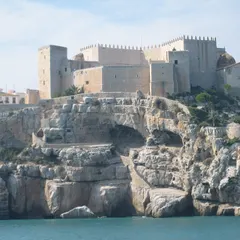
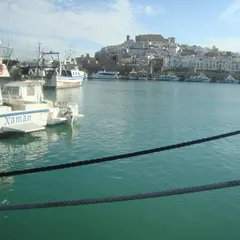
What sets it apart from any other Mediterranean beach lies to the south: the walled old town crowned by Papa Luna Castle, perched on a crag of Jurassic limestone that was originally an islet. The sandbar joining it to the coast disappeared with the storms and formed again in summer, turning the town into an island. That coastal dynamic, already described in the eighteenth century by the naturalist Cavanilles, is catalogued by the Geological and Mining Institute of Spain as a Site of Geological Interest under the code IB223.
Highlights
- Tombolo of Peñíscola — Site of Geological Interest IB223, a landform unique in the region
- Five kilometres of sand — A shore up to 70 metres wide running towards Benicarló
- Seafront promenade — Palms, benches and viewpoints, flat and good for cycling
- Location of 'El Cid' — The battle of Valencia was filmed here in the winter of 1960-1961
- Quality flags — Blue Flag, Q for Quality, AENOR Green Flag and Qualitur
Almost everyone photographs the Playa Norte from the same spot and for the same reason: five kilometres of low coast running horizontal against the emphatic vertical of the crag. What almost nobody knows is that the postcard is, literally, a geology lesson, and that the sand the photographer stands on was for three months in the winter of 1960 a medieval battlefield with one thousand seven hundred infantry soldiers of the Spanish army. The Playa Norte of Peñíscola is an excellent beach, but above all it is the vantage point from which the whole town becomes legible.
The secret history of the Playa Norte has two superimposed layers. The first is natural: an islet of Jurassic limestone tied to land by a cord of sand that the storms erased and the summer rebuilt. The second is human and very recent: in a single decade, between the late sixties and the seventies, a fishing village losing its people to emigration turned into a tourist municipality. To see what to see at the Playa Norte of Peñíscola it is best walked from north to south, and the EarGuide audio guide accompanies that walk stop by stop.
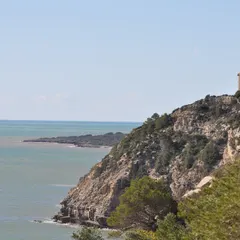
The beach ends at the crag, with its walls and the Sanctuary of the Virgin of the Ermitana at the top; for wild coastline, the Sierra de Irta lies to the south.
The castle that was once an island
Platja Nord
Summary of this stop
The route begins on the northern stretch of the shore, on the sand or at the edge of the promenade, looking south with the old town in the distance. The salt breeze here is constant, the sound of the waves grows clearer the further the town recedes, and the scale of the whole can be taken in at once: five kilometres of fine golden sand, with small pebbles towards the ends, and a walled town that seems to rise out of the water.
That impression is not a literary flourish. The crag holding the old town is a block of Jurassic limestone that was originally an islet, joined to the coast only by a narrow sandbar. Storms made the bar disappear and summer formed it again, so Peñíscola spent spells as a genuine island. The floodable isthmus also made the town very easy to defend, and explains much of its military history.
The Geological and Mining Institute of Spain catalogues the tombolo of Peñíscola as a Site of Geological Interest — code IB223 — a representative example, unique in the region, of this landform; its coastal dynamic was already described in the eighteenth century by the naturalist Antonio José Cavanilles. Today the crag is joined to the mainland artificially by the buildings of twentieth-century urban growth. How the capricious sandbar became a definitive isthmus is what the narration unpicks at this first stop.
The second wall, raised in the sixties
Passeig Marítim de Peñíscola
Summary of this stop
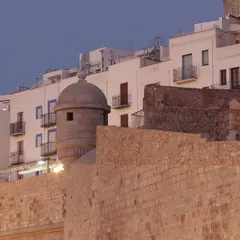
The promenade runs alongside the shore, lined with palms, benches and viewpoints, flat and equally suited to strolling or cycling. On one side lies the sand; on the other, an unbroken row of hotels and apartment blocks. That frontage can be called, without much exaggeration, the second wall of Peñíscola, and its date of birth is surprisingly precise.
Until the mid-fifties this was a fishing village with a long history of emigration. The shoots of ‘Calabuch’ in 1956 and above all of ‘El Cid’ in 1961 marked the turning point: in the late sixties and through the seventies came the boom of hotels and apartments, the municipality became the first in the province of Castellón to approve a General Urban Development Plan, and tourism turned into its main economic engine, reversing that outflow of residents.
Walking among the palms with the white frontage on the right is therefore to follow the physical trace of a lightning mutation. What Peñíscola gained and what it lost in that decade, and why its town planning was settled before that of its neighbours, is the conversation the audio guide opens on this stretch of the promenade.
The sand where the Cid rode
Platja Nord
Summary of this stop
Halfway to the old town, on the sand now and with the fortified town filling the southern horizon, lies the point where the beach changes meaning. In the winter of 1960-1961 Anthony Mann filmed the siege and battle of Valencia here for ‘El Cid’, produced by Samuel Bronston and starring Charlton Heston and Sophia Loren. Peñíscola played medieval Valencia because the real Valencia had modernised too far.
The figures behind the deployment still impress. The production hired 1,700 infantry soldiers from the Spanish army and 500 horsemen from Madrid’s Guardia Municipal de Honor, built fifteen war machines and siege towers from historical engravings and dressed 35 boats with battlements to stand in for the Almoravid fleet. For three months hundreds of workers put up set walls to conceal the modern buildings, and a team of 380 specialists — with the set designer Francisco Prósper and Valencian fallas artists — transformed the look of the town with plaster, paint and wood. Around 5,000 extras passed through the shoot at a time when Peñíscola had some 2,500 inhabitants: whole families took part, grandparents, parents and grandchildren in the same shot, and there were residents who rented the production their houses, their boats and even their animals. The extras were paid a hundred pesetas a day — twenty duros — plus an omelette sandwich, at a time when that sum could equal an ordinary monthly wage.
And the scene they came to film on this sand is itself a legend: the episode in which the Cid won his last battle after death, when his corpse, armoured and tied to his horse, rode out of the city gate and terrified the besieging army. Historiography does not accept it as fact, but the cinema fixed that tradition in the global imagination, and it did so here. How today’s parasols overlay that winter of painted plaster is the core of this stop.
The prize-winning postcard and the star’s return
Passeig Marítim de Peñíscola
Summary of this stop
The final stretch of the promenade reaches the point where the sand ends, the walled town and the castle straight ahead. It is the most recognisable tourist image of Peñíscola and the point at which the beach hands the visitor over to the old town. The Playa Norte arrives at this closing accredited by its distinctions — Blue Flag, Q for Tourist Quality, AENOR Green Flag and Qualitur flag — and by a full set of facilities: showers, children’s area, sports zone and tourist office.
The story also has an epilogue with a name attached. Thirty years after the shoot, in 1991, Charlton Heston returned to Peñíscola to walk the locations of the film. It is also told that President Kennedy invited the actor to talk about the figure of the Cid, such was the mark the character left in the United States, where the Castilian hero entered school curricula in the wake of the film.
Seen from here, the whole thing fits together: an islet the sea tied to the land with sand, an improvised film set that turned a fishing village into an international icon, and a beach that now lives off that image. How much of the postcard is nature and how much is screenplay is the question the narration closes the walk with, just before crossing towards the walls.