
Renaissance Fortification
Renaissance Walls and the Portal Fosc Audio Guide
Three gates, three centuries and a single ring of stone: the one a pope opened to the sea in 1414, the one Philip II armoured against the corsair in 1578 and the one the wars ended up walling shut. Find out what to see on the walls of Peñíscola.
- 10 min of audio
- Military Engineering
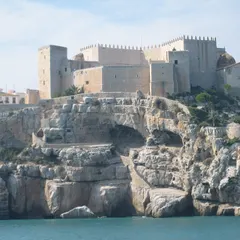
The walls of Peñíscola enclose some five hectares and half a thousand houses on the crag, but they are not a single work: medieval curtains of the thirteenth to fifteenth centuries survive on the south and east faces, alongside the so-called Muralla de la Fuente of the fourteenth and fifteenth centuries finished off by the Santa Ana battery, and a Renaissance landward front already conceived for artillery. That modern front, executed in essentials between 1576 and 1578 under Philip II, is the joint work of Vespasiano Gonzaga, prince of Sabbioneta and viceroy of Valencia, and the engineer Juan Bautista Antonelli.
The gate that sums it all up is the Portal Fosc, dated 1578: an Italian-inspired round arch in white stone, its rusticated jambs ornamented with balls and the king's coat of arms over the keystone. Its name is not poetic but descriptive — 'fosc' means 'dark' in Valencian — because crossing it means passing through a tunnel in half-light. It was the town's main entrance until the eighteenth century and is still the right way into the old town.
Highlights
- Portal Fosc — 1578 arch with the coat of arms of Philip II and the cartouche of Vespasiano Gonzaga
- Iron-bound leaf and sentry box — The original door clad in nailed iron strips and the cylindrical watch post
- Battered walls — Sloping ashlar designed to absorb artillery impacts and deflect them
- Baluarte del Príncipe — Viewpoint over the cliff, home of the Museu de la Mar since 1996
- Portal de Sant Pere — Benedict XIII's gate to the sea, with the keys and the crescent moon
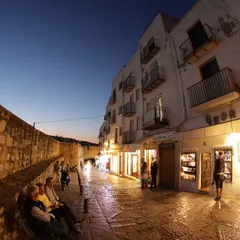
Some walled towns can be explained with a plan; others have to be walked, because every stretch belongs to a different war. Peñíscola is one of the second kind. Within its five hectares of enclosure, thirteenth-century curtains coexist with the Muralla de la Fuente of the fourteenth and fifteenth centuries, the artillery shell Philip II commissioned between 1576 and 1578, and a crown of batteries — Santa Ana, del Olvido, San Fernando, del Bufador — added when danger changed shape. The ensemble has been protected since the castles decree of 1949 and still encloses around five hundred inhabited houses.
The secret history of the walls of Peñíscola lies in its gates, which work like three clocks stopped in different eras: the Portal de Sant Pere, opened to the sea by Benedict XIII in 1414; the Portal Fosc, the king’s gate, dated 1578; and the Portal de Santa María, inaugurated in 1754 under Ferdinand VI and blocked up in 1809. Knowing what to see on the walls of Peñíscola means knowing how to read that sequence while climbing the cobbles. The defensive architecture of the crag can be covered in a short walk, and the EarGuide audio guide follows it gate by gate.
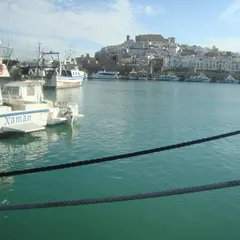
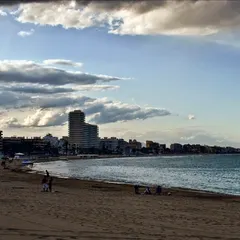
The walls protect Peñíscola Castle and enclose the old town; at the foot of the crag, North Beach stretches along the coast.
The tunnel where a king signs his name
Portal Fosc
Summary of this stop
The first stop stands on the outer esplanade of the Portal Fosc, a few paces from the arch, white stone in the sun and the dark opening ahead. The contrast is deliberate: whoever enters goes from glare to short echo and the cool half-light of a tunnel, and it is that half-light that gives the gate its name. Over the keystone, the arms of Philip II; on the jambs, the ball-studded rustication that betrays the Italian school.
The cartouche preserves the full dedication of the work — “Reynando el siempre vencedor Don Phelipe Segundo… Vespasiano Gonzaga… Año MDLXXVIII” — so the gate comes signed and dated by those who made it. Inside the tunnel a wooden leaf clad in nailed iron strips also survives, and beside the entrance stands a cylindrical sentry box on a fluted base, topped with a dome and a ball.
One nuance is worth adding, and almost no guidebook includes it. The attribution of the Portal Fosc to Juan de Herrera circulates widely in leaflets and tourist websites, but it is undocumented: it comes from the classical air of the gate, not from any paper. The surviving documentation places the direction of the work with Gonzaga and Antonelli, and the 1578 inscription itself makes no mention of Herrera. How that legend of authorship was born, and why it has proved so hard to dismantle, is told in front of the cartouche.
The geometry of fear of the corsair
Rampa de Felipe II
Summary of this stop
Through the tunnel, the route continues up the Rampa de Felipe II, a cobbled climb polished and slippery from centuries of footsteps and cartwheels, flanked by the Renaissance curtains. From a point halfway up, what truly distinguishes this front becomes clear: the walls are not vertical but battered, sloping ashlar calculated to take the impact of a cannonball and deflect its energy rather than receive it flat.
None of this is ornamental. The modernisation answered the Turkish-Barbary threat: in 1570 Gonzaga and Antonelli had toured the coasts of Valencia and Murcia together, by royal order, to propose a defensive system based on watchtowers, and in 1576 the viceroy himself wrote to the king about the measures demanded by the presence of the Turkish fleet in the kingdom of Valencia. The ramp, the batters and the bastions are, literally, the geometry of fear of a sail on the horizon.
The same scenery has since had a second career. In 1961 Hollywood turned Peñíscola for three months into eleventh-century Valencia for ‘El Cid’, with Charlton Heston riding before these walls. And between late September and early October 2015 the ‘Game of Thrones’ production — some five hundred crew and three hundred extras — transformed the enclosure into the city of Meereen: Tyrion and Varys walk down this very ramp in conversation. What had to be changed and what did not to achieve that transformation is one of the details the narration saves for the exact spot.
Two sieges seen from the cliff
Baluarte del Príncipe
Summary of this stop
The third stop is on the terrace of the Baluarte del Príncipe, at the eastern end of the enclosure, leaning over the cliff with the Mediterranean wide open. It is the most exposed point of the wall and one of its great viewpoints. Since 1996 the bastion has housed the Museu de la Mar, installed in the old girls’ schoolhouse that residents still call “Les Costures”.
From here the two episodes that tested all this stone become intelligible. In the War of the Spanish Succession, Peñíscola stayed loyal to Philip V under the military governor Sancho de Echeverría y Orcolaga and endured a two-year siege between 1705 and 1707, sustained above all by English and Dutch detachments, remaining the only Bourbon stronghold on the coast of the kingdom of Valencia. The reward was the title of city, the style of “Muy Noble, Leal y Fidelísima”, tax benefits and the ennoblement of the town council.
The second episode went far worse. In February 1812 Marshal Suchet’s Napoleonic troops took the town after the surrender of Governor García Navarro and occupied it for more than two years. From January 1814 General Elío’s army subjected the town to a siege and bombardment that flattened the houses and forced the French surrender on 25 May 1814. Much of what is seen inside the walls today is therefore reconstruction after that disaster, and telling the old from the remade is part of the game the audio guide proposes.
The gate a pope opened to the sea
Portal de Sant Pere
Summary of this stop
The final descent leads to the Portal de Sant Pere, the oldest gate in the enclosure and the only one that does not face inland. Benedict XIII had it built in 1414 as the fortress’s access at water level, and above its arch the pontiff’s arms are displayed: the keys of Saint Peter beside the crescent moon of the Luna lineage, the coat of arms that explains where the nickname Papa Luna comes from.
It worked as a landing stage until the eighteenth century, when it was blocked for military reasons. On the far side lies the Porteta, the passage down towards the sea that still carries the trace of that vanished quay. A pope with an obedience of his own needed a back door to the Mediterranean, and this was it; that someone should decide a century and a half later to wall it up says a good deal about how Peñíscola’s relationship with the water changed.
Local tradition adds its own version. It tells that when the Papa Luna wanted to leave his besieged fortress he had a staircase cut into the rock in a single night to descend to the sea, where his ship, the Santa Ventura, was waiting; the price of that escape was said to be his pontifical ring, dropped into the water and never recovered. Looking at that descent knowing somebody still gives it up for lost down there turns a blocked landing stage into something else, and it is where the narration closes the walk along the walls.