
Valencian Baroque
Sanctuary of the Virgin of the Ermitana Audio Guide (Santuario de la Virgen de la Ermitana)
A Baroque church welded to the castle of the Papa Luna, with cannons and war drums carved into its doorway instead of saints. Find out what to see at the Sanctuary of the Virgin of the Ermitana in Peñíscola.
- 8 min of audio
- Patroness of Peñíscola
The Sanctuary of the Virgin of the Ermitana was built between 1708 and 1714 in Valencian Baroque, attached directly to the castle, at the top of the crag of Peñíscola. It is not a free-standing chapel: its defensive features make it part of the fortified complex, and the wall of the Templar and papal castle literally serves as its support. It was commissioned by Sancho de Echevarría, military governor of the stronghold, as a reward for the population's loyalty to the Bourbon cause during the War of the Spanish Succession.
The giveaway detail is at street level. Against the custom of decorating religious doorways with sacred motifs, the ashlars on either side of the main door carry carved cannons and war drums, and above the mixtilinear cornice with pinnacles that crowns the façade stands the coat of arms of Philip V. Few Spanish churches display so frankly that they are, in fact, a prize of war in stone.
Highlights
- Carved cannons and drums — Military motifs on the ashlars of the main doorway
- Coat of arms of Philip V — Framed by the mixtilinear cornice with pinnacles on the façade
- Echevarría's bell tower — A square two-storey tower bearing the governor's arms
- Shrine chamber of the patroness — The Mare de Déu de l'Ermitana, a 1953 copy of the burned carving
- Esplanade of les danses — Stage of the September festivities, documented since 1664
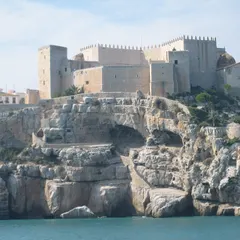
At the very top of the crag of Peñíscola, just before the entrance to the castle, stands a building that breaks every expectation of what a hermitage should be. The Sanctuary of the Virgin of the Ermitana — Santuari de la Mare de Déu de l’Ermitana — was built between 1708 and 1714, with the War of the Spanish Succession barely over, and its architecture makes no attempt to hide where it comes from: a façade with a royal coat of arms, a bell tower bearing a military governor’s blazon and a doorway decorated with artillery. Valencian Baroque, yes, but garrison Baroque.
The secret history of the Sanctuary of the Virgin of the Ermitana strings together three losses and three recoveries: an earlier chapel that vanished beneath this one, an image with an apostolic legend that spent centuries hidden in a cave, and a carving burned in the twentieth century that the town replaced on its own initiative. To understand what to see at the Sanctuary of the Virgin of the Ermitana it helps to look first at the stone outside and then at the gloom within; the EarGuide audio guide accompanies that contrast stop by stop.
The sanctuary stands beside Peñíscola Castle, at the top of the old town.
The esplanade where Peñíscola dances
Sanctuary of the Virgin of the Ermitana
Summary of this stop
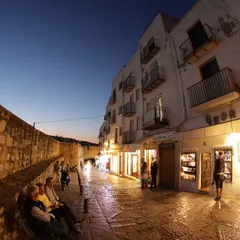
The first stop is on the upper esplanade beside the castle entrance, a few paces from the façade, with the constant sea wind and the sound of the water arriving from both flanks of the crag. It is a square that works at once as fortress courtyard and as church forecourt: the church is not separated from the castle by any space at all, it leans on it, and its clearly defensive features make it one more element of the fortified complex.
Empty, the esplanade looks small. Every September it stops being so. The feast of the Virgin of the Ermitana falls on 8 September and the patronal festivities in her honour, documented since 1664, begin on the 7th and are declared a Festival of National Tourist Interest. Over those days the square becomes the stage for les danses: Moors and Christians, llauradores and cavallets dancing to dolçaina i tabalet, the dolçaina shrill and the dry beat of the tabalet bouncing off the walls.
This is no tourist re-enactment. They are choreographies of medieval origin passed down orally from generation to generation, which the Generalitat Valenciana declared an intangible Bien de Interés Cultural after a process begun in 2021, and which symbolise the struggle between Good and Evil. How the town shares out the roles, and with what spectacular flourish the festive cycle closes, is one of the things the narration tells on this very stone.
Cannons carved into a sacred doorway
Doorway of the Sanctuary of the Ermitana
Summary of this stop
A few metres away, facing the main door, comes the oddity that justifies the trip. On the ashlars on either side of the entrance there are no saints, no angels, no plant motifs: there are cannons and war drums cut into the stone. It is an unheard-of iconographic decision in a Catholic church and it gives away the building’s military origin without ceremony.
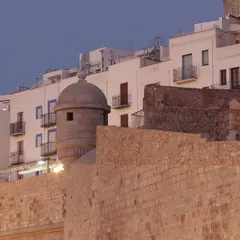
The façade is crowned by a mixtilinear cornice with pinnacles framing the coat of arms of Philip V, the Bourbon monarch who won the War of the Spanish Succession and wanted to leave his mark on the church. To the left, the bell tower — a square-plan tower of two storeys — bears the arms of Sancho de Echevarría and an inscription recalling that it was he who ordered the hermitage built. Governor below, king above: the whole hierarchy sculpted onto the front of a village church.
Read this way, the doorway stops being decorative and becomes a document. A military governor thanks a population for its loyalty during a siege, and does so by raising them a church that displays the instruments of that war. What exactly was being bought with that gift, and what Peñíscola received in return for its fidelity, is set out in front of the reliefs.
The old chapel beating underneath
Nave of the Sanctuary of the Ermitana
Summary of this stop
Through the door, the eyes take a few seconds to adjust: from the blinding light of the esplanade to a cool, gathered gloom, with a smell of wax and cold stone and a very short echo, the echo of a small church. The plan is a Latin cross with a single nave and two chapels on each side, a high choir at the foot, a dome over the crossing and barrel vaults with lunettes covering nave, transept and presbytery.
This eighteenth-century interior did not start from nothing. It was raised on the site of a small earlier chapel beside the fortress, which it replaced and which had given the castle its religious character. That primitive chapel can no longer be seen, but it conditions the place: the sanctuary occupies a point that had been the sacred space of the crag for centuries.
There is also a tradition here to be handled with care. Various popular sources claim that this place held the remains of the Papa Luna for a time. What is verified is that Benedict XIII died in the adjoining castle in 1423 and that his body remained buried in Peñíscola until it was moved to the family palace at Illueca around 1430; the present church is much later, so the tradition could only refer to the vanished chapel, and historiography places that first burial within the palace-castle without specifying which chapel. There is no tomb to point to, and that absence is precisely the story the audio guide develops in the middle of the nave.
The image lost twice
Shrine Chamber of the Virgin of the Ermitana
Summary of this stop
The route ends before the presbytery, looking up at the raised shrine chamber behind the altar where the image of the Mare de Déu de l’Ermitana, patroness of Peñíscola, is venerated. It is the most inward point of the building and the one that concentrates all its emotional charge.
According to local tradition, the image was brought to the peninsula by the apostle James himself. With the arrival of the Muslims the carving was hidden in a cave — tradition places it in the Barrio del Olivo — and stayed concealed for centuries, until it was recovered after the Christian conquest and returned to worship at the top of the crag. It is a legend, with everything that implies, but it explains why the patroness is more here than a mere dedication.
The second act belongs to the twentieth century and has nothing legendary about it: the earlier carving was burned during the Civil War. In 1953, by popular will, it was replaced with a copy of the original, and it is that image that occupies the shrine chamber today. A figure hidden in a cave for centuries and lost again six hundred years later, returned to the altar by the persistence of its neighbours: the circle the narration closes in front of the shrine chamber has rather more edge than the calm of the place suggests.