
Templar Fortress
Peñíscola Castle Audio Guide (Castillo de Peñíscola)
The fortress that warrior monks raised on a crag standing in the sea ended up being, alongside Rome and Avignon, the third place on earth ever to serve as the seat of a pope. Find out what to see at Papa Luna Castle.
- 14 min of audio
- Templar Architecture
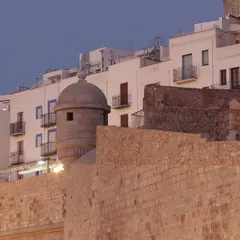
Papa Luna Castle crowns the rock of Peñíscola 64 metres above the Mediterranean, with a perimeter of some 230 metres and walls averaging 20 metres in height. The Templars built it between 1294 and 1307 on the site of an Arab citadel of which no trace has been found, driven by Master Berenguer de Cardona and Commander Arnaldo de Banyuls: golden stone, pointed barrel vaults and not a gram of surplus ornament.
A century later, on 21 July 1411, Benedict XIII — Pedro Martínez de Luna, the Papa Luna — installed his pontifical seat here and turned that barracks of soldier monks into palace, chapel and papal library. The contrast survives intact: in these rooms without marble or frescoes a pope who never accepted ceasing to be one lived, governed and died, and here the smallest conclave on record was held.
Highlights
- Parade ground — The bare heart of the Templar fortress, today a festival stage
- Pointed-vault basilica — The austere nave Benedict XIII turned into a pontifical chapel
- Gothic hall — Where tradition places the three-cardinal conclave of 1423
- Terraces 64 metres up — Parapets over the open sea, the tombolo and the white village
- Papa Luna staircase — 147 steps cut into the cliff, closed to the public
On the map of Christendom only three addresses have ever housed the court of a pope: Rome, Avignon and this crag on the coast of Castellón. The third is the least likely of them all. Papa Luna Castle began as Templar work between 1294 and 1307, after James I took Peñíscola in 1233 — the Muslim stronghold surrendered without a fight once Burriana had fallen — and after James II handed it to the Order of the Temple in an exchange of lands in 1294. With the Temple dissolved, the castle passed in 1319 to the newly created Order of Montesa, and there it would have stayed, one more fortress of the Maestrazgo, had an elderly Aragonese man not decided on 21 July 1411 that this was the place from which he would go on being pope against the entire world.
The secret history of Papa Luna Castle reads better in what is missing than in what is there: no marble, no frescoes, no palatial galleries. There are walls 20 metres high, pointed barrel vaults, an open parade ground and terraces 64 metres above the water. Understanding what to see at Papa Luna Castle means learning to read that austere military architecture as what it was for twelve years: the last Vatican possible. The full circuit, room by room and with the wind as a soundtrack, is the one the EarGuide audio guide accompanies.
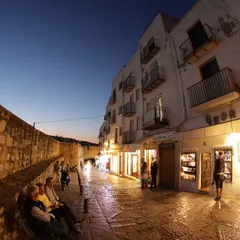
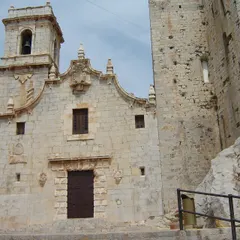
The Renaissance walls and the Portal Fosc complete the fortress, and beside the castle stands the Sanctuary of the Virgin of the Ermitana.
A statue with a tiara facing the sea
Peñíscola Castle
Summary of this stop
The first stop is on the entrance esplanade, that landing reached with just enough breath after climbing the whitewashed streets of the old town. Before the gate, what holds the eye is a bronze figure installed in 2007: an old man with tiara and crozier, looking out to sea. Anyone unfamiliar with the story will take a few seconds to work out why there is a pope on top of a military fortress.
The golden stone doorway behind it accumulates three superimposed layers. The first is invisible: the Arab citadel that occupied the summit and of which not a single identifiable remain has appeared. The second is the one on view, raised by the Templars between 1294 and 1307 with the order’s constructional sobriety, under Master Berenguer de Cardona and Commander Arnaldo de Banyuls. The third is a name: that of the pope who would arrive a century later and who today lends his surname to the whole building.
That the fortress passed in 1319 to the Order of Montesa, the Valencian heir to Templar property, explains why the complex survived the dissolution of the Temple intact. Why that continuity proved decisive for what came next is one of the things the narration unpicks right here, in front of the gate.
A Vatican of bare stone
Parade Ground of Peñíscola Castle
Summary of this stop
The route opens out into the parade ground, the great open space around which every chamber is arranged. Turning slowly takes in the whole fortress: bare walls, undecorated openings, the doors of the basilica, the Gothic hall, the stables and the guardhouse. It is a courtyard for soldier monks, designed for mustering troops and storing provisions, not for receiving embassies.
And yet between 1411 and 1423 it was exactly that: the central courtyard of a pontifical court. Benedict XIII moved his palace and his library here — put by the most detailed monograph on the castle at more than two thousand manuscript volumes brought from Avignon, a figure to be handled with the caution a single source deserves — and during his pontificate opened the Portal de Sant Pere, linking the enclosure to the sea. A pope governing an entire obedience from a stone barracks 64 metres above the waves.
The contrast is the argument of the place. There are few chances to walk through a space where the highest political ambition of its age moved in without changing a single stone of the scenery, and the parade ground is the exact point from which that mismatch can be seen whole.
The smallest conclave in history
Basilica of Peñíscola Castle
Summary of this stop
From the courtyard the route passes into the roofed rooms of the seaward flank: first the Templar basilica, an austere nave with a pointed barrel vault in bare stone, where the pontifical chapel was installed; then the adjoining Gothic hall, a great room of pointed arches. The temperature drops sharply and the echo turns dry. This is the heart of the building and the setting for the episode that justifies everything else.
Benedict XIII died here. He had been born in Illueca, in Zaragoza, in 1328, and was elected pope in Avignon on 28 September 1394 by twenty votes out of twenty-one. The Council of Constance deposed him in 1417; he never renounced the tiara. The chronicle of Friar Martín de Alpartil fixes his death on 23 May 1423, at around ninety-four years of age, but part of current research holds that he may have died months earlier, on 29 November 1422, and that the death was kept secret because the politics of the moment required it. The date in the books, then, is far from settled.
On 10 June 1423, within these walls, three cardinals shut themselves in and elected a successor: Gil Sánchez Muñoz, who took the name Clement VIII. He abdicated on 26 July 1429, recognised Martin V and with that closed the Western Schism before ending his days as bishop of Mallorca. What happened afterwards to the body of the Papa Luna — an odyssey of centuries that ends, as late as the year 2000, with a Guardia Civil operation — is the darkest material in the audio guide, and it is told precisely in this room.
The staircase down to a miracle
Terraces of Peñíscola Castle
Summary of this stop
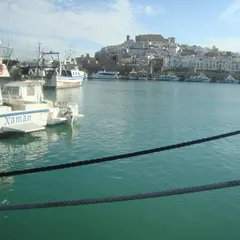
The interior stairs lead up to the high terraces, and the change is physical: constant wind, salt in the air, gulls calling below and the sound of the sea striking the base of the crag sixty-four metres down. From the parapet on the eastern flank the view takes in the coast, the tombolo tying the rock to the mainland and the white village packed onto the slope.
Leaning over that eastern cliff reveals the head of the Papa Luna staircase: 147 steps, cut in their final stretch into the living rock, dropping some forty metres between the fortress and the water. It was a piece of practical infrastructure — resupply and emergency exit for a stronghold that could find itself besieged — and today it remains closed to the public for safety, so it can only be viewed from above.
Local tradition preferred another version. It tells that Benedict XIII himself raised the staircase miraculously in a single night and that, disheartened by the disloyalty of his own people, he went down it to the water, spread his pontifical cloak over the waves and, leaning on his crozier, floated across the Mediterranean to confront his rival in Rome. How a work of logistics ended up as the tale of an old man walking on the sea is the thread the narration picks up at the parapet.
Walls that went from cannon fire to the big screen
Parque de Artillería of Peñíscola
Summary of this stop
The last stop lies outside the castle, on the stretch of Renaissance walls beside the entrance to the Parque de Artillería, with the bastions in view and the sea behind. These defences are neither Templar nor papal: they were designed between 1576 and 1578 by the Italian engineer Giovanni Battista Antonelli on the orders of Philip II, conceived for artillery and against the Barbary piracy then ravaging the coast.
The rock went on working long after the popes. In the War of the Spanish Succession the town stayed loyal to Philip V and withstood the Austracist sieges of 1705 and 1707 without surrendering, earning it the title of city and the style of “Muy Noble, Leal y Fidelísima”. Napoleonic troops occupied it in 1812 and General Francisco Javier de Elío recovered it on 25 May 1814 after an intense bombardment that destroyed part of the fortified complex. Since 3 June 1931 the castle has been a declared monument — today a Bien de Interés Cultural — and it is managed by the Diputación de Castellón.
Its most recent life is the most unexpected. In 1961 the walled town stood in for medieval Valencia in ‘El Cid’, with Charlton Heston and Sophia Loren and thousands of residents as extras; in the autumn of 2015 HBO shot scenes of the sixth season of ‘Game of Thrones’ here and turned the crag into the city of Meereen. Barely anything had to be disguised: why these walls work so well in front of a camera has a concrete architectural explanation, and it is with that explanation that the route closes.