
Working Harbour
Fishing Harbour Audio Guide (Puerto de Peñíscola)
Peñíscola took eleven years to build its harbour, and it did so after the night the sea took thirty-four of its sailors. Find out what to see at the fishing harbour of Peñíscola.
- 8 min of audio
- Seafaring Culture
The fishing harbour of Peñíscola stretches along the foot of the crag, with the castle of the Papa Luna and the white village as a permanent backdrop. Its first stone was laid in 1922, and that same year Joan Feliu founded the Pòsit de Peñíscola, the local fishermen's organisation whose heir, the Cofradía de Pescadores San Pedro, today holds the administrative concession of the fish market. In 2010 the fleet based here numbered 30 trawlers and 19 small-gear boats.
Before 1922 there was none of this. Sailing boats sheltered in natural coves such as the raconada of the Porteta, at the foot of the walls, and a staircase partly cut into the rock came down from the castle to serve as an emergency landing stage. On the night of 31 January to 1 February 1911, the Candelera storm killed some 140 fishermen between Barcelona and the gulf of Valencia; Peñíscola was the worst-hit town on the whole coast, with 34 sailors dead. The harbour is the answer to that night.
Highlights
- Monument to the sailors — The stone bearing names beside the entrance to the harbour precinct
- Trawler quay — High-hulled boats with nets and trawl doors in plain sight
- Harbour fish market — A descending auction every working afternoon from 16:00
- Peñíscola prawn — The catch that underpins local cooking and the suquet de peix
- Breakwater — A view of the harbour mouth and the seaward flank of the crag with the castle above
There are two Peñíscolas that look at each other daily without ever mixing: the upper one, with its postcard castle and whitewashed streets, and the lower one, which smells of brine, wet net and diesel, and works to the fleet’s timetable. The fishing harbour of Peñíscola belongs to the second. Its first stone dates from 1922 and the town celebrated the centenary on 6 September 2022 with a tribute to the fishermen lost at sea, an exhibition of unpublished photographs at the Casa del Agua and a special issue of the Revista Peñíscola produced by the Centro de Iniciativas Culturales.
The secret history of the fishing harbour of Peñíscola begins eleven years before its first stone, on a winter night this town has not forgotten. To grasp what to see at the fishing harbour of Peñíscola is to understand why an artificial shelter was for decades the town’s most urgent demand, and what remains today of that trade: a trawling fleet, an ice factory, an auction that runs backwards and the pleasure boats that take visitors out to sea. The EarGuide audio guide works along the quays stop by stop.
From the harbour, the way up to the old town passes through the Renaissance walls, and to the south the coast remains undeveloped in the Sierra de Irta.
The monument that explains the harbour
Port de Peñíscola
Summary of this stop
The first stop is at the entrance to the harbour precinct, in front of the monument to the sailors lost at sea, the quays opening ahead and the crag behind. It is a discreet piece that many people walk past without stopping, and it is at the same time the founding document of the place.
On the night of 31 January to 1 February 1911, the storm known as the Candelera swept the coast between Barcelona and the gulf of Valencia and killed some one hundred and forty fishermen and sailors. Peñíscola was the hardest hit of all: thirty-four sailors dead in a single night. The boats were then under sail and there was no harbour to shelter them; they moored in natural coves such as the raconada of the Porteta, at the foot of the walls, at the mercy of whatever came in from the east.
The first stone of the harbour was laid in 1922. Before this monument the town still holds its acts of homage to the fishermen who died, such as the centenary tribute in 2022. The exact relationship between that tragedy and the work that followed it, and what it took to obtain it, is what the narration teases out at this point before moving on to the quays.
Trawlers and a 1956 film set
Port de Peñíscola
Summary of this stop
The route continues along the quayside to where the high-hulled trawlers moor, nets and trawl doors hanging, halyards clinking metallically against the masts and diesel engines idling. In 2010 the fleet based in the harbour consisted of 30 trawlers and 19 small-gear boats; that year the Cofradía de Pescadores San Pedro modernised its facilities with an investment of more than 220,000 euros, 25% financed by the European Fisheries Fund, and its flake-ice plant reaches a capacity of ten tonnes a day.
The harbour also leads a double life: it offers fishing-tourism experiences aboard small artisanal boats and manages moorings for pleasure craft of up to eight metres in length. It remains, above all, a working quay, and in the middle of the afternoon the gulls that follow the trawlers as they come in make that clear without any need for explanation.
There is one more layer, and it is made of celluloid. In 1956 Luis García Berlanga shot ‘Calabuch’ entirely in Peñíscola, a Spanish-Italian co-production released on 1 October that year, with locations including the south beach, the area around the Portal de Sant Pere and the lighthouse. Local residents played the extras, sharing the frame with Edmund Gwenn — who was taking his leave of the cinema with this role — and with Italian actors such as Valentina Cortese and Franco Fabrizi. The film won the prize of the International Catholic Office of Cinema at the Venice festival and portrays without make-up the humble Peñíscola of the time. What can still be recognised from those shots among these boats is one of the games the audio guide proposes.
The auction where the price goes down
Llotja de Peñíscola
Summary of this stop
A few steps further on, on the harbour apron, stands the fish market, moved here in the early two-thousands; the activity is watched from outside, beside the glass, with the chill escaping from the crates of freshly dosed ice. Selling begins regularly at four in the afternoon, first with the trammel nets and small gear and then with the trawl.
The mechanism surprises anyone seeing it for the first time, because it works the opposite way round to expectations: it is a descending auction. It starts from a high price per kilo that falls until a buyer takes the crate with a gesture. It is the air-conditioned version of a far older ritual, the one performed on the sand itself, with the fish crates lined up on the beach and the skipper calling out a price that dropped until a carrier took the goods away.
Through this market pass prawns, mantis shrimp, red mullet, monkfish, sole, turbot, meagre, octopus and squid. The Peñíscola prawn is one of the most prized products of the local kitchen, and the fish auctioned here gives rise to seafaring dishes such as suquet de peix, arrossejat and paelleta de molliconet, a strictly Peñíscolan recipe. How to read a bid and why silence is part of the method is explained in front of the glass.
Papa Luna’s staircase, seen from the water
Port de Peñíscola
Summary of this stop
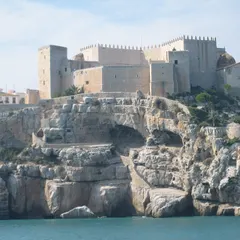
The last stop stands on the breakwater, near the mooring of the pleasure boats, looking at the harbour mouth and the seaward flank of the crag with the castle above. In the low light of late afternoon the rock and the fortress catch fire in gold over the harbour water, and from here it takes a single glance to understand how Peñíscola solved its access to the sea before 1922.
Down that flank towards the water runs a stone staircase, partly cut into the rock itself, which served as an emergency landing stage for the castle. Legend has it that Benedict XIII carved it in a single night to escape his fortress by sea, and that in that flight he lost his pontifical ring, dropped into the water and never recovered. Looking at the crag from the quay knowing that is not the same as looking at it from the beach.
The harbour still takes the town out to sea by two routes. Every 29 June, the feast of Saint Peter, patron of fishermen, the Cofradía holds a sailors’ mass and a procession that crosses the walled citadel and ends here, where the image of the patron is taken aboard and the fishing boats escort it on a sea crossing. And all year round the tourist launches set out: a trip of about thirty minutes to see the castle, the Bufador and the tombolo from the water, along with excursions to the Serra d’Irta Natural Park, whose range reaches 572 metres and falls to the sea in cliffs protected by a marine reserve. With that double image — the old landing stage and the new harbour — the narration closes.