
Natural Park
Sierra de Irta and Torre Badum Audio Guide
Twelve kilometres of cliffs, dwarf fan palm and undeveloped coves south of Peñíscola, crowned by a solid tower of 1554 that lit bonfires whenever corsair sails appeared. Find out what to see in the Sierra de Irta and at Torre Badum.
- 8 min of audio
- Protected Coast
The Parc Natural de la Serra d'Irta and its Marine Nature Reserve were declared by Decree 108/2002 of 16 July of the Valencian government, and protect 7,743 hectares on land and 2,448 at sea across Peñíscola, Alcalà de Xivert and Santa Magdalena de Pulpis. Inside lie around twelve kilometres of undeveloped coast, considered one of the last virgin stretches of the Valencian Mediterranean. The range is organised in two mountain alignments separated by the Estopet valley and culminates in the Campanilles peak, at 572 metres, from where it drops to the sea in cliffs.
Its most eloquent built element is Torre Badum, a circular watchtower raised in 1554 according to the inscription bearing the coat of arms of the Kingdom of Valencia from the time of Charles I. It stands some eleven metres high, 5.75 metres in diameter at the base and 5.25 at the top, and is solid up to about six metres, above which opens a single vaulted circular chamber. It has no door at ground level: access was through a raised opening reached by a ladder that was afterwards withdrawn, precisely to guard against the corsairs it was watching for.
Highlights
- Torre Badum — A 1554 watchtower with no ground-level door, above a cliff of some 97 metres
- Peñíscola sea lavender — Limonium perplexum, its only population on earth within 0.344 hectares
- Slopes of margalló — The only palm native to continental Europe, with kermes oak and mastic
- Pebret and Russo beaches — The park's only two fine-sand coves, with no services
- Casetes de volta — Dry-stone shelters with barrel vaults, from the seventeenth to nineteenth centuries
Six kilometres from the built-up centre of Peñíscola, the same municipality that raised a front of hotels along the Playa Norte keeps twelve kilometres of coast without a single building on it. This is no administrative oversight: it is the result of two decisions widely separated in time. The first was taken by fear, when the Barbary landings of the sixteenth and seventeenth centuries emptied this shore for generations. The second was taken by the Generalitat Valenciana on 16 July 2002, in declaring the Parc Natural de la Serra d’Irta and its marine reserve.
The secret history of the Sierra de Irta and Torre Badum is that of a coast left wild for deeply unromantic reasons and protected today for exactly the opposite ones. To understand what to see in the Sierra de Irta means walking dirt tracks through rosemary, mastic and dwarf fan palm, leaning over a cliff of almost a hundred metres and reaching the park’s only two sandy coves. The EarGuide audio guide accompanies that crossing stop by stop.
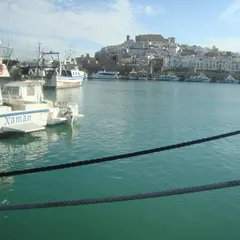
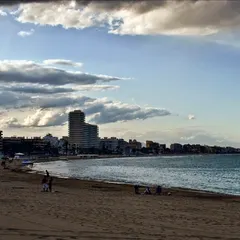
Back in Peñíscola, the fishing harbour lies at the foot of the crag, and on the other side stretches North Beach.
Where the asphalt gives way to the dwarf fan palm
Cala del Volante
Summary of this stop
The route starts beside the Cala del Volante, at the exact point where the road south of Peñíscola becomes a dirt track and the Pebret path begins. The change is immediate and almost comic in its abruptness: within a few paces the bustle, the terraces and the tarmac disappear, and an untamed Mediterranean scrubland begins, gravel crunching underfoot and the warm smell of maquis in the sun.
The dominant vegetation on this coast is the dwarf fan palm, the margalló — Chamaerops humilis — the only palm native to continental Europe, which carpets the slopes between cliffs alongside kermes oak, mastic and rosemary. It is a low, spiny cover, thoroughly unfriendly to anyone thinking of leaving the path, and it is exactly the picture this coast presented before tourism.
The park protects 7,743 hectares on land and 2,448 at sea across three municipalities — Peñíscola, Alcalà de Xivert and Santa Magdalena de Pulpis — and preserves some twelve kilometres of undeveloped coastline. Why such an accessible stretch of coast stayed empty while the rest of the Valencian Mediterranean was built over is the question the narration raises as soon as this invisible threshold is crossed.
The tower with no door that lit bonfires
Torre Badum
Summary of this stop
Some two and a half kilometres of track southward, the sea on the left, and the silhouette that gives this stretch its name appears above the cliff: Torre Badum. Seen close up, the first thing that strikes the eye is what is missing. The ashlar base is completely blind, solid up to about six metres, and the only access is an opening halfway up. There is no door at ground level because there never was one: it was climbed by a ladder that was then withdrawn.
The watchtower is circular in plan, stands around eleven metres high and above its solid base opens a single vaulted circular chamber. It rises on a cliff of some 97 metres at the cape of Irta and is protected as a Bien de Interés Cultural. It formed part of the sixteenth-century network of watchtowers against Barbary piracy: in case of alarm it lit a great bonfire to warn the fortress of Peñíscola of attacks coming from the south, and it communicated with other towers of the system, such as Torre Ebrí, set inland at 499 metres of altitude.
A chronological nuance is needed. The year 1554 in the inscription is sometimes read as the date of construction and sometimes as one of restoration: several sources attribute an earlier origin to the tower, possibly Andalusi — hence the Arabic etymology “Almadum” — over which the Christian watchtower would have been raised or reformed. What admits no doubt is the climate that explains it: for two centuries corsairs landed on this coast to plunder and to carry off captives who were then ransomed or sold as slaves, and that permanent fear is one of the reasons this shore was left depopulated and uncultivated. The solitude celebrated today began as a scar, and the audio guide tells it at the foot of the tower.
The flower that exists only on this cliff
Reserva Marina d'Irta
Summary of this stop
A few paces away, on the signposted cliff edge, a small panel marks a plant micro-reserve. Underfoot there is a drop of some 97 metres and, ahead, the band of protected water of the marine reserve, with no harbour or development in sight. The rock ledges on that edge hide the park’s most valuable rarity.
There grows the Peñíscola sea lavender, Limonium perplexum, a plant scientifically described in 1999 whose only wild population in the world is concentrated in the Torre Badum plant micro-reserve: barely 0.344 hectares and between 75 and 383 specimens depending on the year. It is catalogued as critically endangered. The entire species, on the whole planet, fits into a few metres of cliff in Castellón.
The contrast is hard to beat: a watchtower built to scan an immense horizon and, at its feet, a species occupying a surface smaller than a football pitch. How such a singular plant came to be discovered so late, and what it takes for it to go on existing, is the material the narration develops at this point.
The sandy coves and the range coming back to life
Platja del Pebret
Summary of this stop
The track then descends southward, away from the cliff, to the Pebret and Russo beaches, adjoining and the only fine-sand beaches in the whole park: together they run close to 280 metres in length and some 5,600 square metres in area, with no development and no services, reachable only by the Pebret forest path. The Russo beach also has a naturist tradition, with a deliberately difficult access that is part of its appeal.
Behind them, the range keeps the traces of those who did inhabit it. On the dry coastal farmland the casetes de volta survive, dry-stone huts roofed with barrel vaults and dated between the seventeenth and nineteenth centuries, which served as temporary shelter for the carob and olive harvest and collected rainwater from the roof into a cistern. Higher up, in the range above Peñíscola, stands the Ermita de Sant Antoni, a Baroque complex rebuilt in 1688 on sixteenth-century origins, with hermitage, hermit’s house and lodging around a courtyard from whose parapet the whole coast is commanded. And in the inland foothills, at 431 metres of altitude, the Castell de Xivert holds out, a fortress of Andalusi origin from the tenth and eleventh centuries that passed in 1234 to the Order of the Temple through a pact of peaceful surrender — charter of settlement in 1251 — and, after the order’s dissolution, to the Order of Montesa.
The coast of fear has become a shared coast. Every year, on the Sunday after Easter Sunday, more than a thousand residents of Peñíscola walk up from the town to the Ermita de Sant Antoni on a pilgrimage combining mass, procession and a day of paellas in the courtyard; the town council expressly recommends making the climb on foot. One day a year the silent range smells of woodsmoke and rice, and the same path once used to watch for corsairs becomes the village square again. With that image the narration of the park closes.