
Historic Ensemble
Old Town Audio Guide
A whitewashed maze packed onto a rock the sea very nearly left as an island, with a crack through which the Mediterranean breathes beneath the houses. Find out what to see in the old town of Peñíscola.
- 12 min of audio
- Walled Town
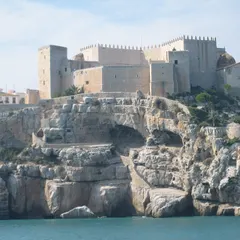
The old town of Peñíscola stands on a tombolo: a rocky peninsula joined to the mainland only by a sand isthmus that storms could cover, leaving the crag isolated. That is where its name comes from, from the Greek 'Chersonesos' translated into Latin as 'paene insula', almost an island. Within its walls fit some five hectares of sloping streets, dazzling lime-washed façades and a handful of buildings that sum up eight centuries of history. It has been declared a Bien de Interés Cultural, in the category of Historic Ensemble, since 26 October 1972.
What makes this maze different is not its postcard but its acoustics. Beneath the houses, a natural crack some seven metres deep opened by marine erosion connects the streets with the water: the Bufador. On stormy days the sea charges in through the lower mouth and the compressed air comes snorting out of the upper opening, in the middle of the street. A town that can be heard from the inside and that also has freshwater springs within the rock.
Highlights
- Portal Fosc — A vault turning ninety degrees that leaves the passage blind for a few metres
- Calle Mayor — The cobbled slope Tyrion and Varys walk down in 'Game of Thrones'
- Church of Santa María — Early Gothic, Baroque enlargement of 1725-1739 and a bell tower of 1862
- Casa de les Petxines — A façade entirely clad in seashells, completed in 1961
- El Bufador — The seven-metre crack through which the sea roars beneath the streets
Arab geographers called it Banáskula and described it as a coastal fortress with saltpans. In 1233, after several failed Christian attempts, its Muslim inhabitants negotiated their surrender directly with James I, who respected their laws and customs: a handover by agreement, without assault, uncommon in the conquest of the kingdom of Valencia. On 28 January 1251 the same king granted Peñíscola its charter of settlement under the fuero of Valencia, and with it the town walked today truly began to exist. A century and a half later, on 21 July 1411, the Papa Luna arrived and for eighteen years the place became the capital of a pontifical obedience.
The secret history of the old town of Peñíscola lies not in any one building but in the layering: the Moorish stronghold handed over by pact, the chartered town, the refuge of the last pope of the Schism, the fishing village and the film set all coexist in the same streets with no sign marking where one layer ends and the next begins. To grasp what to see in the old town of Peñíscola the climb has to be slow, because the architecture here is gradient, lime and short shadow; the EarGuide audio guide follows that ascent stop by stop.
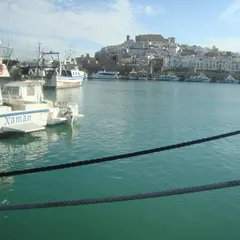
Its streets climb up to Peñíscola Castle between Renaissance walls, and below, at the foot of the crag, lies the fishing harbour.
The bent gate that leaves you blind
Portal Fosc
Summary of this stop
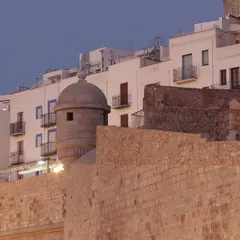
The route starts outside, on the esplanade before the ashlar gate of the Renaissance wall, looking at the dark mouth of the passage. The Portal Fosc is not an arch but a corridor: its inner vault turns through ninety degrees and gives onto a guardhouse, so that whoever enters loses their sight for a few metres before emerging into the whiteness of the first street. The trick is military — an attacker crossing it is left disoriented and exposed — but the effect on today’s visitor is purely sensory.
The landward front in which it opens was raised in the sixteenth century under Philip II, to a design by the engineer Juan Bautista Antonelli. It is worth knowing that the attribution of the gate to Juan de Herrera, the architect of El Escorial, circulates widely but is not conclusively documented: some authors suggest it because of the classical air of the stone, while other sources confine themselves to placing it within the Renaissance intervention linked to Antonelli.
On leaving the half-light the ground begins to rise and never stops. That is the first real fact about the place: this is a fortress that is essentially almost an island, and the slope is a reminder at every step. What exactly it meant to live inside an enclosure declared a Historic Ensemble in 1972 and inhabited without interruption since the thirteenth century is what the narration begins to unfold here.
The slope that was Valencia and Meereen
Calle Mayor
Summary of this stop
Halfway up the Calle Mayor, the cobbled ramp steepens between whitewashed façades and the glare of lime at midday forces the eyes half shut. It is a residential street, washing hung out and flowerpots in place, and at the same time one of the most recognisable film locations on the Spanish Mediterranean coast.
The sequence starts in 1956, when Luis García Berlanga shot ‘Calabuch’ here, a Spanish-Italian co-production about a rocket scientist who hides in a peaceful coastal village; it starred Edmund Gwenn in his last role and won the OCIC prize at the Venice Festival. It continues in 1961 with Anthony Mann’s ‘El Cid’: Peñíscola stood in for eleventh-century Valencia because the real city had already been modernised too far, and for three months hundreds of workers put up set walls to conceal the modern buildings. Filming ran from November 1960 to April 1961 and the battle of Valencia was shot on its beaches with 1,700 infantry soldiers lent by the Spanish army, 500 horsemen and 35 boats dressed with battlements standing in for the Moorish fleet.
The last chapter is from 2015. Between late September and early October, ‘Game of Thrones’ turned the old town into the city of Meereen for its sixth season: some five hundred crew and around three hundred extras, chosen from twelve hundred shortlisted, filmed on this very slope, at the Portal Fosc, in the square of Santa María and in the Parque de Artillería. The town has folded that memory into its street life in a way that surprises almost everyone, and the audio guide tells it exactly where it happened.
Santa María, the parish of two popes
Plaça de Santa Maria
Summary of this stop
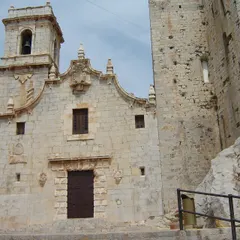
The Calle Mayor opens into the square of Santa María, the high and social point of the enclosure, the church front opposite and the square bell tower rising over the roofs. The parish was begun after the conquest in early Gothic, between the thirteenth and fifteenth centuries, and its later history can be read in the building’s seams.
In the mid-fifteenth century it burned, and Pope Eugene IV granted plenary indulgence to those who donated towards its rebuilding. Between 1725 and 1739 it was enlarged and transformed into Baroque; the bell tower seen today dates from 1862. Its parish treasury holds pieces linked to Benedict XIII and Clement VIII, the two pontiffs who governed from this crag until the second one’s renunciation, in 1429, put an end to the Western Schism.
Few village churches concentrate a biography like this: the Muslim fortress handed over by pact in 1233, the town founded by royal charter in 1251 and the refuge of a pope who refused to resign. How those three histories fit into a single building, and what really survives of each stage, is the thread the narration follows in the square.
The shells that were paid for with tobacco
Casa de les Petxines
Summary of this stop
Going down the alleys towards the seaward face, the most photographed façade in town appears: the Casa de les Petxines, the House of the Shells, finished in 1961 and clad entirely in local seashells. Among them open pointed-arch windows with an Arab air, and the coat of arms of the Papa Luna can be made out. It is still a private home, so it can only be admired from the street.
Behind it lies a post-war story with names attached. It was built by a Peñíscola couple, Timoteo Pau and Justa Mir Soria, who were struggling to get by with their three children, Agustín, Gloria and Joaquín. Justa began offering herself to the first tourists as an improvised guide for whatever they cared to give, and so became the town’s first tourist guide. To clad the façade she devised a barter: she obtained tobacco and traded it with the fishermen for local shells, while Timoteo collected them on the beach after storms.
The ending is consistent with the beginning: Justa went on to open the first souvenir shop in Peñíscola, right opposite her house. The most repeated postcard of the old town was paid for by no nobleman and no pope, but with cigarette packets swapped shell by shell by a family that got ahead by inventing the tourism of their own village. The details of that barter are among the best-loved parts of the audio guide.
The hole through which the sea breathes
El Bufador
Summary of this stop
The route ends on the Bajada del Bufador, near the Portal de Sant Pere — the gate the Papa Luna had opened in the fifteenth century towards the seaward face, one of only three entrances to the enclosure — where a dull rumble grows as the street descends. The source of the sound is a natural crack some seven metres deep opened by marine erosion beneath the houses, wedged between the walls of the buildings.
How it works is simple and spectacular: on stormy days the water charges in through the lower mouth, flooded by the sea, and the compressed air comes snorting and spraying out of the upper opening, in the middle of the street. Hence the name, “bufador”, the one that snorts. Local chronicles add that this roar once had a defensive use: the bellow of the sea coming out of the rock, heard from outside the walls, unnerved anyone thinking of storming the town, as though the crag itself were growling at its attackers.
One last fact explains why this rock is inhabited at all. Inside the walls, beside the hermitage of Santa Ana, rises the Font de Dins, a freshwater spring that has supplied the population since time immemorial and channels its water through a vaulted conduit to the Font de la Petxina and the washhouse at the foot of the Santa María bastion; as many as twelve springs have been documented on the crag. Sea on every side and fresh water within: that is the equation the narration closes with in front of the Bufador.