Sacred Mount
Wat Saket and the Golden Mount Audio Guide (Phu Khao Thong)
The only height in old Bangkok is a tower that failed: Rama III's great prang sank into the mud and its ruins ended up as a mount crowned with gold, with a Buddha relic at the summit and the memory of epidemics at its foot.
- 45 min of audio
- Ayutthaya-style chedi
In 1782 Rama I restored an old Ayutthaya-era shrine, gave it its present name and had a canal dug around it. Half a century later, Rama III wanted to raise beside it a colossal prang imitating the Golden Mount of Ayutthaya. The soft ground could not bear it, the work was abandoned and Rama IV, in 1865, turned the ruin into an artificial mount crowned by a bell-shaped chedi. At 77 metres, it was the highest point of Rattanakosin Bangkok.
Before the gold there were vultures. Outside the walls, Wat Saket received the corpses the city did not want to cremate within its precinct, and during the cholera epidemics of the nineteenth century the bodies overflowed its crematoria. The expression "the vultures of Wat Saket" entered Bangkok's popular speech. On that past is held today, each November, the oldest temple fair in the city.
Highlights
- Golden Mount — 77 metres, the highest point of Rattanakosin-era Bangkok
- 344-step staircase — A spiral climb between golden bells and a gong
- Summit chedi — A gilded Ayutthaya-style reliquary with a Buddha relic
- Vulture sculpture — A memory of the cholera epidemics of the nineteenth century
- Rama III's prang — The tower sunk in the mud that lies beneath the concrete walls
In a city as flat as the palm of a hand, the only hill of historic Bangkok was not made by nature. Wat Saket and the Golden Mount are the result of an engineering error that three reigns turned into a monument: the tower that Rama III (1824-1851) dreamed for his capital cracked and sank, undergrowth disguised it as a hill and Rama IV crowned it in 1865 with a gilded chedi that Rama V finished and endowed, in 1899, with a Buddha relic. Today it is an active monastery, a 360-degree viewpoint over Rattanakosin island and the setting of the oldest temple fair in the city.
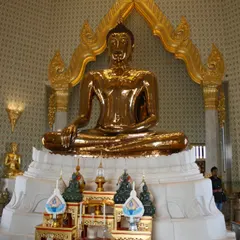
The history of Wat Saket and the Golden Mount also has chapters that cannot be seen from the staircase. In 1825 Rama III had the Phra Attharot brought from Phitsanulok, a standing bronze Buddha of about nine metres cast in a single piece in the Sukhothai style; according to tradition, the raft carrying it down the Chao Phraya sank so low that riverside residents believed they saw the image floating, and the 300,000 people said to have helped unload it, “sam saen”, are supposed to have given the Samsen district its name. In April 2025, for the bicentenary, the temple again paraded it around the mount and shipped it downriver. At the foot of the hill, in a vihara facing the canal, also sits Luang Pho Dam, the “Venerable Black Father”, lacquered but never gilded: it is said it was made so that those unable to climb to the summit could pray to him instead of to the relic.
Understanding what to see at Wat Saket and the Golden Mount and how to read its architecture, from the buried ruin to the chedi at the top, calls for climbing slowly, landing by landing. The EarGuide audio guide accompanies that ascent in four stops, from the vultures at the foot of the mount to the highest terrace.
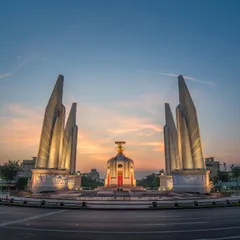
Very close, Ratchadamnoen Avenue leads to the Democracy Monument, and a few streets to the southwest wait Wat Suthat and the Giant Swing.
The vultures of the ghost gate
Vulture sculpture
Summary of this stop
The route starts at the foot of the mount, before a group of stucco vultures perched beside a small mondop with a Buddha footprint. At first sight the sculpture looks almost picturesque. Its meaning changes on learning that, between the reigns of Rama I and Rama V, cremation within the walls was avoided, and that Wat Saket, outside the fortified precinct, received the corpses leaving the city through Pratu Phi, the “ghost gate”.
In 1820, under Rama II, cholera reached Bangkok from Penang and killed more than 30,000 people. The bodies overflowed the temple’s crematoria, were left in the open and attracted flocks of vultures. In the epidemic of 1849, although some place the century’s worst outbreak in 1840, the future Rama IV, then a monk, designated Wat Saket as a crematorium alongside Wat Bang Lamphu and Wat Choeng Len: as many as 696 cremations were reached in a single day and the birds occupied the courtyard, the trees, the walls and the roofs of the cells. Hence the popular expression “Raeng Wat Saket”, the vultures of Wat Saket, which Bangkok pairs with the spectres of Wat Suthat.
Tradition also preserves the figure of Luang Poo Toh, one of the most venerated monks of Siam, who came on purpose to this field of exposed bodies to meditate on impermanence. Why a master chose to sit here, and what comparison has accompanied the place ever since, is what the narration tells in front of the vultures.
Rama III’s prang that the mud swallowed
The 344-step staircase
Summary of this stop
The staircase of 344 steps, a figure signposted as “344 Steps” at its start although some descriptions speak of 318, climbs in a spiral around the mount between rows of golden bells and a great gong that visitors strike as they pass. The metallic sound accompanies the whole climb, but what lies underfoot tells another story.
Rama III wanted to raise here a great prang imitating the Phu Khao Thong, the Golden Mount of Ayutthaya, and entrusted the work to Phraya Si Phiphat Ratanakosa. The base, with a plan of twelve indented angles, reached only the second terrace: Bangkok’s soft ground gave way under the weight, the brick cladding cracked throughout and the construction was abandoned. What now looks like a hill is that ruin.
The concrete walls that girdle the slope date from the 1940s, when, in the midst of the Second World War, the mount was corseted to halt its erosion. Beneath, the failed tower remains. How the sunken prang is recognised from the staircase, and what the layout of the climb gives away, is explained on the landing, beside the bells.
A Buddha relic above the ruin
Golden summit chedi
Summary of this stop
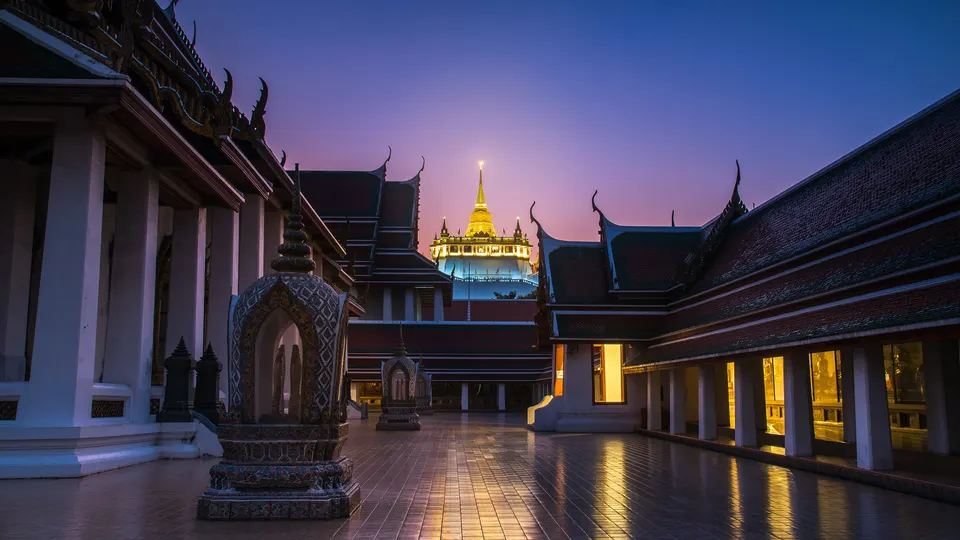
At the summit rises the bell-shaped Ayutthaya-style chedi, covered in gold mosaic and visible from a good part of the old city. Rama IV conceived it in 1865 when transforming the failed prang into an artificial mount, named it Phra Borom Banphot, and the work was concluded under Rama V. The gold and the incense give the measure of a devotion that remains very much alive.
Inside the niche of the main chedi, a small chedi holds a Buddha relic. One version identifies it with the bone remains excavated at Piprahwa, near Kapilavastu, in January 1898, which the British government of India handed to Rama V in 1899; another version, by contrast, has it arriving from Sri Lanka at the hands of Prince Prisdang. The debate remains open.
Since Rama V, every year, on the eighth day of the waxing moon of the twelfth lunar month, in November, a procession carries up at dawn a long red cloth bearing the names of worshippers to wrap the chedi. It is the opening of the Golden Mount fair, some ten days and nights that coincide with Loi Krathong and that still set up sideshows of frights and oddities, with the Phi Krasue, the ghostly woman’s head with glowing entrails, the two-headed child and the snake woman. How the relic and the sideshow live door to door is one of the scenes the audio guide reconstructs in front of the chedi.
The navel of old Bangkok
Panoramic terrace
Summary of this stop
The circular terrace at the top offers a 360-degree view over Rattanakosin island, its canals and, in the distance, the skyscrapers of modern Bangkok. At 77 metres, the Golden Mount was the highest point of the Rattanakosin-era capital and was regarded as its “navel”. From the parapet one understands why: in a city without relief, no other lookout dominates so much.
It already had that function before the chedi. In the decades between Rama III and Rama IV, the ruin of mud and brick was covered with undergrowth until it looked like a natural hill; people simply called it “phu khao”, the mountain, and soldiers used it as a lookout post against the arrival of enemy armies.
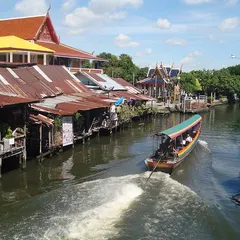
Below, the canal that surrounds the precinct is the one Rama I had dug in 1782, when he restored the old temple of Wat Sakae and renamed it Wat Saket, “washing the hair”. According to tradition, the name recalls an intimate gesture of a king returning from war who stopped here before entering his new capital. What rite he performed and why the temple’s name changed is the account with which the narration closes the climb.