Historic Canal
Khlong Bang Luang Audio Guide
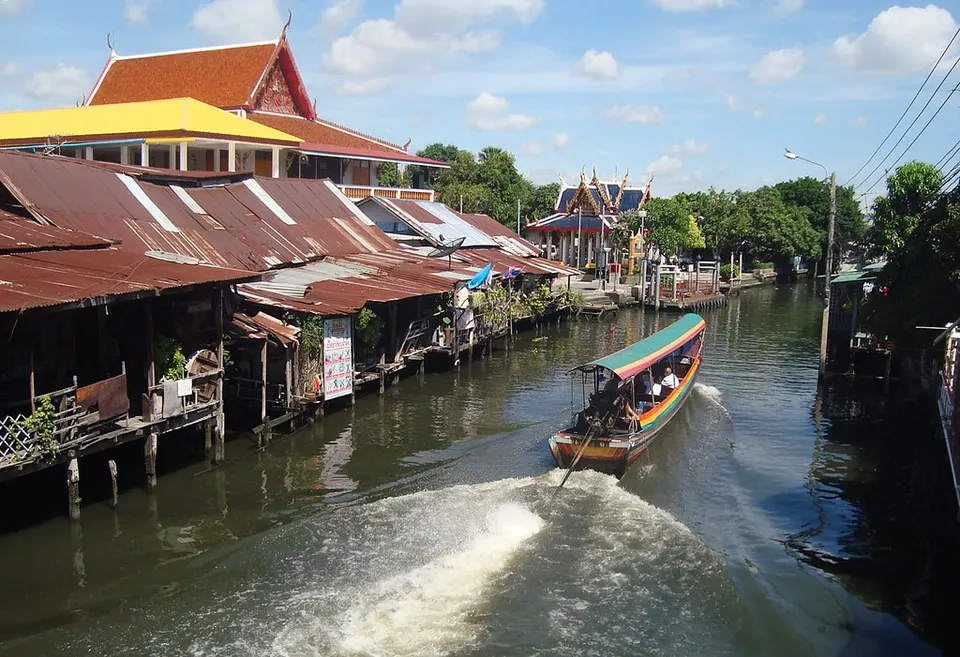
Five centuries ago the Chao Phraya abandoned this channel for a shortcut, and the old river was left as a canal. In Thonburi, Khlong Bang Luang preserves wooden houses over the water, Ayutthaya-era temples and a goldsmiths' house built around a chedi.
- 60 min of audio
- Thonburi canals
Khlong Bang Luang, today called Khlong Bangkok Yai, was not born as a canal: it was a meander of the Chao Phraya itself, so long that travelling it by boat took more than a day. In the sixteenth century a shortcut was dug to cut off the bend, the river took the short way and the old channel was split into two canals, the Bangkok Noi above and the Bangkok Yai, or Bang Luang, below. When Taksin set up his court in Thonburi (1767–1782), its banks filled with the residences of senior officials, the khaluang, and of the Chinese families who had helped the king: hence the names Khlong Bang Kha Luang and Khlong Bang Luang.
The final stretch, between Wat Kamphaeng Bang Chak and Wat Khuha Sawan, was a thriving market and an important thoroughfare, was sidelined for centuries and revived with the arrival of Baan Silapin, the Artist's House. That goldsmiths' house has a oddity that defines it: it does not stand beside an old twelve-cornered chedi, but around it, with the monument wedged into its courtyard. On its ground floor, three puppeteers dressed in black move each puppet of the Thai puppet theatre.
Highlights
- Baan Silapin — The wooden house of a family of goldsmiths, built around a chedi of about 10 metres
- Hun lakhon lek puppets — Three puppeteers dressed in black to move a single puppet
- Wat Kamphaeng Bang Chak — Jataka murals with the Danish signal mast and seven twelve-cornered chedis
- Old course of the Chao Phraya — The meander the river abandoned for a sixteenth-century shortcut
- Wat Khuha Sawan — Carved wooden gables, double red sandstone semas and a Buddha that left for Wat Pho
On the Thonburi bank, facing the Bangkok of skyscrapers, runs a narrow canal that is really a retired river. The history of Khlong Bang Luang begins before Bangkok existed: the poem Kamsuan Samut, composed around 1482–1491, describes the journey along this same meander of the Chao Phraya and names communities such as Bang Chak, Bang Ramat, Bang Chueak Nang and Bang Nang Nong. Soon afterwards, a shortcut dug in the Ayutthaya period diverted the river, and the old bend was left as a canal. With Taksin’s court in Thonburi came the officials and the Chinese families who gave it its name; later, Khlong Bang Luang was the first canal in Thailand to have street lamps.
Today it is officially known as Khlong Bangkok Yai, and since a Council of Ministers resolution of 13 June 1967, under the government of Field Marshal Thanom Kittikachorn, it has been declared an important canal to be preserved along its roughly 6 km, from Wichai Prasit fort to Khlong Mon. What to see at Khlong Bang Luang comes down to its liveliest stretch, from Wat Kamphaeng Bang Chak to Wat Khuha Sawan: wooden houses on stilts, an artists’ gallery that breathes around a chedi and two temples whose architecture points to late Ayutthaya. The EarGuide audio guide covers that stretch on foot in four stops.
The canal lies on the same Thonburi bank as Wat Arun, and across the Chao Phraya, Wat Pho completes the visit to the Bangkok of royal temples.
The goldsmiths’ house that embraces a chedi
Baan Silapin
Summary of this stop
Baan Silapin, the Artist’s House, was for generations the home of the Raksamruat family, an old lineage of goldsmiths. When the last heir sold it, the buyer, Chumphon Akkaphanthanon, turned it into a gallery and meeting point for artists. It is a two-storey wooden house, in the “Manila” style and L-shaped: upstairs, the gallery; downstairs, the puppet stage and a shop; and a porch café overlooking the water.
What makes it unique is in the courtyard. There stands a twelve-cornered, indented chedi of about 10 metres, worn by time: the monument belonged to the neighbouring temple and the house was built around it, so that it ended up inside. On its age, the sources do not agree: one describes it as a century-old house, another as a house of several centuries, and the figure of 200 years repeated by some blogs does not appear in open sources.
On the ground floor hun lakhon lek is performed, the Thai small-puppet theatre, in which three puppeteers dressed in black move a single puppet: one the body, another the left hand and foot, the third the right hand and foot. One source attributes the performances to the Sippatham Dance Troupe, present since 2010; another, to the Kham Nai company. How those six hands coordinate so that the puppet seems to breathe is something the narration explains in front of the stage.
Bang Chak, the crossing once sung in a poem
Wat Kamphaeng Bang Chak
Summary of this stop
A few steps further on, the small Khlong Bang Chak splits off from the main canal. That fork, between Baan Silapin and the temple, is the Bang Chak named in the Kamsuan Samut in the late fifteenth century, when the great river still passed this way. At the mouth of the canal stands Wat Kamphaeng Bang Chak, with a recorded foundation in 1824 and a consecrated precinct in 1850. Its small ubosot, in late Ayutthaya style and presided over by the Buddha Luang Pho Butsarakham, received major renovations under Rama III and Rama V, probably paid for by a Chinese-descended official of the Krom Tha Sai known as Chin Sue, although the attribution is not certain.
Inside, the murals narrate the last ten births of the Buddha and the cosmology of the Traiphum, but among the sacred scenes an earthly detail appears: the signal mast of Denmark beside Pong Patchamit fort, a painted testimony to trade with foreigners. The temple also gathers seven twelve-cornered, indented chedis; the two large ones, of about 10 metres, are twins: one rises south of the ubosot, beside the wall, and the other is the one that ended up inside the courtyard of Baan Silapin.
An unsettling episode is also associated with this precinct, recorded by the temple’s tradition: one of the two small viharas flanking the ubosot courtyard remained closed for more than eighty years. When it was opened, numerous ancient Buddha images appeared, in bronze and wood, most of them in the same posture. What it was and what it means beside a canal is what the audio guide reveals at this stop.
Walking the old course of the Chao Phraya
Wooden houses on stilts
Summary of this stop
The walk continues between a row of wooden houses, cafés and shops on stilts, with landing stages at water level and long-tail boats passing a few metres away. It is hard to believe that this narrow strip of water was the kingdom’s great river: the meander was so long that travelling it by boat took more than a day, and so, under King Chairachathirat of Ayutthaya (1534–1546), a shortcut canal, Khlong Lat Bangkok, was dug. The date is not entirely settled: one source places the work in 1522, while others attribute it to that reign.
The Chao Phraya took the shortcut and the old channel was left on the margin. For centuries the final stretch between the two temples, once a thriving market and an important thoroughfare, lost life, until the arrival of Baan Silapin woke it up. The bank has another driving force too: according to local tradition, the floating market of Khlong Bang Luang was started on the initiative of the abbot of Wat Kamphaeng Bang Chak, Luang Pho Narong Panyathipo, so that the canal’s residents would have a livelihood.
That mix of an abandoned river and a community that refuses to let it die is the thesis of the route, and in this stretch, with the water at foot level, the narration unfolds it calmly.
Wat Khuha Sawan and the Buddha that left
Wat Khuha Sawan
Summary of this stop
At the end of the community stretch, the ubosot of Wat Khuha Sawan can be seen from the bank with its carved wooden gables and its double red sandstone semas from late Ayutthaya. Its foundation with a consecrated precinct is recorded in 1777, in the middle of Taksin’s time, and its first name was Wat Sala Si Na, after a four-façade pavilion. Rama I restored it, gave it its present name and took away its great bronze Buddha from the early Ayutthaya period, the Phra Phuttha Thewa Patimakon, to preside over the ubosot of Wat Pho, across the river. The image that presides over the temple today is the replacement the king had made.
Beside the scripture library, a vihara holds the statue of Luang Pho Phong Thammachotiko, abbot approximately between 1912 and 1928 and a highly venerated meditation master on the Thonburi bank. He made amulets for his devotees, and the most famous bears a curious name, “Phra Somdej Lep Mue”, where “lep mue” means “fingernail”: a tablet of powder associated with benevolence and success in trade. Worshippers still come to pay homage to him.
Behind the temple, inside a school, survives the Buddha of another vanished shrine, Wat Suwan Khiri, believed to be from late Ayutthaya and left without monks since the reign of Rama VI. Between one absence and two survivals, the last stop closes the circle of the canal, and it is there that the audio guide tells what remains to be known.