Temple of the Golden Buddha
Wat Traimit Audio Guide
The largest solid gold Buddha in the world spent twenty years under a tin roof, disguised in stucco, a few steps from where it now shines. It was brought to light not by a discovery but by a rope that snapped in 1955.
- 30 min of audio
- Solid gold
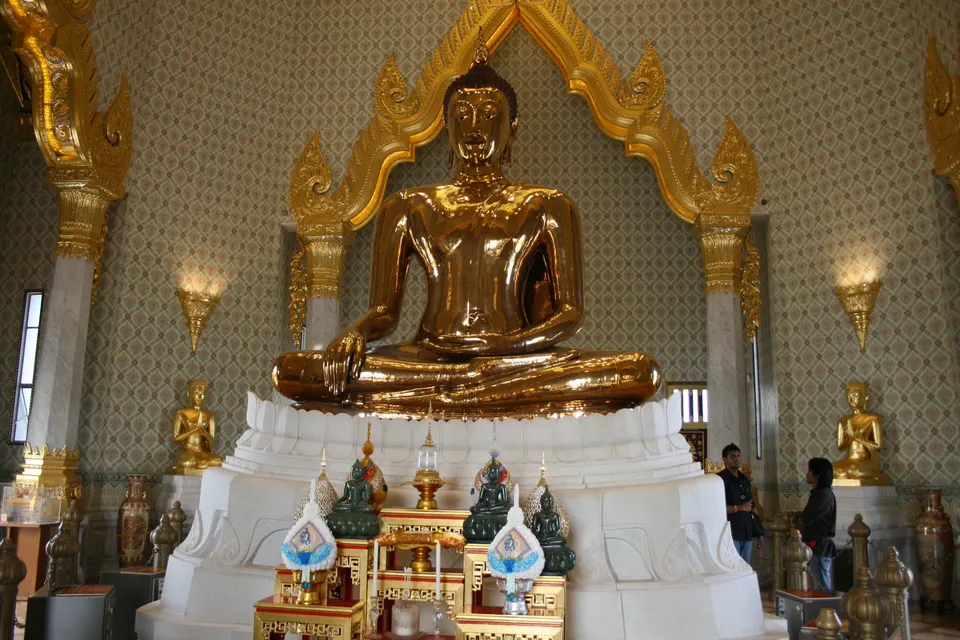
Wat Traimit stands at the entrance to Yaowarat, Bangkok's Chinatown, and keeps what Guinness recognises as the largest solid gold sculpture in the world: the Golden Buddha, a seated figure of about 3 metres containing 5.5 tonnes of gold. The statue occupies the upper hall of the Phra Maha Mondop, a four-storey white marble pavilion inaugurated in 2010, while at its feet a neighbourhood temple still beats, with its ubosot of 1947 and its monastic residences of 1937.
For generations nobody knew what was inside. A thick layer of painted stucco studded with coloured glass disguised it, applied according to tradition before the fall of Ayutthaya in 1767 to spare it from looting. It arrived here in 1935 as the Buddha left over from a distribution, waited twenty years under a tin roof beside the road and showed its gold only on 25 May 1955, when the ropes hoisting it snapped and the image struck the ground.
Highlights
- Golden Buddha — 5.5 tonnes of solid gold in about 3 metres, a Guinness record for a solid gold sculpture
- 25 May 1955 — The ropes snapped as it was hoisted and the fallen stucco revealed the gold
- Fragments of the original stucco — Real pieces of the disguise and photographs taken as it was removed
- Phra Maha Mondop — A four-storey white marble pavilion inaugurated in 2010
- Ubosot of 1947 — The work of Luang Wisansinlapakam, awarded for its conservation in 2011
From the street, the first thing to appear is a white marble pavilion with a multi-tiered golden roof and a spire. Above, in the shrine hall on the top floor, is the Golden Buddha of Bangkok, whose official name is Phra Phuttha Maha Suwanna Patimakon: a Buddha seated in the earth-touching posture, about 3 metres high and made of 5.5 tonnes of solid gold, figures with which Guinness recognises it as the largest solid gold sculpture in the world. The exact measurements vary by source (some give 3.91 or 3.94 metres counting the flame on the head), but none disputes its record.
The history of Wat Traimit is, above all, that of a treasure that went unnoticed. The statue was wrapped in stucco for generations, travelled as a secondary image, waited two decades under tin and showed what it was only through an accident in 1955, almost on the eve of the year 2500 of the Buddhist era. Its origin remains open: the style, with the oval head, the eyebrows joined in a curve and the hair in a “V”, points to the Sukhothai period (thirteenth-fourteenth centuries, perhaps somewhat later), although a Thai hypothesis maintains that it was cast much later, in the time of Rama III.
Knowing what to see at Wat Traimit means looking downward too: the 1947 ubosot, the monks’ residences of 1937 and a stucco Buddha that the neighbours love more than the gold one. The architecture of Wat Traimit thus tells of two eras, that of the neighbourhood temple rebuilt in the 1930s and that of the Phra Maha Mondop of 2010. The EarGuide audio guide covers both in four stops, from the courtyard to the high gallery.
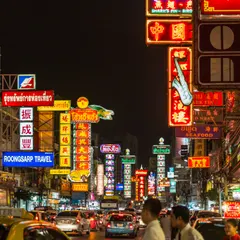
The temple is at the entrance to Chinatown, beside the gate at Odeon Circle, and on Charoen Krung stands Wat Mangkon Kamalawat, the largest Chinese Buddhist monastery in Thailand.
Two Buddhas: one with jasmine, one under tin
Ubosot and Luang Pho To
Summary of this stop
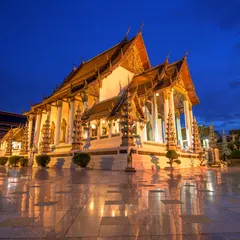
The route begins in front of the ubosot, the ordination hall raised in 1947 in an applied Thai style. Inside presides Phra Phuttha Thotsaphonlayan, a lacquered and gilded stucco Buddha that the neighbourhood’s people call Luang Pho To or Luang Pho Wat Sam Chin. It is the image to which devotees offer jasmine garlands to ask for favours, and that detail is enough to understand that this is not a museum of gold but a neighbours’ temple.
From this same compound came one of the most unusual episodes of its recent history. Phra Prommangkalachan, known as Chao Khun Thongchai and nicknamed “the magic monk”, was an assistant to the abbot when Vichai Srivaddhanaprabha, the Thai tycoon who owned Leicester City, invited him to England. As documented, he travelled at least ten times to the King Power stadium with other monks to bless the pitch and hand out amulets and sacred cloths “that don’t know how to lose”. In May 2016, while the club’s first Premier League title was being decided, he prayed for the team in the small hours, Bangkok time.
The most striking thing, however, is a few steps from here. When the statue arrived in 1935, the temple had no building able to house it, and the largest solid gold sculpture in the world spent twenty years under a simple tin roof beside the road, east of this ubosot. Where exactly it stood and why nobody suspected anything is what the narration locates on the ground.
Fragments of the disguise and the Buddha left over
Fragments of the original stucco
Summary of this stop
On the third floor of the mondop, the exhibition devoted to the statue preserves what for generations hid the gold: real pieces of the stucco layer, photographs taken as it was removed and a model that keeps one side still “disguised”. According to tradition, that thick layer, painted and studded with coloured glass, was applied before the Burmese razed Ayutthaya in 1767, so that nobody would want to steal the image.
The statue’s journey has little glory in it. Under the reign of Rama III (1824-1851), still wrapped in stucco, it was installed as the main image of the main hall of Wat Chotanaram, known as Wat Phraya Krai. When that temple was abandoned and the East Asiatic Company asked to lease its land, beside the river where Asiatique now stands, its two great Buddhas were shared out: the delegation from Wat Phai Ngoen arrived first and chose the bronze one. Wat Traimit got the stucco one, the one left over. Another version of the move exists, placing it during works on the banks of the Chao Phraya in the early 1930s, and the exhibition allows them to be compared.
Outside Thailand the find also circulates as a parable, in a version different from the historical one: a clay statue cracked by drought, some monks with a lantern and the gleam of gold beneath the mud. The meditation teacher Tara Brach, author of Trusting the Gold, uses it as a metaphor for the goodness each person covers with protective layers. How much of that tale is true and what has been added along the way is part of what the audio guide separates in this hall.
May 1955: the broken rope and the gold
Golden Buddha
Summary of this stop
The shrine hall on the upper floor holds the statue everyone comes to see. Its emergence into the light was an accident: on 25 May 1955, as it was being hoisted to take it to the new vihara built a year earlier, the ropes broke, the image fell hard to the ground and part of the stucco came away, revealing the gold. Work stopped immediately. The Thai press covered it as an event that many Buddhists considered miraculous. What happened next admits several accounts, and some have added mud, a storm and an abbot discovering the gleam at dawn.
The statue can also be read up close. It is cast in nine sections (head, torso, lap and three pieces per arm) that fit together as if they were one, although one source speaks of ten parts with a different division. When the stucco was removed, a key appeared at its base that allows it to be dismantled for transport.
The finest detail is invisible to the naked eye: the purity of the gold increases from bottom to top, from around 40% at the base to 80% in the face and 99.99% in the top finial, which weighs 45 kilos by itself. Why anyone would cast an image like this, ever purer toward the head, is one of the questions the narration raises in front of the Buddha.
From above, the temple of the three Chinese
Gallery over Yaowarat
Summary of this stop
The gallery surrounding the Buddha’s hall opens the view over the start of Yaowarat and the neighbourhood’s rooftops, and returns the gold to its context. The temple was first called Wat Sam Chin, “the temple of the three Chinese”, and oral memory attributes its foundation to three Chinese friends. On 3 February 1940 it took the name Wat Traimit Witthayaram, where “traimit” means “three friends”, after a restoration carried out together in 1939-1940 by merchants, neighbours, teachers and pupils. Inside the compound there then operated a school of Buddhist studies and the public school Traimit Witthayalai.
Below can be made out the pieces of that reconstruction: the monks’ residences of 1937 and the 1947 ubosot designed by Luang Wisansinlapakam, both awarded by the Association of Siamese Architects in 2011 for their conservation. The Phra Maha Mondop, inaugurated on 14 February 2010 with a design by Arvuth Ngoenchuklin, joins the two memories of the place: the Buddha at the top and, on the second floor, the Yaowarat Chinatown Heritage Center, devoted to the first Chinese immigrants to Siam.
For the neighbourhood’s people the statue is simply Luang Pho Thong Kham, the “venerable golden father”. Among enthusiasts of luck and the supernatural, the so-called sai mu, it is believed that venerating it makes money flow without fail throughout the year, and at Chinese New Year the temple fills with devotees who come to ask for fortune. A golden Buddha turned by popular belief into a magnet for more gold: with that paradox the audio route closes.