Royal Temple
Wat Pho Audio Guide (Wat Phra Chetuphon)
A 46-metre gilded Buddha so large that its house had to be built around it, four ceramic towers for four kings and 1,431 lessons carved in stone for anyone who cared to read them. This is the Temple of the Reclining Buddha, the living cradle of Thai massage.
- 60 min of audio
- 46 m Reclining Buddha
Wat Pho is older than Bangkok as a capital. It was called Wat Photaram and dated from the Ayutthaya period when Rama I, who in 1782 had moved the court to this bank of the Chao Phraya and built the Grand Palace beside it, ordered it rebuilt in 1788 on swampy ground that had to be drained and filled. In 1801 it was renamed Wat Phra Chetuphon, in memory of the Jetavana monastery, and decades later Rama III enlarged it to some 9 hectares and gave it almost all the buildings seen today, including the chapel of the Reclining Buddha.
The temple's greatest contrast lies not in its gilding but in its purpose. Under Rama III, some 50 people from the court and learned monks filled pavilions and galleries with inscriptions on medicine, history, literature and astrology, with the idea that knowledge should be open to all regardless of rank. From that encyclopedia in stone was born the school that now teaches massage at the eastern end of the compound, and which has trained more than 200,000 masseurs spread across 145 countries.
Highlights
- Reclining Buddha — 46 metres long and 15 high, of brick and plaster, lacquered and gilded throughout
- Soles of the feet — 108 mother-of-pearl panels with the auspicious signs of the Buddha and a chakra on each foot
- Phra Maha Chedi Si Rajakarn — Four chedis of 42 metres, one for each of the first Chakri kings
- 1,431 stone inscriptions — Inscribed by UNESCO in the Memory of the World register in 2011
- Massage school — The origin of more than 200,000 masseurs trained for 145 countries
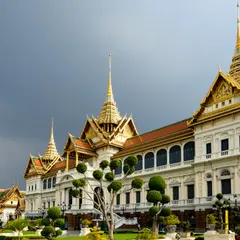
Beside the walls of the Grand Palace, the royal temple that Thais call Wat Phra Chetuphon and the rest of the world knows as Wat Pho, or the Temple of the Reclining Buddha, holds much more than its famous golden figure. The history of Wat Pho begins before Bangkok was a capital: the old Wat Photaram already existed in Ayutthaya times, and in 1788 Rama I had it rebuilt on swampy ground, in the shadow of his new palace. Half a century later, Rama III undertook a renovation of more than sixteen years that left standing almost everything that is visited today.
What came out of those works was more than a temple. Rama I had had some 1,200 Buddha images brought from abandoned temples in Ayutthaya, Sukhothai and elsewhere; Rama III added 1,431 stone inscriptions, written between 1831 and 1841, on religion, medicine, history, literature and astrology. UNESCO included them in its Memory of the World register, and from that engraved knowledge descends the school of traditional medicine and massage that still operates inside the compound. What to see at Wat Pho, then, runs from the golden giant to the four great ceramic chedis, from the cloister of identical Buddhas to the pavilions where massage is learned.
The temple also holds minor stories that say a lot about it: a pond where, around 1822, the British envoy John Crawfurd noted that the monks kept fish and a crocodile, today a garden with stone crocodiles reopened in late 2024; or Barack Obama’s visit in November 2012, barefoot beside Hillary Clinton before the Reclining Buddha, which ended with an electoral prophecy amid laughter. To read the architecture of Wat Pho with all its meaning, the audio guide covers the complex in five stops, in the order in which the temple lets itself be understood.
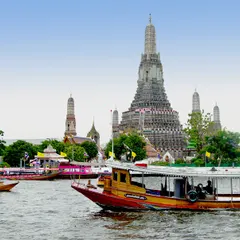
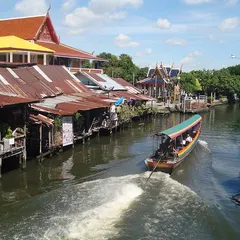
From the temple’s bank, across the Chao Phraya, Wat Arun can be seen. The jasmine garlands offered to Bangkok’s Buddhas come from Pak Khlong Talat, the neighbouring flower market, and on the Thonburi bank Khlong Bang Luang preserves the old course of the river.
A Buddha larger than his house
Reclining Buddha
Summary of this stop
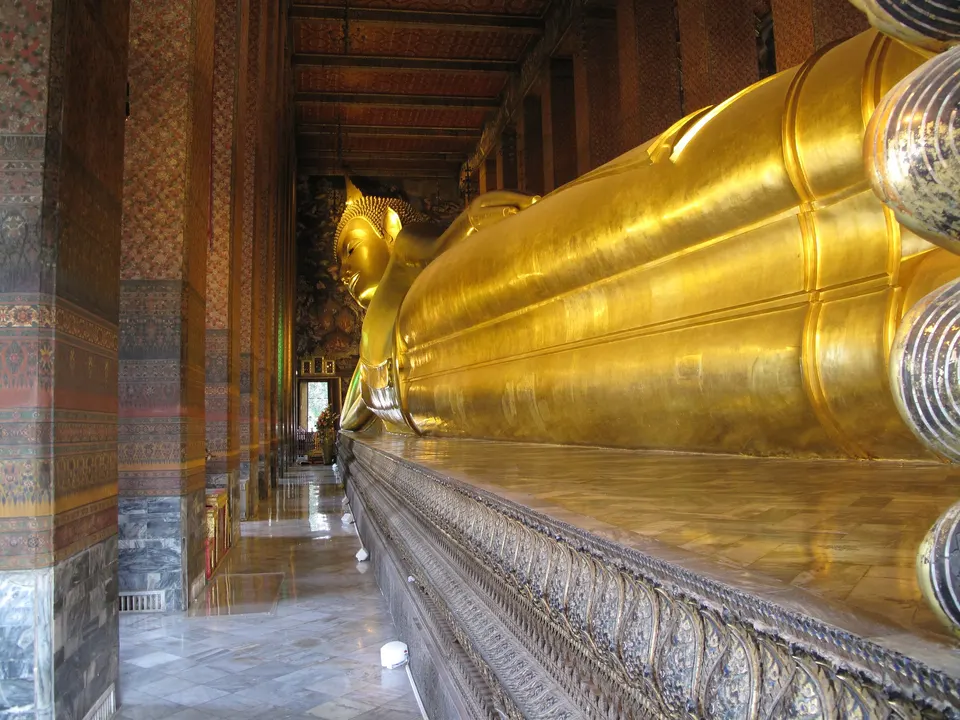
The first stop stands before the head of the Reclining Buddha, Phra Buddhasaiyas, and the first thing that imposes itself is the disproportion. The figure measures 46 metres long and 15 high, and fills almost the whole vihara that shelters it. It is no accident: under Rama III the statue was raised first and only afterwards the building that envelops it, so the house was built to the measure of its occupant. It is made of brick and plaster, lacquered and gilded from top to bottom.
The posture has its own name. It is the sihasaiyas, that of the resting lion: the Buddha lies on his right side, with his head propped on his arm and on two pillows inlaid with glass mosaic, and it represents his entry into Nirvana. It is usually presented as the largest Reclining Buddha in Thailand, although sources do not agree: others place it among the largest in the country or as the third longest.
Beneath that scale there is an older story. The temple was called Wat Photaram, hence the short form Wat Pho, and dates from the Ayutthaya period; its foundation is disputed, because one source attributes it to King Phetracha and others consider it unknown. What is documented is that part of its southern sector came to be occupied by a French star fort, which Phetracha ordered demolished after the siege of Bangkok in 1688. How that fort fits into the history of the golden giant is what the narration tells in front of it.
108 mother-of-pearl signs and ringing coins
Mother-of-pearl soles and bronze bowls
Summary of this stop
On reaching the feet, the route moves from scale to detail. The Buddha’s soles, about 3 metres high by 4.5 long according to the most cited measurement (other sources give different figures), are inlaid with mother-of-pearl and divided into 108 panels with the auspicious signs of the Buddha: flowers, dancers, white elephants, tigers. In the centre of each foot a chakra turns.
Behind the figure, the corridor of the vihara is flanked by 108 bronze bowls. Worshippers leave a coin in each and the chiming accompanies the whole walk; what is collected helps maintain the temple. The number is not repeated by chance, and its meaning is part of what is heard at this stop.
That relationship between devotion and upkeep reaches its peak each April, around Thai New Year. During the annual festival in homage to the Reclining Buddha, the esplanade in front of the vihara fills with sand chedis, worshippers stick gold leaf on the image of their birth day and Luang Pho Ong Dam, an image held sacred in the temple, is ritually bathed; each afternoon a group of monks is bathed as well. It is a documented tradition that serves, at the same time, to raise funds.
The green chedi that encloses Ayutthaya
Phra Maha Chedi Si Rajakarn
Summary of this stop
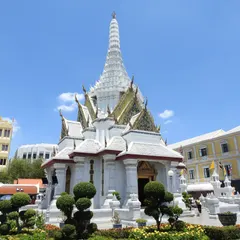
In an enclosed compound rise the four great chedis, Phra Maha Chedi Si Rajakarn, 42 metres each and covered in four-coloured ceramic. Each tower corresponds to one of the first four Chakri kings: the green is Rama I’s; the white, with the ashes of Rama II, and the yellow, dedicated to Rama III, were raised by the latter; the blue is Rama IV’s, who closed the compound with the four inside and no room for a fifth.
Rama I was the one who in 1788 ordered the old, ruined Wat Photaram rebuilt, and who in 1801 renamed it Wat Phra Chetuphon. His green chedi does not hold a treasure but a wound. Inside are the remains of Phra Phuttha Sanphet, the great bronze standing Buddha image of Wat Phra Si Sanphet, in Ayutthaya, destroyed by the Burmese in 1767. The king wanted to recast it, but the monks warned him that melting it would bring bad fortune to the kingdom, and he chose to enclose it.
As the story goes, the plunder had been brutal: after the fall of Ayutthaya, the Burmese are said to have set fire to the image to melt and strip off its gold covering, estimated at nearly two tonnes, and what remained was later broken when the vihara housing it collapsed. Those fragments are what travelled to Bangkok. What it meant for the new capital to keep them this way is the key the audio guide develops before the towers.
Four hundred identical Buddhas that are not
Phra Rabiang cloister
Summary of this stop
The double Phra Rabiang cloister surrounds the ubosot, the ordination hall, with some 400 golden Buddha images, seated and standing, lined up on identical pedestals. They look like a series, but they are not: they are part of the nearly 1,200 that Rama I had brought from abandoned temples, and they come from different periods, Chiang Saen, Sukhothai, U-Thong and Ayutthaya. The stucco and gold leaf that cover them make them equal to the eye.
That idea of equalising the different runs through the whole temple. Rama III’s great renovation, begun in 1832 according to some sources and in 1830 according to the epigraphic archives and the temple’s own website, lasted sixteen years and seven months, enlarged the compound to 56 rai and left built or rebuilt most of the present buildings. In the ubosot, beneath the pedestal of the golden Buddha Phra Buddha Theva Patimakorn, Rama IV placed ashes of Rama I, and the outer balustrade preserves some 150 stone reliefs of the Ramakien brought from Ayutthaya.
To that same period belong the 1,431 stone inscriptions spread across pavilions, viharas, the ordination hall and that of the Reclining Buddha. They were composed by some 50 people from the court and learned monks led by the abbot, the Supreme Patriarch Prince Paramanuchitchinorot, so that the temple would be a source of knowledge open to anyone. UNESCO inscribed them in the Memory of the World register in Manchester on 27 May 2011, although some sources date the recognition to 2008. Why a king wished to teach medicine on the walls of a temple is what this stop finishes revealing.
From stone hermits to massage
Massage pavilions
Summary of this stop
The last stop leads to the pavilions at the eastern end, but the way passes the rock mounds of the courtyard, the Khao Mor, where figures of hermits stretch and twist. In 1836 Rama III commissioned 80 figures in postures of Ruesi Dat Ton, the therapeutic gymnastics of the hermits, each with inscribed verses explaining which ailment it relieves. Far fewer survive, and even that is not undisputed: one source says they were cast in zinc and tin, with 24 postures preserved; another maintains they were made of stucco and counts 18 figures on two mounds.
The large Chinese stone figures that guard the gates and adorn the mounds arrived in part as ballast of the junks trading with China, and among them are four pairs of giants in European dress identified as Marco Polo. They are often confused with the true Yak Wat Pho, the red and green giants who guard the scripture library. A documented legend says that the yak of Wat Pho did not repay a loan to the one of Wat Arun, that the two fought until they flattened the river bank and that Shiva turned them to stone and left each on guard at his temple; from this would come the name of Tha Tian, the neighbouring pier, although other explanations point in another direction.
In the end, the encyclopedia in stone becomes practice. In 1955, or in 1957 according to other sources, a school of traditional medicine and massage was founded in the temple, teaching Thai pharmacy, medical practice, midwifery and massage, and has trained more than 200,000 masseurs present in 145 countries. Its classes and paid treatments are given in two pavilions of the compound, and Nuad Thai entered UNESCO’s Representative List of the Intangible Cultural Heritage in 2019. How that knowledge passed from the slabs to the hands is the closing of the audio route.