Historic Market
Pak Khlong Talat Flower Market Audio Guide
Before it smelled of jasmine, this bank of the Chao Phraya was a floating market and a fish wharf. Today it never closes, and its counters supply the garlands that end up in the hands of Bangkok's Buddhas.
- 30 min of audio
- Open 24 hours
Pak Khlong Talat means "the market at the mouth of the canal": it occupies Chak Phet Road and its neighbouring streets, beside the Chao Phraya and the southern end of the city's old moat. On the same site there have been, in succession, a floating market under Rama I, a great fish market under Rama V, a vegetable and fruit market and, finally, the wholesale flower market that now opens 24 hours a day.
The flowers arrive in the small hours from Nakhon Pathom, Samut Sakhon and Samut Songkhram, and the cool-climate ones from Chiang Mai and Chiang Rai. Jasmine is bought here by the sack to string offering garlands. For decades, a single metre of pavement had several owners who shared it by the hour, until in 2016 the city decided to clear the pavements.
Highlights
- Phuang malai workshops — Jasmine and marigold by the sack for the garlands offered at temples and cemeteries
- State market of 1953 — The first branch of the Markets Organization, at 26-28 Chak Phet Road
- Taphan Pla — The old fish wharf for the catch arriving from the Tha Chin River in the time of Rama V
- Yodpiman River Walk — An old warehouse and pier reopened in 2016 with a terrace over the Chao Phraya
- Memorial Bridge — The 1932 bridge that closes the market to the south, rebuilt in 1949
Few scenes explain Bangkok as well as the one repeated every small hour at Pak Khlong Talat. The name means “the market at the mouth of the canal”: the market sits beside the Chao Phraya, near the southern end of Khlong Khu Mueang Doem, the city’s old moat, and occupies Chak Phet Road and its adjacent streets as far as Memorial Bridge. It opens 24 hours, but its peak comes before dawn, when boats and trucks unload flowers from the provinces.
The history of Pak Khlong Talat is a stack of markets superimposed on the same site. During the reign of Rama I (1782–1809), the founder of Bangkok as a capital, trade here was conducted from boats, in a floating market. Then came the fish market known as “Taphan Pla”, the vegetable and fruit market and, finally, flowers. On the exact origin the sources do not agree: one places commercial activity already in the Thonburi period (1767–1782) and the Thai Wikipedia traces settlement in the area back to Ayutthaya. Nor is it clear where the figure repeated by the press comes from, according to which it would be the fourth largest flower market in the world and the third for orchids: nobody identifies the original ranking.
To understand what to see at Pak Khlong Talat it is not enough to stroll among roses and orchids. The architecture of Pak Khlong Talat is that of the shophouses of Chak Phet Road, that of the state market born of a 1953 decree and that of the old Yodpiman warehouse on the river, and each keeps a different era. The EarGuide audio guide covers those layers in four stops, from the scent of jasmine to the terrace over the Chao Phraya.
The garlands woven here end up on altars like those of Wat Pho, a few minutes’ walk away, and following the river east leads to Chinatown, the other great trading district of the bank.
Jasmine by the sack for the Buddha’s hands
Phuang malai workshops
Summary of this stop
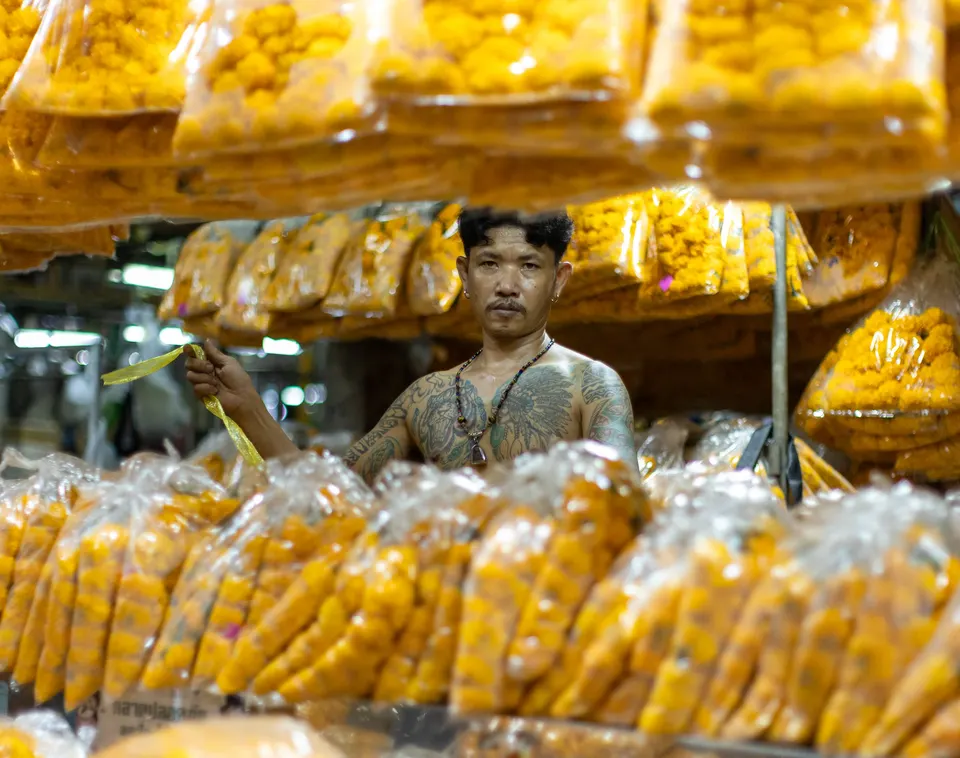
The route begins among the garland stalls of Chak Phet Road, a row of two- to four-storey shophouses with awnings and goods piled out to the street: roses, orchids, chrysanthemums and bundles of wholesale flowers. On the counters, jasmine, marigold and rose buds are strung by hand, next to heaps of jasmine and sacks of marigold in bulk. Most of those flowers travel from Nakhon Pathom, Samut Sakhon and Samut Songkhram; the cool-climate varieties come down from Chiang Mai or Chiang Rai, in the north of the country.
Those who buy here by the sack are the stringers of phuang malai, the offering garlands, often poor vendors of the city. One of them, the malai chai diao, is the one left as an offering and placed in the hands of statues in temples and cemeteries. A good part of the flowers that adorn Bangkok’s Buddhas begins its journey at these counters.
The calendar changes the market every 12 August, Mother’s Day in Thailand. Jasmine, a symbol of pure love, is the flower of mothers, and on the eve the crowd fills the stretch of Chak Phet Road as far as Maharaj Road. The bud is sold by the litre, like a liquid, and its price follows the harvest: in 2018 it cost 200–300 baht a litre and in 2019, with good flowering, barely 100. What happens to that price in a year of rain and cold is one of the details the narration keeps for this spot.
The fish wharf that ended up in flowers
State market of the Markets Organization
Summary of this stop
The second stop is at the gate of the state market, at 26-28 Chak Phet Road. Beneath the perfume lies another story: in the Rattanakosin era this place was a great fish market supplied directly from the Tha Chin River, in Samut Sakhon. Under Rama V (1868–1910) it was still a fish market and was known as “Taphan Pla”, the fish wharf.
The fish trade later moved to Hua Lamphong, and the old market was transformed into a market for farm produce, vegetables, fruit and fresh flowers, a function it keeps to this day. On 19 November 1953, under the government of Field Marshal Plaek Phibunsongkhram, a royal decree created the Markets Organization (Ongkan Talat) to bring order to the vendors crowding beside Wat Pho. Its first branch is precisely this public market, still centred on wholesale vegetables and fruit.
The specialisation in flowers was reinforced when Talat Thai, the great wholesale market on the outskirts of Bangkok, drew away the wholesale trade in vegetables and fruit. How a 1953 decree and a peripheral market ended up deciding what is sold on these streets today is the thread the audio guide follows in front of the gate.
Empty pavements after the 2016 eviction
Pavements of Chak Phet Road
Summary of this stop
Opposite the private Song Serm Kaset Thai market, across Chak Phet Road, the most eloquent thing is what is missing. These pavements were occupied by hundreds of street flower stalls until, from 29 February 2016, the Bangkok Metropolitan Administration cancelled the tolerated sales spots of 359 vendors and ordered another 809 who sold outside them to leave. The street stalls had to move inside the neighbouring markets, Song Serm Kaset Thai among them.
The figures of a marigold seller with more than 20 years in the market sum up the change: on the pavement she paid only 300 baht a month for cleaning and sold 24 hours a day; the move to Yodpiman meant 8,000 baht per square metre a month for eight hours of use a day. That same year, the outdoor stalls of Yodpiman could only sell from 18:00 to 06:00, while the indoor ones and those on the riverbank operated without closing.
The pavement also had its own logic, a documented local custom: a single stall could have several owners who shared out the clock. Narong Plong-uan, representative of the vendors of Yodpiman and Pak Khlong Talat, explained it in February 2016 with an example: in the morning jasmine was sold, in the afternoon marigold and at night roses. What it meant for those vendors to lose a space that was shared in shifts is told in the narration, on the cleared pavement.
Yodpiman, the old warehouse returning to the river
Yodpiman River Walk
Summary of this stop
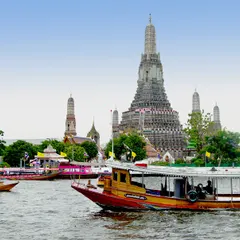
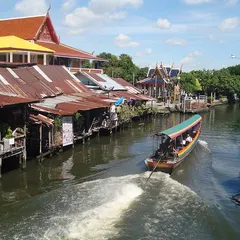
The route ends behind the market, at Yodpiman River Walk, a three-storey colonial-style building that for 50–60 years was a warehouse and old pier. From 1961 it was part of the flower market and in early 2016 it reopened refurbished as a riverside shopping promenade, with flowers on the ground floor and its own Chao Phraya Express Boat pier (N6/1), heir to the port through which goods arrived by water. From the terrace, on the Thonburi bank, can be seen the Santa Cruz Church, Wat Kalayanamitr, Wichai Prasit fort and the prang of Wat Arun.
It is the place where it all began. Under Rama I trade was conducted here from boats, and it was flower growers from the Thonburi bank, who crossed the river by boat and sold their local flowers on the pavement, who were the first to turn the old fish market into a flower market; later came orchids and imported flowers. The date of that shift is not settled. One historian placed it in 2016 “60 years ago”, in the mid-1950s; the Yodpiman building has been part of the flower market since 1961, and another source links it to the later rise of the wholesaler Talat Thai.
At the southern end of the market stretches Memorial Bridge (Saphan Phut), inaugurated on 6 April 1932 by King Prajadhipok (Rama VII) to commemorate the 150th anniversary of the Chakri dynasty and of the founding of Bangkok. Its history has a dark chapter, disputed in its details: according to accounts of the Second World War, on 5 June 1944 United States B-29 bombers began their combat missions over Bangkok, with the Makkasan railway workshops as the target and bad weather as the enemy. The bridge, attacked several times during the war, ended up disabled by the Allies and was not rebuilt until 1949. What happened to the bombs that missed their target is the last twist of the audio route.