Chinese Mahayana Temple
Wat Mangkon Kamalawat Audio Guide (Leng Noei Yi)
Among the shops of Charoen Krung opens the head of a dragon: the largest Chinese Buddhist monastery in Thailand, from where the Chinese of Siam negotiated their faith, their power and their luck with the Thai kings.
- 25 min of audio
- Teochew architecture
Wat Mangkon Kamalawat was born in 1871 as Wat Leng Noei Yi, "temple of the dragon and the lotus" in Teochew, when the Chan monk Sok Heng, who had come from China, no longer fitted with his disciples in his first temple in Yaowarat. The work, commissioned under Rama V from the senior official Phraya Chodukratchasetthi, lasted about eight years and followed the plan of a Teochew palace: walled compound, north-south axis, halls in hierarchy and courtyards. When finished it was the largest monastery of the Chinese sect in the country and the seat of the Chinese Buddhist clergy of Thailand.
The temple is Teochew in architecture, but for almost seventy years it was governed by Hakka monks, starting with the founder himself, born in Jiaying. That inheritance went through the exclusion of the Chinese clergy from royal ceremonies, one abbot's return to China and another's departure for Hong Kong in the midst of Phibun's anti-Chinese policy. Only in 1948, with the Teochew abbot Chang Yi, did Chinese Buddhism in Thailand pass into Teochew hands, where it has remained since.
Highlights
- Hall of the Four Heavenly Kings — Guardians in Chinese armour holding a lute, a sword, an umbrella and a pagoda
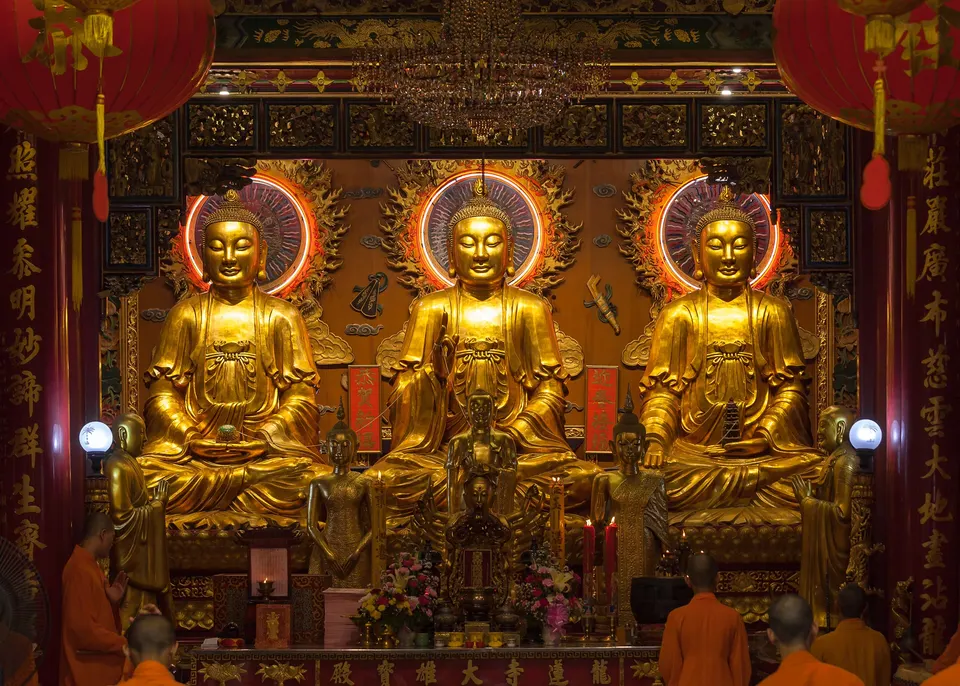
- Ubosot triad — Sakyamuni, Amitabha and the Medicine Buddha, escorted by 18 arhats
- 58 deities — Buddhist, Taoist and Confucian, with Tai Sui and Cai Shen at the head of the petitions
- Deposit of destiny — The little red book the temple keeps for a year before burning it
- Sok Heng pavilion — The Chan monk who came from China and founded the temple in 1871
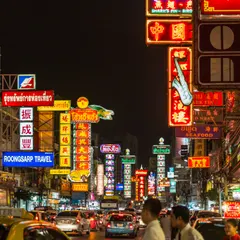
Charoen Krung is one of the busiest commercial streets in Bangkok, and amid its traffic of shops and stalls opens a red gateway with couplets in Chinese characters. Behind it is Wat Mangkon Kamalawat, the city’s great Chinese Mahayana Buddhist monastery, built from 1871 by the monk Sok Heng and made the administrative seat of the Chinese Buddhist clergy of Thailand. Most sources agree on that date, Buddhist year 2414; some encyclopedic entries instead attribute the foundation to Rama III, with completion in 1846, a claim hard to square with the founder’s own arrival.
The history of Wat Mangkon Kamalawat is that of a community that had to make a place for itself in Siam: a homeless monk who receives a royal title, a temple that disputes the colour of robes, abbots who leave in anti-Chinese times and a devotion that still fills its altars with smoke today. Understanding what to see at Wat Mangkon Kamalawat means reading its architecture as a Teochew palace on an axis, from the hall of the guardians to the founder’s pavilion, and that is the route the audio guide follows stop by stop.
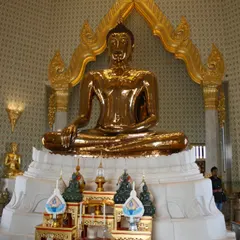
The temple is one of the great stops of Chinatown, and a short distance away, at the entrance to the district, Wat Traimit keeps the largest solid gold Buddha in the world.
A dragon peering out onto Charoen Krung
Wat Mangkon Kamalawat
Summary of this stop
The visit begins in front of the gateway, where the street noise collides with a Chinese-style door flanked by parallel couplets and the name of the temple. That name is already a programme: “Leng Noei Yi” means “temple of the dragon and the lotus” in Teochew, and the official Thai name, Wat Mangkon Kamalawat, translates the same idea. The Thai Wikipedia dates its granting to 16 February 1912 and attributes it to Vajiravudh (Rama VI), although several sources assign it to his father, Chulalongkorn.
The dragon is not just a word. According to the tradition of the three dragon temples, Leng Noei Yi is the “head” of a route that continues at Leng Hok Yi, the “belly”, in Chachoengsao, and Leng Hua Yi, the “tail”, in Chanthaburi; hence its façade faces the Chao Phraya River, as the feng shui of a dragon’s head requires. An academic study, however, places the temple in the belly position, and the debate remains open.
The animal reappears underground. Since 2019 the Wat Mangkon station of the MRT Blue Line has borne the temple’s name, with red columns, golden dragons on the ceiling and a descending staircase that imitates a dragon’s belly. How the street, the river and the metro fit into that symbolic body is what the narration reveals right there.
Four warrior kings for a homeless monk
Hall of the Four Heavenly Kings
Summary of this stop
Once through the gateway, the north-south axis leads to the first hall, that of the Four Heavenly Kings, the “Si Tai Thian Ong”. They are four great guardians in Chinese warrior armour, two on each side, and each holds his attribute: a pipa lute, a sword, an umbrella and a pagoda. They guard the four cardinal points and mark the threshold between the street and the sacred space.
This hall is the first step of a plan that follows five principles of Teochew architecture: walled compound, north-south axis, hierarchy of halls along the axis, symmetry and courtyards. The sequence, in wood and brick, advances from the guardians to the ubosot at the centre and to the hall of deities at the back, beneath curved roofs topped with dragons and floral motifs.
Behind this palace stands a monk who arrived with nothing. Sok Heng, of the Chan (Zen) school of the Linji branch, landed from China before 1871 and lodged in an abandoned Guan Yin shrine in Yaowarat, the Yong Hok Am. When his monks no longer fitted there, he undertook in 1871 a work that lasted about eight years. The leap from that refuge to this monumental axis is told in detail in front of the guardians.
Robes in dispute beneath three golden Buddhas
Buddha triad of the ubosot
Summary of this stop
At the centre of the axis rises the ubosot, the ordination hall. Three golden Buddhas reign there, the “Sam Po Hut Cho” in Teochew: Sakyamuni, Amitabha and Bhaisajyaguru, the Medicine Buddha, accompanied by 18 arhats and with an altar in front where the rites are held.
This hall also holds a paradox. Though a Mahayana monastery, in the time of its first two heads it celebrated the kathin, the robe offering characteristic of Thai Theravada Buddhism. The rite was interrupted for some 40 years and since 1956 Thai and Chinese worshippers have organised it together each year.
The robe also served as a frontier. According to a documented tradition, in 1928 the abbot of Leng Noei Yi asked the government of Siam that no Chinese monk outside his branch be allowed to wear yellow, and a rumour spread that the others would have to swap their robes for black ones. The authorities rejected the request, but the episode portrays a struggle over the prestige and donations of the Chinese community, whose background the audio guide reconstructs before the three Buddhas.
A little red book against the year of clash
Tai Sui altar
Summary of this stop
In the side chapels candles, offerings and worshippers are concentrated. The temple houses 58 Buddhist, Taoist and Confucian deities, and two of them draw most people: Tai Sui, lord of the annual destiny, and Cai Shen, god of fortune. Each year those born in a “pi chong” year, in clash with the zodiac sign of the year, come here to ward off bad luck.
The central gesture is the “po ung”, the deposit of destiny, a documented tradition. The worshipper writes their name, age and date and hour of birth in a little red book, recites the prayer printed on the middle page and, with the book closed, sweeps their body twelve times from head to foot before leaving it on the red shelf at the back. The temple keeps it for a year while the monks pray for its owner, and when the cycle closes it burns all the slips in a rite of thanksgiving.
The custom is centuries old among the Chinese of Thailand, from when a fortune-teller calculated the worshipper’s birth date at the start of each year. The label “kae chong” that the signs now advertise, on the other hand, came much later, in the last decades of the twentieth century, from Hong Kong. How the ritual is lived at the altar, and what is left behind with each sweep, is what the narration tells in that corner.
Sok Heng and the legacy of a Hakka founder
Sok Heng pavilion
Summary of this stop
At the back of the compound, three small pavilions close the axis: one for Guan Yin, the bodhisattva of compassion, another for the saint Lak Chao and another for the founder. Nearby, display cases show golden Buddhas with both hands raised in a double Abhaya mudra. The Sok Heng pavilion commemorates the monk to whom King Chulalongkorn granted the title of Phra Archan Chin Wangsa Samathiwat and whom he named first supreme head of the Chinese Buddhist clergy, the Chin Nikai, of Siam.
Sok Heng came from Jiaying, present-day Meizhou, Hakka land, and died in 1888; he was succeeded by his Hakka disciple Guo Wu. From the 1920s came the decline: the Chinese clergy was left out of royal ceremonies, the third head, Lu Qing, returned to China in 1932, and his disciple Fu Ren governed as interim abbot without royal recognition until leaving for Hong Kong in 1942, with the royal subsidy suspended and donations sunk under Phibun’s anti-Chinese policy. The turn came in 1948 with the Teochew abbot Chang Yi.
Despite its size, the temple is not the oldest Chinese Mahayana shrine in Yaowarat: Wat Bamphen Chin Phrot, of 1795, is earlier, and Sok Heng himself restored it. How a temple like this became the headquarters of an entire community is the closing the audio guide reserves for this pavilion.