Royal Temple
Wat Suthat and the Giant Swing Audio Guide (Sao Ching Cha)
A 21-metre red gateway with no swing, the Brahmins' shrine across the street and, behind the wall, an eight-metre bronze Buddha brought from Sukhothai. In this Bangkok square, Buddhism and Brahmanism never quite came apart.
- 40 min of audio
- Buddhism and Brahmanism
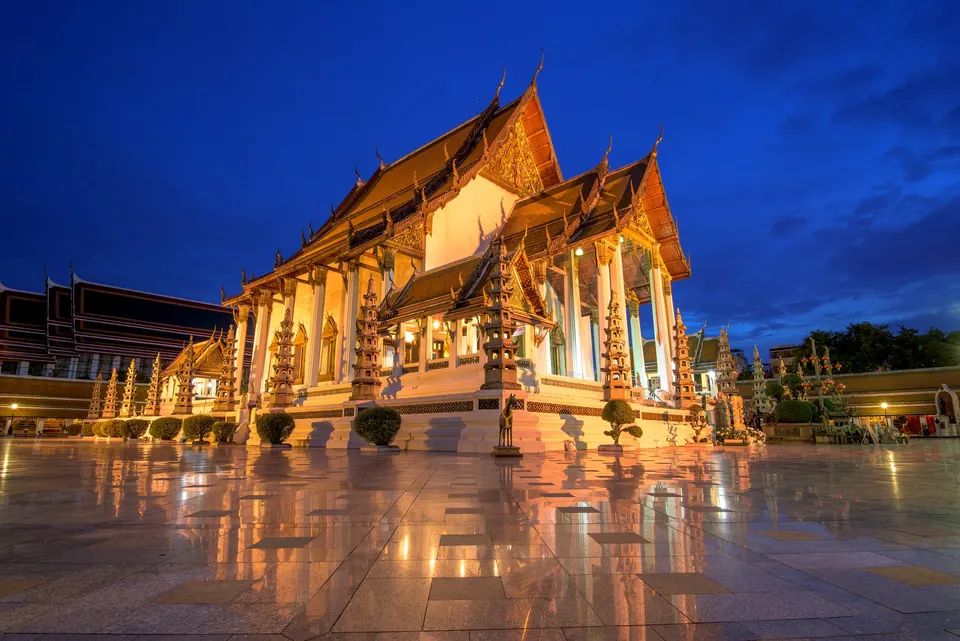
Wat Suthat is a first-class royal temple that King Rama I began in 1807 and that was not finished until the reign of Rama III, in 1847 or 1848. During those four decades of work the neighbourhood called it Wat Phra To, Wat Phra Yai or, quite simply, Wat Sao Ching Cha, "the temple of the swing", after the gateway rising in front: the Giant Swing, raised in 1784 before the Brahmin shrine of Devasathan, barely two years after Bangkok became the capital.
From 1784 until the 1930s, at the Brahmin New Year, men with serpent headdresses flew between those posts to snatch with their teeth a bag of coins hung at the top. Nobody has swung on it since, and the original timbers rest in the National Museum, but the rite has not disappeared: every year-end, a few steps away, the court Brahmins still rock their gods.
Highlights
- Giant Swing — A red teak gateway of 21.15 m on a circular base, raised by Rama I in 1784
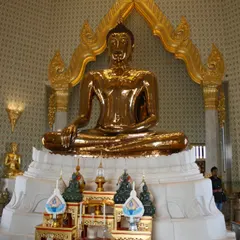
- Phra Si Sakyamuni — A bronze Buddha of about 8 m, cast in the fourteenth-fifteenth centuries and brought from Sukhothai
- Doors of the wihan — Teak leaves of 5.5 m carved in deep relief, attributed to Rama II
- Devasathan shrine — Chapels to Shiva, Brahma, Ganesha and Vishnu where the swing rite lives on
- Chinese stone statues — They arrived in Bangkok as ballast on ships returning from China
In the heart of Bangkok’s old town there is a square where two religions coexist without a wall to separate them. On one side, the Giant Swing (Sao Ching Cha), a gateway of red-painted teak 21.15 metres high that King Rama I had raised in 1784 before the Brahmin shrine of Devasathan. On the other, Wat Suthat, a first-class royal temple begun in 1807 and completed under Rama III around 1847 or 1848 to house a bronze Buddha of about eight metres brought from Sukhothai.
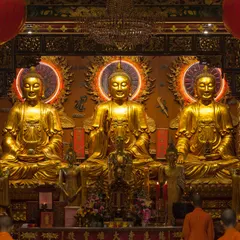
The history of Wat Suthat and the Giant Swing is that of a newly founded capital that wanted to bring together at one point the court’s Brahmin rite and the kingdom’s Buddhism. The figures of the complex give the measure: 28 small Chinese-style pagodas on the terrace surrounding the wihan, 156 seated golden Buddhas in a row in the cloister and an ubosot from the time of Rama III, finished around 1843, considered the longest ordination hall in Thailand. Alongside runs Bamrung Mueang, the second paved street in Bangkok, opened in 1863 and unofficially known as “the Giant Swing street”, where the shops selling articles for monks now line up. And one afternoon a year, almost always in early March, the setting sun is wedged exactly between the two posts; in 2025 it happened on 6 March, and the scene has become an appointment for the city’s photographers.
Knowing what to see at Wat Suthat and the Giant Swing and how to read the architecture of Wat Suthat and the Giant Swing requires crossing the square, entering the temple courtyard and reaching the great Buddha. The EarGuide audio guide covers that itinerary in four stops and about 40 minutes.
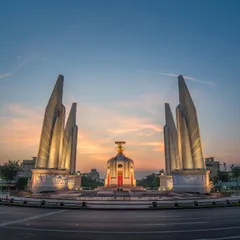
A few streets away wait Wat Saket and the Golden Mount and the Democracy Monument, and to the west, the City Pillar Shrine, where Bangkok’s founding pillar was driven in.
Two red mountains for a Brahmin rite
Giant Swing
Summary of this stop
The first stop stands on the circular base of the swing, a platform of about 10.5 metres in diameter. What from afar looks like a monumental arch turns out to be the stage of the Triyampawai ceremony, which marked the Brahmin New Year of the Thai lunar calendar. The rite required three swing boards and twelve officiants, the naliwan, who launched themselves through the air to catch a bag of coins placed at the top of one of the pillars, while a high dignitary, the Phraya Yuen Chingcha, embodied the god Shiva and presided over the festival.
Behind the acrobatics lay a myth that tradition documents in detail. When Brahma finished creating the world, Shiva came down to check whether it was firm: he set one foot on the earth and ordered the nagas, the mythical serpents, to shake the mountains on both sides of the ocean. Shiva did not fall, and so it was proved that the earth was stable. According to that symbolism, the two posts are the mountains and the round base, the earth and the seas; the naliwan wore naga headdresses, tried to snatch the bag with their teeth and, when finished, danced sprinkling holy water with animal horns.
The origin of all this is, however, an enigma. The chronicles maintain that Brahmins who came from India brought the custom, but no similar festival is known in India, and historians still debate whether it is a local tradition grafted onto the Hindu rite. The other version of the myth, that of the naga king who swings between two trees over a river, is reserved for the narration at this very spot.
An empty swing and a rite that goes on
Gates of the Devasathan shrine
Summary of this stop
At the edge of the square, facing the gates of Devasathan, what weighs most is the absence: the gateway has no board or ropes. The ceremony was last held around 1934 or 1935, under Rama VII, and since then nobody has swung on it. The sources do not agree on the reason: some speak of fatal accidents; others, of the cost of the rite and the changes that followed the revolution of 1932.
The posts are not the original ones either. In 1947 they burned when embers from the incense of devotees fell into the cracks of the wood and caught fire. The present ones, of teak brought from Phrae province, were consecrated between 11 and 13 September 2007, after the old ones were removed in 2006, which explains why some sources give one date and others the other. The timbers of the original swing are kept in the National Museum of Bangkok.
Across the street, among chapels dedicated to Shiva, Brahma, Ganesha and Vishnu, the rite lives on. Every year, between late December and early January, the court Brahmins hold the Triyampawai-Tripawai for fifteen days: they recite Tamil hymns and, to bid farewell to the gods, mount them on a golden hamsa, a mythical swan, and rock it while they sing. How a ceremony that seems unchanging has added in recent decades a new farewell, and to whom it is dedicated, is what the audio guide tells in front of those gates.
Doors carved by a king, statues of ballast
Carved doors of the wihan
Summary of this stop
After crossing the wall, the courtyard opens before the wihan, the great main hall of Wat Suthat. The temple’s construction spanned three reigns: Rama I began it in 1807 and it was not considered finished until 1847 or 1848, under Rama III. Throughout that time the red gateway of the square was the neighbourhood’s landmark, and that is why people called the temple Wat Sao Ching Cha, “the temple of the swing”, as well as Wat Phra To or Wat Phra Yai.
The façade holds an uncommon piece: the teak doors of the wihan, 5.5 metres high, 1.5 wide and 15 centimetres thick, carved in deep relief and attributed to the hand of King Rama II himself. One of the original leaves is today in the National Museum.
Scattered around the courtyard appear Chinese-style stone figures that tell another story: they arrived as ballast on ships returning from China after carrying Siam’s exports there. The wood carved by a monarch and the stone that balanced the holds sum up in a few metres the two engines of the Bangkok of the time, the court and trade, a contrast the narration develops in this courtyard.
A Buddha from Sukhothai and a painted ghost
Phra Si Sakyamuni
Summary of this stop
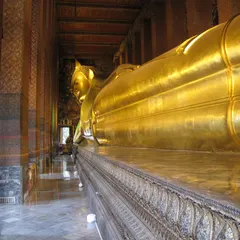
Inside the wihan, the gaze rises along Phra Si Sakyamuni, a seated gilded bronze Buddha of about eight metres cast between the fourteenth and fifteenth centuries in Sukhothai, the old capital, and moved to Bangkok by Rama I. Behind the image a gilded limestone relief in Dvaravati style is preserved.
At the base, a decorative cloth has held since 1950 the ashes of King Ananda Mahidol, Rama VIII. Every 9 June a ceremony in his memory is held there, which makes the hall not only a place of worship but also a place of memory of the monarchy.
The temple also has its ghost. Tales circulate by word of mouth of a preta, one of those very tall, famished spirits of Thai Buddhism who never satisfy their hunger, seen at night in front of the temple. The legend refers to a painting from the time of Rama III on a pillar of the wihan, beside the great Buddha, where a preta lies stretched out while ten monks in a row pour water from their bowls into his mouth. What could actually be seen in the half-light of dawn is the last surprise of the route, and the audio guide keeps it for this point.