Royal Palace
Grand Palace and Wat Phra Kaew Audio Guide
Bangkok was born in 1782 inside these white walls, around a 66-centimetre green Buddha brought back as war booty. More than two centuries later, the king still changes its golden robes with each season.
- 120 min of audio
- Royal chapel and palace
The Grand Palace of Bangkok is the city's founding charter turned into architecture. Rama I, the first king of the Chakri dynasty, ordered work to begin on 6 May 1782, when he moved the capital from Thonburi to the eastern bank of the Chao Phraya. A year later he began Wat Phra Kaew, the Temple of the Emerald Buddha, inside the compound: a royal chapel with no monks, only a worship area, built to house the most venerated image in Thailand. The court and government lived here until 1925, and the last coronation held within these walls was that of Rama X, on 4 May 2019.
The gold dazzles so much that it is hard to see what it hides. The compound occupies the land of a Chinese quarter that Rama I moved outside the walls; the first palace was made of wood, behind a palisade of logs; and the figure that justifies the whole complex is not an emerald but a green stone, described as jade or jasper, that has never been analysed. It arrived from Vientiane after the sack of 1779 and wears one of its three sets of golden robes according to the time of year.
Highlights
- Emerald Buddha — An image of about 66 cm in green stone, with three sets of golden robes changed in a ceremony three times a year
- Ramakien murals — 178 continuous panels running along all four sides of the cloister gallery
- Guardian yakshas — Twelve giants of about 5 m guard six gates of the temple
- Phra Si Rattana Chedi — A gilded bell-shaped stupa from 1855, modelled on those of Ayutthaya
- Chakri Maha Prasat — A throne hall of 1876-1882 with a European body and Thai roofs
Few capitals can point to the exact place and day on which they began. Bangkok can: on 6 May 1782, King Phutthayotfa Chulalok, Rama I, ordered a palace built on the eastern bank of the Chao Phraya and with it founded the Chakri dynasty, which still reigns. That first palace was made of wood and enclosed by a palisade of logs. Today it is enclosed by some 1.9 kilometres of white wall, with 12 gates and 17 forts, around roughly 218,400 square metres of throne halls, pavilions and shrines. According to the sources, the wall measures 1,910 or 1,900 metres, and some popular works even date the start of the complex to 1792, although the great majority keep 1782.
Inside the compound, in 1783, Rama I began Wat Phra Kaew, the Temple of the Emerald Buddha, whose official name is Wat Phra Si Rattana Satsadaram. It is not a monastery but a royal chapel without monks, built for the green stone image of about 66 centimetres that General Chao Phraya Chakri, the future Rama I, had taken from Vientiane. The history of the Grand Palace and Wat Phra Kaew is that of a dynasty legitimised by an evicted neighbourhood, war booty and a Buddha whose clothes are changed with each season. To understand what to see at the Grand Palace and Wat Phra Kaew and how to read its architecture, from the giants of the Ramakien to the Thai roofs over a European hall, the route advances in five stops; the EarGuide audio guide accompanies it for two hours.
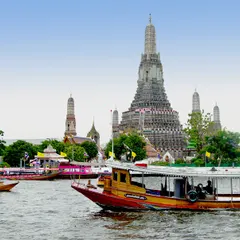
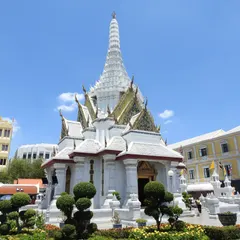
The city’s history actually begins a few steps away, at the City Pillar Shrine, and the Emerald Buddha once had its home across the river, at Wat Arun.
A citadel on an evicted Chinese quarter
White walls and bastions
Summary of this stop
The route begins in front of the white, crenellated walls, with their bastions at regular intervals. Their look of an eternal fortress is deceptive: in 1782 there was no brick here, only a wooden palace behind a palisade of logs. The brick, the 12 gates and the 17 forts came later, as the new capital settled in.
Nor was the ground empty. Phraya Ratcha Setthi and the Chinese community lived on this land, and Rama I moved them outside the walls, to the area now occupied by Bangkok’s Chinatown. The royal citadel was therefore born of an eviction, and that forced move is the origin of the location of today’s Chinatown.
Under these same walls an unexpected find came to light much later. In 2022, during maintenance work on the roadways, the Royal Household Bureau unearthed about a hundred stone statues that had lain in the mud for around a century. They were the ballast of the junks that traded with China at the start of the Rattanakosin era. Why carved figures ended up discarded as dead weight, and where they can be seen today, is what the narration tells at the foot of the wall.
Five-metre giants for a temple without monks
Ramakien mural gallery
Summary of this stop
The entrance to the temple is a blow of scale. Twelve yakshas, giants from the Ramakien epic of about 5 metres each, guard six of its gates, each one a different colour. Among them stand out Thotsakan, green and with two tiers of heads above his crown, and Sahatsadecha, white and with multiple heads.
Behind them unfolds the cloister gallery that surrounds the temple, covered by the Ramakien murals in 178 continuous panels on all four sides. The epic seems never to end. They were commissioned by Rama I, but what can be seen today is something else: Rama III had them erased and repainted entirely.
All this display surrounds an atypical temple. Wat Phra Kaew houses no monks: it has only a worship area (phutthawat) and lacks a monastic area (sangkhawat), so it works as the king’s chapel. How the painted story is ordered along the gallery and which scenes are worth looking for among the panels is gradually unpacked in the audio while walking the cloister.
The gilded stupa that longs for Ayutthaya
Phra Si Rattana Chedi
Summary of this stop
On the upper terrace, north of the ordination hall, rises the Phra Si Rattana Chedi, a large gilded bell-shaped stupa. Rama IV (Mongkut) had it built in 1855 to keep relics of the Buddha, and its design takes as its model the stupas of Wat Phra Si Sanphet, in Ayutthaya, the old capital razed to the ground. It is, in a way, a quotation in gold of the lost city.
The terrace brings together other notable pieces: the Phra Mondop, the single-room library whose floor is covered with a woven silver mat, which keeps the Tripitaka and is viewed from outside; a detailed model of Angkor Wat commissioned under Rama IV; and the Prasat Phra Thep Bidon, the Royal Pantheon with the statues of the Chakri kings, which opens to the public only on 6 April each year, Chakri Day.
Rama IV also left a less visible mark here. During the cholera epidemic of 1820 the Emerald Buddha was believed to hold the “nana”, the knowledge capable of eradicating disease, and in times of plague the image was taken out in procession. Mongkut put an end to those outings: he feared the figure would be damaged and held that illnesses are caused by germs, not by evil spirits. How an enlightened king who builds reliquaries can also believe in microbes is the thread the narration follows at this stop.
The Emerald Buddha that is not an emerald
Ubosot of the Emerald Buddha
Summary of this stop
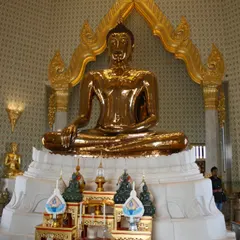
The staircase of the ubosot, flanked by twelve bronze lions, leads to a rectangular single-storey ordination hall, entered from the east, surrounded by 48 square columns with twelve corners and with hundreds of little golden bells on the eaves. Inside, high on a golden altar, is the Emerald Buddha. The first surprise is its size: about 66 centimetres. The second is that it is not an emerald but a semi-precious green stone, described as jade or jasper, whose composition and origin have never been analysed. Some art historians place it in the Chiang Saen style of the fifteenth century; its meditative posture has led others to propose an origin in southern India or Sri Lanka.
Its documented trail begins in the kingdom of Lan Na in 1434 and continues through Chiang Mai in 1468, Luang Prabang in 1552 and Vientiane in 1564. In 1779, according to the most widespread version, the Siamese general Chao Phraya Chakri sacked Vientiane and took the image to Thonburi, where it was installed beside Wat Arun; other sources attribute the capture to Taksin, as ruler of Thonburi, and date it to 1778. Nor is there agreement on the day it was enthroned here: the chronicles and later studies range between March 1784 and February 1785.
The figure has three sets of golden robes, two from the time of Rama I, for the summer and the rainy season, and one from Rama III for the cool season. The king, or a senior member of the royal family in his place, changes them in a ceremony three times a year, and when it ends, by tradition, sprinkles the leftover sacred water over the crowd. Legend has it that the image appeared in 1434 inside a chedi in Chiang Rai split by lightning, disguised under a layer of stucco, and that an elephant determined to take the road to Lampang kept it in Lampang for some 32 years. What gave away that plaster Buddha is left for the narration in front of the altar.
Thai roofs over a European hall
Chakri Maha Prasat
Summary of this stop
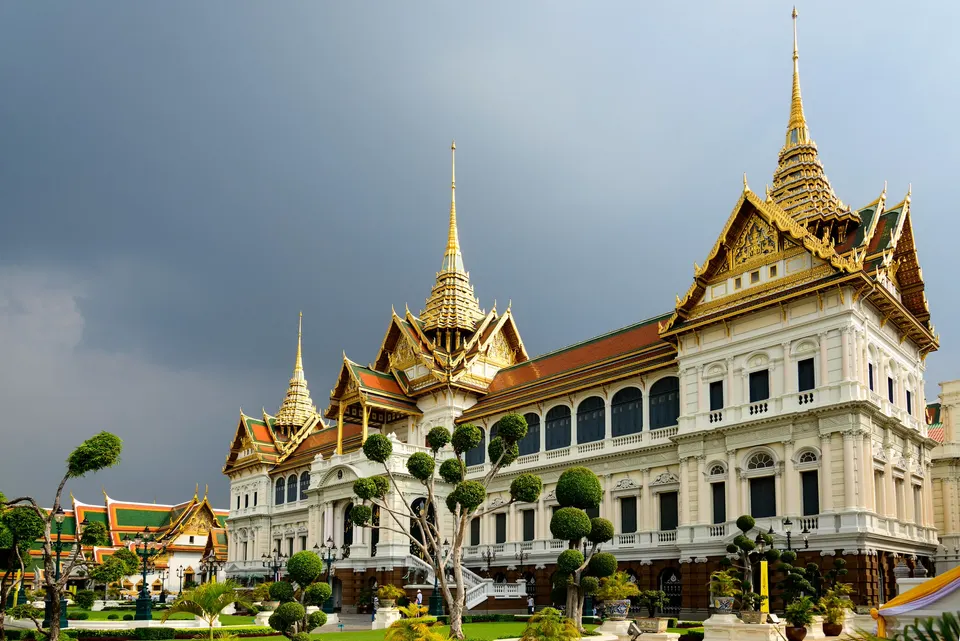
The route ends in the courtyard of the throne halls, now in the palace proper. The façade of the Chakri Maha Prasat sums up a negotiation: the body, designed by the Englishman John Clunich, is European in style, but it is crowned by Thai roofs with three golden spires. Rama V (Chulalongkorn) wanted it entirely European, with domes; Prime Minister Chao Phraya Si Suriyawongse insisted until the spires prevailed. Work began on 7 May 1876 and was finished in 1882, the dynasty’s centenary.
Nearby rises the Dusit Maha Prasat, cruciform in plan with a tall spire, which takes the place of a vanished hall. In 1789 lightning set fire to the Amarinthara Pisek Maha Prasat and reduced it to ashes; in its place the Dusit Maha Prasat and the Phiman Rattaya were built. Rama I’s mother-of-pearl throne survived the fire and is kept today in the Dusit, where the principal members of the royal family also lie in state.
The palace is not a backdrop of the past. Rama I held his full coronation here in 1785, when the ceremonial halls were finished, and the last was that of Rama X, on 4 May 2019. To the south lay the Inner Court, reserved for the women of the royal harem, which came to have close to 3,000 inhabitants and kept a regiment of female guards in order. What that city within the city reveals about how the court worked is what the audio guide saves for the end of the route.