Historic Monument
Democracy Monument Audio Guide (Anusawari Prachathipatai)
A traffic roundabout in the middle of Bangkok holds, encoded in metres and cannons, the date of the 1932 revolution. A military regime built it, and it ended up as the stage for Thailand's great protests.
- 20 min of audio
- 1940 Art Deco
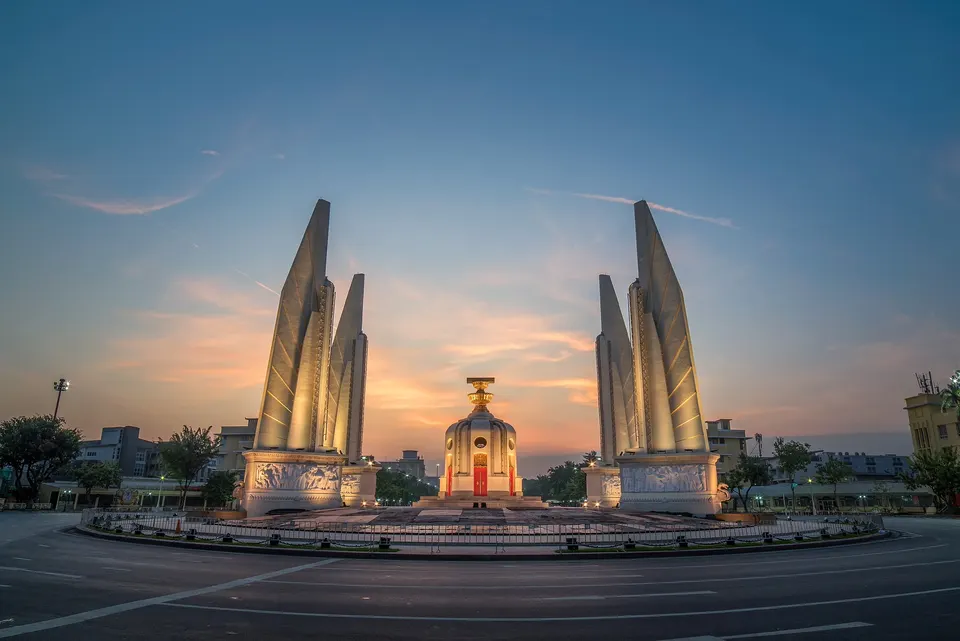
The Democracy Monument stands on the roundabout where Ratchadamnoen Klang Avenue crosses Din So Road. Field Marshal Plaek Phibunsongkhram commissioned it in 1939 to commemorate the revolution of 24 June 1932: the first stone was laid on 24 June 1939 and the inauguration came exactly a year later. The ambition was to turn Ratchadamnoen into Bangkok's Champs-Élysées and this white ensemble of four Art Deco wings into its Arc de Triomphe.
Almost nothing in it is accidental. The wings measure 24 metres, just like the radius of the base, for 24 June; the Constitution at the top measures 3 metres for June, the third month of the calendar of the time, and the fence is made of 75 old cannons for the Buddhist year 2475. The monument that a de facto military regime conceived as a tribute to itself later became the gathering point of the crowds of 1973 and 1992.
Highlights
- Four 24-metre wings — Their height and the radius of the base encode 24 June 1932
- Fence of 75 cannons — Muzzles buried and an iron chain, for the Buddhist year 2475
- Constitution at the top — A book on the phan waen fa tray, cast in copper: 3 m and 4 tonnes
- Reliefs by Silpa Bhirasri — Soldiers, people and nation, with the only woman in the whole monument
- Kilometre 0 of Thailand — Origin of the national highways and stage of 1973 and 1992
Among Bangkok’s golden temples and palaces, the Democracy Monument is something else: a political message written in concrete in the middle of the traffic. It was inaugurated on 24 June 1940, exactly eight years after the revolution of 24 June 1932, and its construction cost 250,000 baht. The design came from a government competition that, according to most sources, was won by Mom Luang Pum Malakul; some attribute it instead to Chitrasen Aphaiwong, who did co-design the avenue’s buildings with him. The sculptor Silpa Bhirasri directed the work, with Sitthidet Saenghiran as modelling assistant.
The history of the Democracy Monument began with an unexpected use: the first mass gathering before its wings, on 8 October 1940, was of students and citizens backing the government’s campaign to recover the territories of French Indochina lost in the crisis of 1893. It is also said to have had a twin project, the “Thai Monument”, conceived in the same years to celebrate regained judicial sovereignty and never got beyond paper; and 24 June ceased to be a national holiday in the time of Field Marshal Sarit Thanarat. Its meaning is still under discussion: for some its reliefs are propaganda of a de facto military regime, for others the account of the People’s Party struggle, and the use later made of it by democratic movements has added another legitimacy.
Knowing what to see at the Democracy Monument requires reading it from several distances: from the Art Deco pavement, from the fence of cannons, at the foot of the reliefs and facing the Din So junction. The architecture of the Democracy Monument works as a numerical code, and the EarGuide audio guide deciphers it stop by stop on a route of about twenty minutes.
Along Ratchadamnoen it is a few minutes to Wat Saket and the Golden Mount, and through the streets to the south, to Wat Suthat and the Giant Swing.
The Champs-Élysées that Phibun opened by demolition
Art Deco buildings of Ratchadamnoen Klang
Summary of this stop
The route starts on the pavement of Ratchadamnoen Klang, with the monument at the end of a straight perspective flanked by four-storey blocks from the 1940s. The uniformity is no accident. Phibun wanted a grand boulevard with its Arc de Triomphe, and in 1939 everything within 40 metres on each side of the avenue was expropriated and demolished. The residents and shopkeepers, mostly Chinese, were given 60 days’ notice to leave.
The avenue also lost its greenery: the double rows of mahoganies that shaded it were replaced by a single row of central islands. A new architecture gradually grew in their place. By about 1941 ten multi-storey buildings already stood on both sides of Ratchadamnoen Klang, part of a series of 21 Art Deco buildings raised under the People’s Party along the avenue.
This first stop serves to look at the boulevard as what it was: a political project paid for by those who lived there. What remained of the earlier neighbourhood and what that continuous façade of the 1940s was meant to say is what the narration unpacks with the avenue ahead.
A 1932 calendar in metres and cannons
Democracy Monument
Summary of this stop
Before the low fence that surrounds the platform, the monument begins to read like a calendar. The fence is made of 75 old cannons driven in with the muzzle buried and joined by an iron chain: 75 for the Buddhist year 2475, which corresponds to 1932. The four white wings that surround the turret like guardians measure 24 metres high, and the radius of the base measures another 24, for 24 June, the day of the revolution.
At the top, the focal point of the whole ensemble, rests a book of the 1932 Constitution in the form of a traditional manuscript, placed on the two-tiered ceremonial tray phan waen fa. Cast in copper, it measures 3 metres and weighs 4 tonnes. Those 3 metres allude to June, which was the third month of the year in the calendar of the time, when the year began in April.
The code came close to being erased. According to a story that not all sources tell the same way, in the postwar period, with the People’s Party already dismantled, Phibun’s government agreed to erect a statue of King Prajadhipok (Rama VII) at this same junction, which required demolishing the monument; a committee chaired by the Minister of the Interior, General Banyat Thephatsadin na Ayutthaya, pushed the plan. What stopped it, and why, is one of the twists the audio guide reserves for this stop.
Stone soldiers and a single woman
Reliefs at the base of the wings
Summary of this stop
At the foot of a wing, the monument changes scale and moves from numbers to narrative. Around the central turret open six doors with six phra khan swords, which represent the six principles of the People’s Party: independence, internal peace, equality, liberty, economy and education. Above the doors appears Arun Thepphabut, the god of dawn, as a metaphor for the arrival of democracy. Beside the wings, the fountains in the form of a great naga serpent have heads that recall European dragons more than traditional nagas.
The reliefs on the base bear the signature of Corrado Feroci, the Italian sculptor naturalised as a Thai under the name Silpa Bhirasri. They show soldiers fighting for democracy, the figure of the nation with sword and scales, and the panel “Personification of the people”, where a mother with her child is the only woman in the whole monument. The ensemble presents the armed forces as the authors of democracy and civilians as its beneficiaries, a reading that some call propaganda and others interpret as the memory of the People’s Party struggle.
The hands that raised it also came from afar. According to the documented tradition, the physical work was carried out by Christiani & Nielsen, a Danish construction firm founded in 1904 by the engineer Rudolf Christiani and Captain Aage Nielsen, whose Siamese subsidiary was born in 1930 and began its activity with a locomotive shed for Hua Lamphong station. How a Thai national symbol also ended up being a small story of emigrant Europe is told in the narration, in front of the reliefs.
Kilometre zero of a country in the street
Ratchadamnoen and Din So roundabout
Summary of this stop
The last stop looks toward the roundabout where Ratchadamnoen Klang crosses Din So Road. In his inaugural speech of 24 June 1940, Phibun announced that the roads leaving Bangkok for the provinces would count their origin from here: the roundabout is kilometre 0 of Thailand’s main national highways.
It is also the place the crowds return to. On 13 October 1973, more than 400,000 people marched to the monument against the military regime of Thanom Kittikachorn; after the crackdown of 14 October, the body of one of the first victims was placed on the monument itself. In May 1992, during so-called Black May, the protests against General Suchinda Kraprayoon around the roundabout ended with 52 officially confirmed dead and some 3,500 detained. Every 17 May the victims are remembered at a memorial on the same avenue.
Those days left another episode nearby: the Royal Hotel on Ratchadamnoen, turned into a field hospital for those wounded on the avenue, was stormed by the army in the early hours of 19 May, and about 700 people were detained inside. How the street ended up appropriating a military monument is the closing the audio guide keeps for this junction.