Royal Temple
Wat Arun Audio Guide (Wat Arun Ratchawararam)
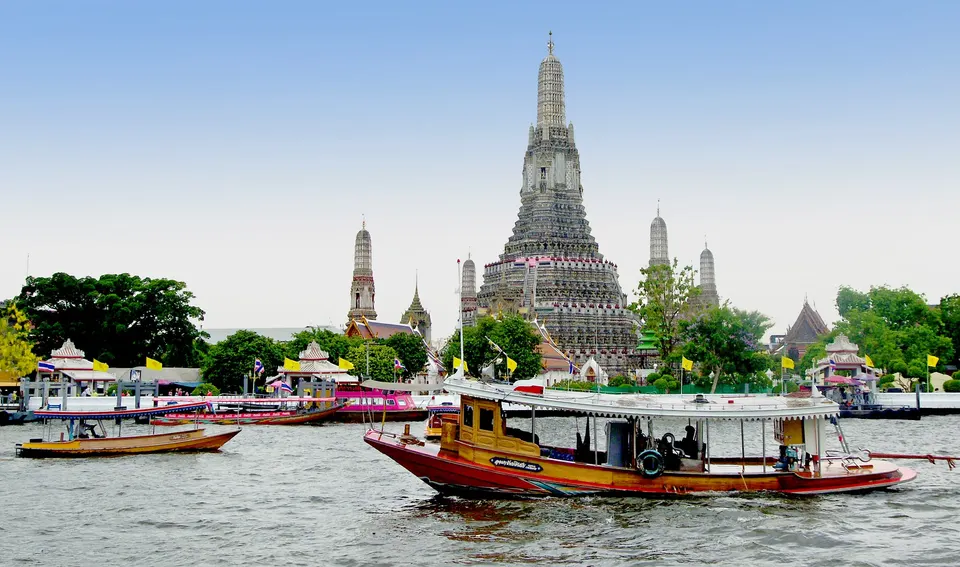
The Temple of Dawn raises over the Chao Phraya a tower clad with the ballast of Chinese ships and topped with a crown that belonged to another Buddha. It was a palace temple, home of the Emerald Buddha and beacon of a capital that changed banks.
- 45 min of audio
- Khmer-style prang
Wat Arun has occupied the Thonburi bank since long before Bangkok was a capital: under the name Wat Bang Makok it already appears on the French maps of the reign of Narai, in the seventeenth century. Under Taksin it stood inside the royal palace of Thonburi and housed the Emerald Buddha between 1779 and 1784. Rama III gave it its present form with a prang finished in 1851 after nine years of work, the largest and tallest in Thailand, in Khmer style and covered with porcelain and shells.
The tower that half the world photographs today was made, in part, from navigation waste: fragments of plates and bowls that served as ballast for the ships arriving from China. Its summit bears a crown borrowed from the image intended for another temple, and in 1858 the explorer Henri Mouhot described it as the first sign of the capital for anyone travelling up the river. The restoration of 2013–2017 replaced some 120,000 ceramic pieces and reopened a discussion that is still alive about how a monument should be cared for.
Highlights
- Central prang — Finished in 1851 by Rama III, the largest and tallest prang in Thailand
- Chinese porcelain mosaic — Plates and bowls that arrived as ship ballast, alongside sea shells
- Borrowed crown — The finial of the summit comes from a Buddha image intended for Wat Nang Nong
- Wihan Noi — The small vihara that housed the Emerald Buddha for five years
- Giants of the ubosot — Thotsakan, green, and Sahatsadecha, white, guardians of the hall with Rama II's ashes
Few silhouettes in Bangkok are as tied to the river as that of Wat Arun, the Temple of Dawn. Its official name, Wat Arun Ratchawararam, is the last in a long series: in the Ayutthaya period it was called Wat Bang Makok, after the village that surrounded it, and so it appears on the French maps drawn by Claude de Forbin and de Lamare during the reign of Narai (1656–1688). Later it was Wat Chaeng. Tradition attributes that name to King Taksin, who is said to have arrived before the temple at dawn in 1767; an Ayutthaya-period poem, the Phleng Yao Nai Phimsen, already mentions Wat Chaeng on the journey to Phetchaburi, so the origin remains under discussion.
The history of Wat Arun is that of a capital that changed banks. Under Taksin (1767–1782) the temple stood inside the royal palace of Thonburi and housed the Emerald Buddha, brought from Vientiane in 1779. When Rama I moved the court to the eastern bank in 1782, the bricks of its wall were dismantled and the temple became a monastery outside the royal city. Rama II dreamed of turning its modest prang of about 16 metres into the great relic stupa the new capital lacked, and Rama III finished the tower in 1851 after nine years of work. Its exact height is another disputed matter: published figures range from 66.8 to 86 metres.
Knowing what to see at Wat Arun requires going beyond the postcard silhouette: the pier, the buildings of the old palace, the base of the tower, its steep terraces and the ordination hall guarded by two giants. The temple also features on the “nine temples” routes with which many Thais start the year: popular belief plays on its name and promises a life as resplendent as the dawn. The architecture of Wat Arun is best read up close, and the EarGuide audio guide accompanies that route in five stops.
On the opposite bank wait Wat Pho and the Grand Palace, where the Emerald Buddha was moved; inland, in Thonburi, Khlong Bang Luang keeps the Bangkok of wood and water.
The river’s beacon noted by Mouhot
Wat Arun Pier
Summary of this stop
The route begins at the pier, among six Chinese-style pavilions of green granite lined up beside the landing stages on the Chao Phraya. From here something that is lost in aerial photos becomes clear: Wat Arun was conceived to be seen from the water. In 1858 the French explorer Henri Mouhot noted that its spire, two hundred feet high, was the first sign of the capital seen by the traveller going up the river from the sea.
The river still marks the temple’s calendar. At the royal Kathin, the monarch arrives at Wat Arun in a procession of royal barges to offer robes to the monks.
Across the water lies Tha Tian, the pier that links the two banks, and Bangkok folklore has an explanation for its name. It is said that the guardian giant of Wat Chaeng and that of Wat Pho were friends until an unpaid debt ended in a fight that devastated the bank; the god Phra Isuan turned them to stone and the flattened ground remained as “the flattened pier”. How the story of that loan ends is the first thing the narration tells in front of the river.
Where the Emerald Buddha lived for five years
Bot Noi and Wihan Noi
Summary of this stop
Before the great tower are preserved two older, discreet buildings, the Bot Noi and the Wihan Noi, remains of the palace temple that Taksin integrated into his Thonburi residence, in the manner of Wat Phra Si Sanphet in Ayutthaya. The Wihan Noi housed the Emerald Buddha, the most venerated image in Thailand, for five years, from its arrival from Vientiane in 1779 until its move to Wat Phra Kaew, on the eastern bank, in 1784.
That move sums up the turn of history: when the capital moved in 1782, the wall of Wat Chaeng was dismantled brick by brick and the palace temple was left converted into a monastery of resident monks, across the river from the new power.
The Bot Noi also holds a cast statue of Taksin and, in front of it, his wooden bed. According to a documented tradition, devotees crouch and pass underneath it to leave bad luck there and attract good fortune; in January 2019, Princess Ubolratana also did so during her round of nine temples. The meaning of that gesture and the memory of Taksin that feeds it are unpacked in the audio guide beside the statue.
Flowers made from ships’ ballast
Porcelain mosaic of the prang
Summary of this stop
At the base of the central prang the monument changes scale. What from afar looks like a uniform relief turns out to be a mosaic of flowers and motifs made from fragments of Chinese plates and bowls and from sea shells of the species Mauritia mauritiana. A good part of that porcelain had served as ballast for the ships arriving in Bangkok from China. Around the base stand guard Chinese-style stone figures, soldiers and animals, and at the corners of the platform rise four satellite prangs with the same cladding.
In the niches on the four sides of the main prang appears Indra on the back of Erawan, the multi-headed elephant. It is an iconographic novelty of the time of Rama III: until then those niches had housed Buddha images.
Up close the seams of the 2013–2017 restoration can also be seen, the largest in a century: the Fine Arts Department replaced some 120,000 of the 300,000 ceramic pieces, around 40%, and remade surfaces with lime. Critics and civic groups accused it of whitewashing the tower and sinking the ceramics beneath lime; the department defended that it respected the original appearance, although its director admitted that some retouched surfaces altered the patterns. Where that boundary between old and new shows is something the narration points out piece by piece.
A borrowed crown at the summit
Terraces of the central prang
Summary of this stop
The stairs of the central prang are very steep and climb by terraces from which the river and the opposite bank open out completely. The tower being climbed is the work of three reigns. The original Ayutthaya-period prang measured about 8 wa, some 16 metres; Rama II wanted to transform it into the great relic stupa of the new capital Rattanakosin, but died in 1824 with the excavation of the foundations only scheduled.
It was Rama III who raised the definitive tower, finished in 1851 after nine years of continuous work: the largest and tallest prang in Thailand, with an almost straight silhouette and Khmer style. To crown its summit, the nabhasula, he borrowed the crown cast for a jewelled Buddha image that was to preside over another temple, Wat Nang Nong.
From below, that crown is barely perceived as a pinnacle. The story of one king who dreamed the tower, another who did not see it begin and a third who crowned it with someone else’s ornament is the thread of this stop, and the narration tells it with the vertigo of the terraces underfoot.
Giants, royal ashes and the fire of 1895
Yakshas of the ubosot gate
Summary of this stop
The crowned gate of the ubosot, the ordination hall, is flanked by two guardian yakshas from the Ramakien, of stucco covered in glazed tile and armed with clubs: Thotsakan, green, to the south, and Sahatsadecha, white, to the north. According to tradition, they were modelled by Luang Thepkan, court sculptor, on the orders of Rama III. On 24 August 1930 lightning brought down the one on the north side; the abbot Luang Pu Nak, known for his takrut amulets, gathered donations from the neighbourhood to raise it again and held an “eye-opening” rite with both. Since then it is believed that worshipping them brings luck in marriage and at work.
An old rhyming Bangkok saying, of disputed origin, already counted them among the three terrors of the city: “Yak Wat Chaeng, raeng Wat Saket, pret Wat Suthat”, the giants of Wat Chaeng, the vultures of Wat Saket and the hungry ghosts of Wat Suthat. The temple that is photographed today at sunset was for generations one of Bangkok’s childhood nightmares.
Inside presides the Buddha Phra Phuttha Thammamit Ratcha Lokkathat Dilok, in the attitude of defeating Mara, whose face Rama II himself modelled; his ashes have rested in the pedestal since the reign of Rama IV. It was Rama II who celebrated the temple’s renovation in 1820 with Ramakien performances. On 31 December 1895 the ubosot burned from embers carried from a coal store, and King Chulalongkorn came to direct the firefighting, put the ashes to safety and paid for the reconstruction with 12,800 baht from his own pocket. The murals seen today postdate that fire, and what happened that afternoon is the closing the audio guide reserves for the end of the route.