Historic Neighbourhood
Chinatown Audio Guide (Yaowarat)
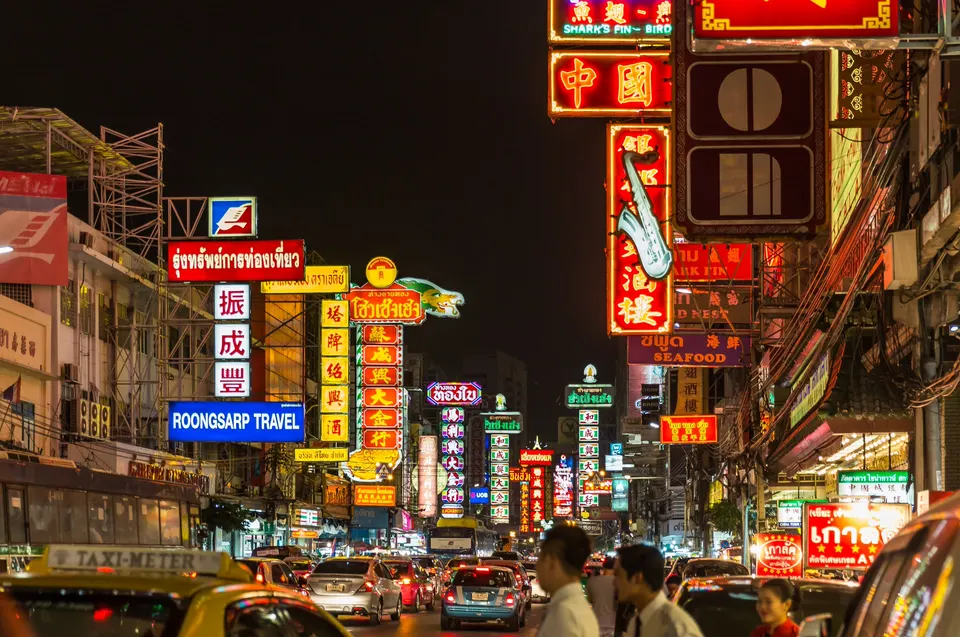
A kilometre and a half of crooked street that sells gold by day and turns into an open-air dining room by night. The curve the neighbourhood calls a dragon keeps the trace of a tug-of-war between nobles and residents, in a Chinatown that began as exile.
- 60 min of audio
- Teochew Chinatown
Yaowarat is the main street of Bangkok's Chinatown and its history begins before the street itself. In 1782, when Rama I founded the new capital on the east bank of the Chao Phraya, the Teochew community that occupied the site of the future Grand Palace was moved downstream, to Sampheng, then a swampy area between Wat Sam Pluem and Wat Sampheng. After the fires that devastated that crowded settlement, Chulalongkorn (Rama V) had a new road of about 1.5 km long and 20 m wide opened over rice fields and canals, named Yaowarat, "young king", in honour of Crown Prince Vajirunhis.
Before the Second World War it was the busiest area of Bangkok and the first street in the country with the tallest buildings, the so-called seven- and nine-storey ones. Around 1900 it was at once the city's great commercial centre and its red-light district, with opium dens, theatres and gambling houses. Today the contrast is different: red shopfronts full of chains and ingots by day, and one of Bangkok's great food streets when night falls.
Highlights
- Chinatown Gate — The red paifang of 1999 at Odeon Circle, the "head of the dragon"
- Gold Street — 40 gold shops on Yaowarat and another 132 in the surroundings according to the 2002 count
- Seven- and nine-storey buildings — The tallest in the country before the Second World War
- Talat Kao — The old market at Soi Yaowarat 11, the "belly of the dragon" and a great wholesaler of dried seafood
- Sampheng Lane — The original alley of Chinatown, older than Yaowarat Road
Bangkok’s Chinatown was not born by choice. In 1782 Rama I founded his new capital on the east bank of the Chao Phraya and the Teochew community living where the Grand Palace was to rise was displaced to Sampheng, a swampy, inaccessible stretch downstream from the walled city. There, among merchants’ houses and dirt alleys, formed the neighbourhood that would in time be the busiest in the capital. The street that now gives it its name, Yaowarat, came a century later: it was planned in 1891 under the name “Yuppharat” and King Chulalongkorn gave it the definitive one, “young king”, in honour of his eldest son, Prince Vajirunhis.
The history of Yaowarat is that of a route disputed house by house. The sources do not agree on the exact dates (some place the works between 1892 and 1900, others count eight years from 1891) nor on the length, which ranges between about 1,510 and 1,532 metres, but they agree on the essentials: the street was opened against the resistance of owners and nobles, and came out curved. The neighbourhood turned that curve into a dragon, with the head at the gate of Odeon Circle, the belly at the old market and the tail at the opposite end. Knowing what to see at Yaowarat means walking that body from end to end: the architecture of Yaowarat, its gold shops, its alleys and its food stalls are best understood on foot, with the EarGuide audio guide marking each stop.
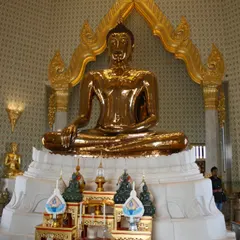
At the dragon’s head, beside the neighbourhood gate, Wat Traimit keeps its solid gold Buddha, and on Charoen Krung stands Wat Mangkon Kamalawat, Chinatown’s great Chinese temple; upriver, the flower market Pak Khlong Talat extends the commercial Bangkok of the riverbank.
The dragon’s head at Odeon Circle
Chinatown Gate
Summary of this stop
The route begins at the roundabout where the street starts, beneath a red paifang with inscriptions in Thai and Chinese on both sides. The gate was raised by the Thai community of Chinese origin to celebrate King Bhumibol’s 72nd birthday, the sixth twelve-year cycle, and was inaugurated by Princess Sirindhorn on 5 December 1999, on the spot previously occupied by a fountain. For the neighbourhood, this point is the dragon’s head.
On the sides stand guard two white jade lions given by China in 2007: the male rests his paw on a ball and the female on a cub. In front appears a jade rabbit of 2011, an allusion to Bhumibol’s birth year. Under the gate, a brass plaque in the ground bears the Chinese character 地, “earth”; above, on the same axis, appears 天, “heaven”. According to feng shui belief, whoever stands exactly at that point receives cosmic energy.
The first lesson of the stop is that on this traffic roundabout almost nothing is decorative. What relation the gate bears to the crown prince who gave the street its name, and how the rest of the dragon is read from here, is what the narration reveals standing under the arch.
Gold in the windows, pre-war skyscrapers
Gold shop windows
Summary of this stop
Along the pavement follow one another red fronts with golden lettering and display cases full of chains and ingots. It is not a tourist picture: in 2002 there were 40 gold shops on Yaowarat Road alone and another 132 in the surroundings, hence the nickname “Gold Street”. The oldest, Tang To Kang, goes back to the reign of Rama V and remains open on nearby Mangkon Road.
Above the shop windows rise the blocks that made this street famous before the Second World War, when Yaowarat was the busiest area in Bangkok and the first in the country with the tallest buildings. One of seven storeys, on the right-hand pavement near the junction with Songsawat, is recognised by its plain pilasters and vertical grooves; another of nine, on the left before Mangkon, has only stucco garlands and bouquets on the three lower floors. Both have been considered for registration as monuments.
Something is missing from the one-way roadway: between 1894 and 1968 an electric tram ran along Yaowarat and Charoen Krung. How the tram, the skyscrapers and the gold fitted together on the city’s most bustling street is one of the scenes the audio guide reconstructs on the very same pavement.
Trok Tao, the alley that bent the street
Soi Yaowarat 8 (former Trok Tao)
Summary of this stop
Soi Yaowarat 8 looks like any side alley, but its old name, Trok Tao, appears twice in the neighbourhood’s history. The first, in the protests over the layout: residents complained that the officials driving in the stakes avoided the houses of nobles and shifted the line onto those of ordinary people. The complaint reached the king and in 1894 it was proposed to compensate Thai subjects as well as foreigners. The works dragged on for about eight years, and on 4 June 1898 Rama V had to order the cutting of the street to continue.
There lies the other reading of the curve. The popular explanation speaks of a deliberate imitation of the dragon’s body; the documentation of the layout points to those stakes moved to spare nobles’ houses. Both versions coexist, and it is enough to look at the roadway from any point to see that Yaowarat is not straight: it snakes.
The second appearance of Trok Tao is less official. Around the turn of the century the neighbourhood was also Bangkok’s red-light district, and this alley was among the best-known places for gambling and prostitution. A documented tradition places here, in the time of Rama III, the brothel of Yai Faeng, “Grandmother Faeng”, who in 1833 paid for a temple with her girls’ money and received from the most famous monk of her time an unexpected verdict on the value of that merit. The name the king ended up giving it is still on the façade, and what the monk said is the finishing touch the narration keeps for this alley.
Talat Kao, the dragon’s belly
Talat Kao market alley
Summary of this stop
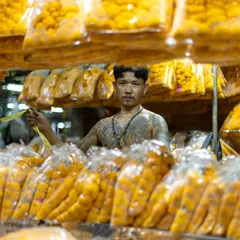
At the entrance to Soi Yaowarat 11 begins Talat Kao, the old market, with stalls of dried food, seafood and prepared dishes. It occupies some 3 rai of land that belonged to Phra Si Song Yot (Chesua Niam), a Chinese magnate of the early Rattanakosin era, and that before being a market was an orchard and a place where the neighbourhood’s Chinese relieved themselves. Its proximity to the Song Wat pier later made it the largest wholesale market for seafood, fresh and dried. Opposite, Soi Yaowarat 6 leads to the Leng Buai Ia market.
The dragon’s belly is also the heart of the night. In April 2017 it was reported that the Bangkok administration was going to ban food stalls on the main streets; the Tourism Authority of Thailand denied it and specified that Yaowarat and Khao San would not be affected, although their vendors would come under hygiene control. The street remains, as the sun goes down, a great food street.
During the first nine days of the ninth Chinese lunar month the neighbourhood changes its skin with the Thetsakan Kin Je, the vegetarian festival of Buddhist and Taoist root. Stalls cooking according to the rule hang yellow pennants with the character 齋 or the Thai word “เจ” in red, and devotees dress in white and give up meat, everything of animal origin and even garlic and onion. What each colour means and what happens in the shrines on those days is told by the audio guide among the stalls.
Sampheng Lane, the neighbourhood before the street
Sampheng Lane
Summary of this stop
Parallel to Yaowarat runs Sampheng Lane, today Soi Wanit 1: a narrow pedestrian passage with wholesalers of costume jewellery, fabrics and toys under awnings. This was the first axis of Chinatown, the path that joined the settlement of the Teochew moved in 1782 with the fortified city, long before Yaowarat Road existed. In the second half of the nineteenth century, turned into a very dense shantytown, it suffered numerous fires that cleared the ground for the new streets.
Fire left its mark on the language. In Thai, “fai mai Sampheng”, “the Sampheng fire”, is a popular expression for a chaotic crowd, and among muay thai fans it designates the great surprise, when the one nobody expected wins. Popular belief links it to a great fire that supposedly devastated the neighbourhood in 1800. Another trace remains from the same nocturnal past: according to the neighbourhood’s memory, the brothels of Sampheng did not advertise with a red lantern but with a green one, and “i-Sampheng”, “that woman from Sampheng”, became one of the harshest insults that could be hurled at a woman in Bangkok.
The route closes with an episode from 1946. On 3 June, in the midst of violent tension between Thais and postwar Chinese, King Ananda Mahidol (Rama VIII) and his brother, Prince Bhumibol, walked through Yaowarat and Sampheng from nine to noon, some 3 km. Why that walk is remembered as the gesture that defused the conflict is the last chapter of the narration, told in the alley where it all began.