Founding Shrine
City Pillar Shrine Audio Guide (San Lak Mueang)
Before the Grand Palace, before any temple, Bangkok was a wooden post driven into the ground at the hour dictated by the astrologers. That post is still here, and it has a twin beside it.
- 20 min of audio
- Living worship
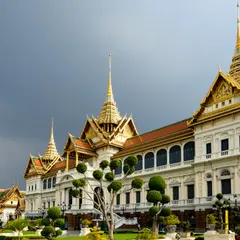
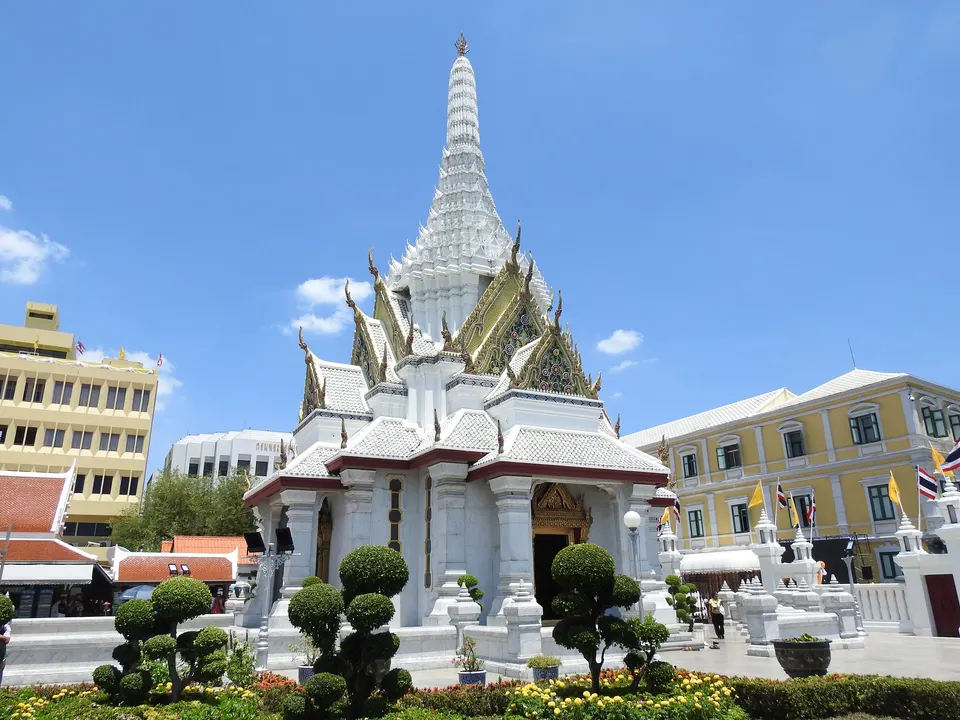
Opposite the Grand Palace, wedged into the grounds of the Ministry of Defence, a small pavilion crowned by a prang holds the exact origin of the Thai capital. King Rama I had the founding pillar raised here on 21 April 1782, the same year he moved the capital from Thonburi, and it was the first construction in Bangkok. Seventy years later, King Mongkut planted a second pillar and rebuilt the building in the image of the pillar shrine of Ayutthaya. Today both stand side by side, each with a horoscope of the city inside.
The history of the City Pillar Shrine is made of astrology. According to a documented tradition, four snakes slid into the hole at the moment the pillar was being lowered and were buried with it, and the court astrologers read it as a bad omen. Far from being a silent relic, the shrine still works as the spiritual centre of the capital: gold leaf, oil lamps, three-coloured silk cloths and dances commissioned by those who have seen a wish fulfilled.
Highlights
- Pillar of 1782 — A trunk of chaiyaphruek, the tree of victory, topped with a lotus bud and 4.75 m long
- Mongkut's pillar — A teak core, a mandapa finial and a new horoscope of Bangkok inside
- Prang pavilion — Rebuilt by Mongkut on the Ayutthaya model and finished in 1853
- Five guardian deities — Among them a rider on an owl and the spirit of the drum tower
- Offering dances — Dancers and musicians paid by worshippers to give thanks for a fulfilled wish
Bangkok has a date and time of birth. On Sunday 21 April 1782, Buddhist year 2325, at 6:54 in the morning according to Thai sources and most guides (some English-language sources give 6:45), King Rama I had the founding pillar of the new capital driven into the ground. Nothing had yet been built: neither the Grand Palace, nor the temples, nor the walls. The City Pillar Shrine was the first construction in Bangkok, and everything else grew around it.
The history of the City Pillar Shrine is that of a destiny calculated by astrologers and corrected by a king. In 1852, Mongkut (Rama IV) replaced the original pillar with a new one and rebuilt the pavilion as a masonry building crowned by a prang, finished on Sunday 1 May 1853. In 1982, on the occasion of the Rattanakosin bicentenary, King Bhumibol (Rama IX) ordered a restoration that lasted until 1986: the original pillar was placed beside Mongkut’s, and the shrine of the five guardian deities and a hall of Buddha images were added. Popular belief added a prophecy to this chronology: legend has it that the bad omen of the founding foretold a dynasty of 150 years, and that the term was fulfilled on 24 June 1932, when a revolution ended the absolute monarchy.
Knowing what to see at the City Pillar Shrine requires reading a small space of great density: two different finials, five gods evicted from their chapels and a ritual that never stops. The architecture of the City Pillar Shrine, with its Ayutthaya-inspired prang, is only the wrapping; the route with the audio guide goes stop by stop from the entrance to the dance hall.
The shrine stands next to the Grand Palace, the citadel born with it in 1782, and a short walk from Wat Pho.
Bangkok’s first stake, before the palace
Bangkok City Pillar Shrine
Summary of this stop
The visit begins at the entrance, opposite the Grand Palace, at a junction from which the southeast corner of Sanam Luang and the Ministry of Defence building can be seen. The shrine is within its grounds: the ministry has looked after it since 1937 and, since 1948, custody belongs to the War Veterans Organization of Thailand. The scale is disconcerting. It is a corner that can be walked in a few steps, and yet it was the first thing raised in the capital, before the palace that stands in front of it.
The contrast between the size of the shrine and the weight of what it represents is the starting point. Rama I fixed the ritual heart of the city here in the same year he left Thonburi, in a ceremony timed to the minute by the court astrologers.
That precision did not prevent something from going wrong. According to a documented tradition, when the pillar began to descend into the hole at the auspicious hour, four small snakes slid to the bottom; the pillar went down anyway and they were buried with it. The astrologers interpreted it as a bad omen. What that augury came to mean for the city is the story with which the narration opens the route.
Two pillars and the city’s birth chart
Chamber of the two pillars
Summary of this stop
Under the prang, in the central chamber, Bangkok’s two founding pillars stand side by side, wrapped in offerings. The 1782 one is a trunk of chaiyaphruek, the Javanese cassia known as the “tree of victory”, covered on the outside with sandalwood according to the official website and Thai sources, and topped in the form of a lotus bud. It measures 187 inches, about 4.75 metres: 108 protrude from the ground and 79 were buried. Its upper part was hollowed out to house the city’s horoscope, the duang mueang.
Beside it stands Mongkut’s pillar, of 1852: a teak core lined with six plates of chaiyaphruek and a mandapa-shaped finial that holds a new horoscope of Bangkok. Each pillar is, literally, the box of a destiny. The measurements of the second vary according to the source, and so does when the two came to be together: the shrine’s official website places the reunion at the 1982 restoration.
The official reason for the second pillar is that the first was deteriorated. But another explanation circulates, of disputed history: Mongkut is said to have calculated his own horoscope and seen that it clashed with the ascendant of the city’s, so he planted a new pillar with a new birth chart to remake the destiny fixed in 1782. The creation of Phra Siam Thewathirat, the supreme guardian deity of the kingdom, is associated with that same tradition. How the two finials are told apart and what separates the official version from the astrological one is unpacked in the chamber.
Five guardians left homeless by the new streets
Shrine of the five deities
Summary of this stop
In an adjoining pavilion, added in the 1982-1986 restoration, the images of five guardian deities of Bangkok are gathered: Phra Suea Mueang, Phra Song Mueang, Phra Kan Chaisi, Chao Chetkhup and Chao Ho Klong. Each had its own chapel, until the modern city demolished them to build official buildings and open streets. Their gods ended up here, beside the pillar.
According to local custom, Phra Kan Chaisi rides an owl, and Chao Pho Ho Klong is the spirit of the drum tower. That three-storey tower was raised by Rama I with a drum on each floor: one marked dawn and dusk, another sounded the fire alarm and the third, intended to warn of an enemy attack, was never used. Rama V had it demolished; the drums ended up in what is now the National Museum and its guardian spirit, according to tradition, moved to this shrine.
The tower’s story holds a domestic detail that tradition recounts with relish: some very particular officials who watched over the drum ropes. Who they were and what they protected the tower from is part of what the narration tells in front of the five guardians.
Gold leaf and dances for fulfilled wishes
Pillar replica
Summary of this stop
Beside the chamber of the pillars stands a replica of the pillar, the point where worship becomes tactile. The circuit of offerings includes a lotus flower in the Buddha hall, sheets of gold leaf stuck to the replica, a three-coloured silk cloth tied around it without separating the pieces and oil for the lamp of each worshipper’s birth day.
In an adjoining hall, dancers and musicians perform traditional Thai dances. They are not a show for tourists: they are commissioned from the shrine’s managers by someone who has seen a wish fulfilled, as an offering of thanks (kae bon) to the deities.
The shrine opens daily from 6:30 to 18:30 and does not close all night on New Year’s Eve, New Year’s Day and Chinese New Year. Every 21 April it celebrates the anniversary of the pillar’s founding with ceremonies of Brahmanic tradition. The order of the ritual and what each gesture means is what the audio guide explains at this last stop.