Fengshui Trees
Ancient Trees at the Village Entrance Audio Guide
The gateway of Hongcun is neither an arch nor a wall: it is two living trees some 500 years old, one with a crown as broad as an umbrella and the other straight as a sword, around which brides and coffins once circled.
- 20 min of audio
- 500-Year-Old Trees
At the entrance of the village stand a Chinese wingnut, which Hongcun calls hongyang or “red poplar”, and a ginkgo, the baiguo or “white fruit”. Together they are the “red and white trees”, the fengshui trees of Hongcun, and in the symbolic plan of the village, which imitates an ox, they act as horns in front of the head formed by Leigang Hill. When Xidi and Hongcun were evaluated for World Heritage inscription in 2000, 100% of the ancient trees were in a satisfactory state of conservation, ahead of the buildings and the water system.
Each tree had its rite. According to old custom, the bride's sedan chair made a wide circuit around the hongyang as an omen of a hundred years of harmony, and at the funeral of a long-lived elder the coffin was carried around the ginkgo to ask for many descendants and a long life. The same threshold served for marrying and for saying farewell.
Highlights
- Hongyang — a Chinese wingnut some 20 m tall and 6 m round, with an umbrella crown
- Ginkgo of some 500 years — about 20 m, straight as a sword thrust into the sky
- Weddings and funerals — the procession that circled each tree
- Horns of the ox — the piece that completes the symbolic plan of Hongcun
- Hongji Bridge — where the Xixi Stream meets the Yangzhan
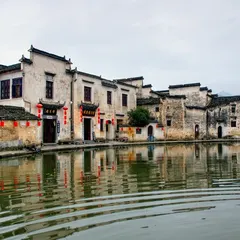
Hongcun, a south-facing village of 19.11 hectares at the foot of Leigang Hill, does not greet travellers with a stone gate but with two trees. The history of the Ancient Trees at the Village Entrance, the 村口古树, is bound up with that of the Wang clan: at the start of the Southern Song dynasty the family moved from near Lake Qishu to Leigang Hill and settled halfway up the slope, far from a Xixi Stream that burst its banks with every storm. Only when a great flood, at the end of the Southern Song, changed its course and left a cultivable floodplain did the villagers come down to the flat land where the village stands today.
That struggle with the water was put in writing. Near the dam at the “water mouth” (水口) of Hongcun stands a modern replica of a stele whose original was raised in the spring of 1434. Its text tells that the Hongcun branch of the Wang descended from Renya, who came to Qishu in the Xianping era of the Song, and that, living far from the stream, the clan suffered repeated fires and droughts: the reason for bringing water into the village.
What to see at the Ancient Trees at the Village Entrance comes down to two opposing silhouettes, an esplanade of shade and a bridge over the stream, but each opens a different layer: fengshui, wedding and funeral rites, the ox drawn by the whole village and the river that decided where to live. The narration of the audio guide, heard beneath the canopies, pieces those layers together over a route of about 20 minutes.
The water running through the Hongcun water channels comes from the same Xixi Stream, and a few steps from the entrance rises South Lake Academy.
An umbrella and a sword at the gate
Hongcun village entrance
Summary of this stop
The first image is of a pair that could hardly look less alike: on one side, a broad, low crown; on the other, a narrow arrow rising straight up. They are the hongyang, a fengyang or Chinese wingnut that the village calls “red poplar”, and the baiguo, a ginkgo whose name means “white fruit”. Together they form the “red and white trees” (红白古树), the fengshui trees of Hongcun, and between them opens the esplanade where visitor routes begin or end: one usual route runs from the entrance to the Ancient Ginkgo and then to the Ancient Red Poplar, and another closes the tour right here.
Their condition is no accident either. In the evaluation for the inscription of Xidi and Hongcun as World Heritage in 2000, 100% of the ancient trees were judged to be in a satisfactory state, against 70% of the ancient buildings and 90% of the water system. The houses have been wearing away; these trees, considered a characteristic feature of the villages, have come through whole.
A popular tale says that the founder, Wang Yanji, who around 1131 fled with his family from a fire in Qishu and built a thirteen-room house at the foot of Leigang, wanted before anything else to mark this threshold with a pavilion, the Suiyang, as the landmark at the way into the village. What remains of that “gateway” gesture, and why two trees guard it today, is something the narration reveals on site.
Under the hongyang, the bride’s circuit
Ancient red poplar
Summary of this stop
The hongyang occupies the north side of the entrance. It stands about 20 metres high and about 6 metres round: it takes four or five people to embrace its trunk. Its crown, shaped like a giant umbrella, shades several mu of the esplanade, a Chinese farmland unit of about 667 m² each, and beneath it shops and benches are spread out today.
It is the wedding tree. According to the old custom of the village, the bride’s sedan chair made a wide circuit around it as an omen of “a hundred years of harmony”. That circling had a reverse side, and it lay on the other side of the esplanade.
The name holds its own surprise. “Red poplar” is only a local nickname: the tree is identified as a fengyang, a Chinese wingnut, and the character 枫, which also means maple, has fed more than one confusion. Nor do all sources agree: one version speaks of a camphor tree, and even of “red and white” camphor trees. How that tangle of names is resolved is part of the narration.
The ginkgo and the horns of the ox
Ancient ginkgo
Summary of this stop
On the south side, the baiguo rises about 20 metres with a silhouette that local descriptions compare to a sharp sword thrust into the sky. Because the ginkgo is a rare species worldwide and this one is around 500 years old, it is called the “treasure” of the entrance; in autumn its narrow crown turns golden.
If the hongyang was the wedding tree, the ginkgo was the tree of the final journey. At the funeral of a long-lived elder, the cortège carried the coffin around this tree to ask for many descendants and a long life.
From its foot, looking north, Leigang Hill comes into view, and with it the key to the village. Hongcun is laid out as an ox, according to the saying “the hill is the head and the trees the horns; the bridges the four hooves, and the houses the body”: the Moon Pond would be the heart or the stomach, South Lake the belly and the winding channel the intestines. One version places the horns in these two trees at the entrance; another puts them on the hill itself. The whole village, facing south between mountain and water according to geomancy, takes on another meaning when the audio guide reassembles it piece by piece from here.
The Xixi Stream, which moved the village
Hongji Bridge
Summary of this stop
The route ends at Hongji Bridge, at the western approach (some sources place it to the northwest), over the Xixi Stream. The water of Hongcun rises in the Yongxi Stream, which on reaching the northwest dam takes the name Xixi, “West Stream”, and in front of this bridge joins the Yangzhan Stream at the islet of Zhongzhou. Beside the Hongji is the dam through which the “outside water” enters the village and becomes “inside water”.
That quietly murmuring stream is the same one that forced the Wang to live halfway up the slope and that, after the flood that changed its course, left them the flat land. Nor has it lost its temper: between 18 and 28 June 2024 an average of 590.1 mm fell on the city of Huangshan, more than a whole normal meiyu rainy season, and the Xixi ran high and brown with mud. Even so, Hongcun was one of the few tourist sites in the city that stayed open.
Looking back, the two trees compose a scene with a poetic name of its own. Among the classic views of Hongcun is “Ancient Trees before the Pavilion”, usually associated with this pair, although the specific pavilion is not identified. Where that pavilion, no longer visible, might have stood is the small riddle with which the narration takes its leave.