UNESCO World Heritage
Chengzhi Hall Audio Guide (Chengzhi Tang)
A salt merchant bought the official rank he lacked and in 1855 raised the largest house in Hongcun to show it off: nine light wells, 136 columns and carvings covered in gold.
- 35 min of audio
- Huizhou Carving
Chengzhi Hall was built in 1855, the fifth year of the Xianfeng reign of the Qing dynasty, as the residence of Wang Dinggui, one of the great salt merchants of the late Qing era. It is the largest built complex in Hongcun: a plot of some 2,100 m², more than 3,000 m² of floor space, around 60 rooms and 136 carved wooden columns. It belongs to the village inscribed as a UNESCO World Heritage Site in 2000 together with Xidi, and the richness of its carvings has earned it the nickname “the people's Imperial Palace”.
The contrast lies inside: the same house that displays an officials' banquet in gold and devotes an entire hall of filial piety to the elders set aside two small pavilions for its owner's leisure, one for smoking opium and another for playing mahjong. Walked from the gate to the garden, the mansion reads as the self-portrait of a merchant who bought the rank he lacked and who, without meaning to, left the beginning of his decline carved into it.
Highlights
- Ceremonial gate — The second gate of a purchased official rank, opened only on great occasions
- Banquet beam — Gilded officials, a servant making tea and another cleaning an ear
- A Hundred Children at the Lantern Festival — The emblematic carving above the central door
- Elders' hall — Column bases with the character for longevity and Nine Generations under One Roof
- Opium and mahjong pavilions — The cloud ceiling of Tunyun Xuan and the tile room
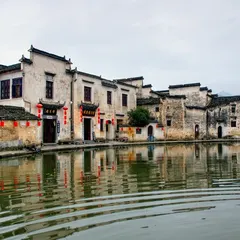
In Hongcun the houses press together along stone channels and alleys, and almost none of them lets on from outside what it holds. Chengzhi Hall takes that game to the extreme. On a narrow street behind the central pond, along the middle stretch of the village’s upper channel, opens the residence that the salt merchant Wang Dinggui had built in 1855: the largest house in Hongcun, with nine light wells, 136 columns and carvings gilded with gold dust. Its name, Chengzhi, means “continuing the aspiration”, and its owner’s aspiration is written everywhere.
The history of Chengzhi Hall is that of a rich merchant in a society that ranked traders below officials. Wang Dinggui bought the rank of fifth-grade sub-prefect and adapted the house to that title; then he filled beams and balustrades with scenes of official banquets and wishes for longevity and prosperity. Some sources point to a rebuilding in 1911, though it is unclear how far that work went compared with the version that describes the house as preserved intact. In 2001 the ensemble of ancient buildings of Hongcun, to which it belongs, was declared a Major Historical and Cultural Site Protected at the National Level, and today the mansion is visited with guides and houses a small museum.
To know what to see at Chengzhi Hall and understand its architecture, from the ceremonial gate to the opium and mahjong pavilions, the audio guide walks through the house in five stops and follows the thread of a man who surrounded himself with gold to look like what he was not.
If South Lake Academy shows how the merchants of Hongcun invested in learning, this house shows how they spent on themselves; the government of the lineage, by contrast, sat in Lexu Hall, the ancestral hall of the Wang.
A solemn gate for a purchased rank
Chengzhi Tang (承志堂)
Summary of this stop
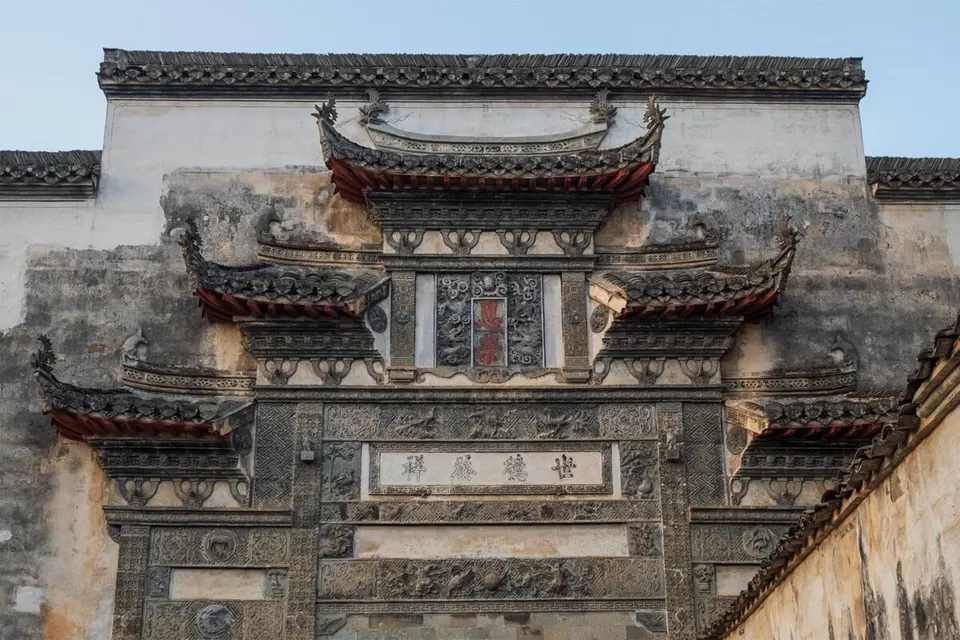
The first contrast is one of scale: after the narrow street, the house suddenly opens up. Past the entrance comes a second gate, a ceremonial gate of the official type with a splayed, “eight-shaped” plan, which belonged only to those who held rank. Wang Dinggui added it thanks to the title of fifth-grade sub-prefect he had bought, and kept it closed except for great celebrations or illustrious guests.
Ordinary visitors came in through the side doors, topped by a carved motif in the shape of the character 商, “commerce”. The popular reading sees in it the owner’s revenge on the low social standing of merchants, or an obligation for every guest to pass “beneath commerce”; it is a much-repeated interpretation, but one without scholarly backing. At this threshold the merchant’s pride and the rank he paid for meet, and the narration on the spot reveals what that double entrance says about the man who designed it.
The ear-cleaning servant beneath the banquet’s gold
Chengzhi Tang (承志堂)
Summary of this stop
In the front hall, facing the central door, a long carved and gilded beam shows a banquet of officials in a garden, also cited as the banquet of Emperor Suzong of Tang. Among its figures are a servant preparing tea and another cleaning an official’s ear. According to Huang Jie, vice-president of the Huihuang tourism group of Yixian, the scene expresses the owner’s wish to become an official. The carvings combine openwork in several layers with high and low relief, and in them, as the official description of the “three carvings of Huizhou” stresses, every person has a different face and every face a different expression.
The gold visible today has faded, and around it the figures multiply. According to the tradition passed on by local guides, the house took about seven years to build and some twenty craftsmen spent about four years on the carvings. Accounts of the gold used do not agree: some speak of 100 taels of gold just to gild the carvings, others of more than five kilos, and no figure has documentary support. The hall also holds a clock, a vase and a mirror whose Chinese names form a pun on a lifelong wish; the audio guide explains which one.
A hundred children, dragons and eyes behind the railing
Chengzhi Tang (承志堂)
Summary of this stop
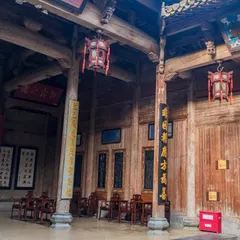
Before the central door, the overhead light of the courtyard reveals how the house is put together: light-well courtyards (tianjing) surrounded by columns and wooden galleries. The sources speak of nine courtyards and some 60 rooms, though other counts give 66 rooms or seven courtyards, differences that seem to stem from different ways of counting. Above the central door, on the upper-floor balustrade, four carved posts depict the fisherman, the woodcutter, the farmer and the scholar; below them are the gods of wealth of the North and the South, and in the centre, facing the hall, the carving of A Hundred Children Celebrating the Lantern Festival, considered the signature piece of Chengzhi Hall.
Michelin singles out the medallions engraved on the lintels in honour of several family lineages and, on the gutters, pewter finials shaped like open-mouthed dragons that watch over the water falling into the courtyard. Above, the upper-floor gallery keeps a custom told on every visit: according to popular belief, its carved balustrades had peepholes through which the unmarried daughters of the house watched, unseen, the men arriving in the hall, especially when a suitor came. The narration in the courtyard places that game of glances among the gilded beams.
Longevity carved at the elders’ feet
Chengzhi Tang (承志堂)
Summary of this stop
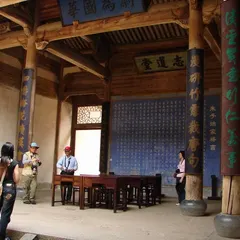
The rear hall was the residence of the parents and elders of the family, and everything in it speaks of filial piety. Every column base bears the carved character for longevity, so the old people literally walked on wishes for a long life.
On the beams, two scenes complete the programme: Guo Ziyi receiving birthday congratulations and Nine Generations under One Roof. It is the domestic, affectionate face of the same ambition that in the front hall dressed itself up as an official banquet, and the audio guide shows how the two halls answer each other.
Opium clouds on the merchant’s ceiling
Tunyun Xuan (吞云轩)
Summary of this stop
The mansion was a closed world: its own pond and well so there was no need to go out for water, a fish-pond hall, a family schoolroom, a back garden, kitchen, stable, a room for bodyguards and separate quarters for male and female servants. It also kept its owner’s vices: the Tunyun Xuan, the “Pavilion that Swallows Clouds”, where opium was smoked, and the Paishan Ge, the “Pavilion of Tiles in a Row”, devoted to mahjong.
On the ceiling of the opium room, clouds and vapours were painted among delicate flowers that are said to be poppies, the plant from which opium is extracted. It is usually read as a sign of the times: after the First Opium War the country was sinking into the drug, and the room already foretold the decline of Hongcun. Other stories circulate around it. The schoolroom door, which opened onto the street, was barred every night with a system recorded by local tradition under the name “one horizontal, two vertical, three diagonal”, whose slots remain in the threshold and the courtyard floor. And it is said, in versions that do not agree, that somewhere in the house Wang Dinggui kept a concubine hidden. The final narration gathers those rumours under the ceiling of clouds and completes the portrait of the merchant.