UNESCO World Heritage
South Lake Audio Guide (Nanhu)
A lake that was once farmland: in 1607 Hongcun gave up some hundred mu of fields to store its water and shaped them into a bow drawn taut at the foot of the village.
- 30 min of audio
- Water Engineering
South Lake is the end point of the water system of Hongcun, one of the Ancient Villages in Southern Anhui inscribed by UNESCO in 2000 together with Xidi. In the ox scheme used to describe the village plan, the channels are the intestines and this lake is the belly: here ends the water that runs through the lanes after passing the Moon Pond. Its great bow shape, split by a central causeway that serves as the arrow, was laid out in imitation of a famous scene of West Lake in Hangzhou.
The most photographed image of Hongcun, the Painted Bridge on the causeway, is probably the newest piece of the lake: according to local sources it was built during the 1986 repairs. Even so, its name is credited to an eighteenth-century verse, and in 2000 Ang Lee made it the crossing where Li Mu Bai leads his horse over in “Crouching Tiger, Hidden Dragon”.
Highlights
- Belly of the ox — the end of Hongcun's water system
- Some hundred mu of farmland dug out in 1607
- Bow-and-arrow plan inspired by West Lake in Hangzhou
- Painted Bridge — Li Mu Bai's crossing in “Crouching Tiger, Hidden Dragon”
- Full moon and lanterns on Mid-Autumn night
Stepping out of the maze of lanes and channels of Hongcun, the space suddenly opens onto a sheet of water curved like a bow. The history of South Lake begins with a very down-to-earth problem. Around 1405, on the advice of geomancers, the village opened a channel to bring water from the West Stream; some two hundred years later, the population and the number of houses had grown so much that the Moon Pond was no longer enough as a reservoir. The sources date the work to 1607, the dingwei year of the Wanli era of the Ming dynasty, although other versions speak only of “two hundred years after” the channel, or of an enlargement rather than a new excavation.
What now looks like a serene postcard was a calculated decision: farmland sacrificed, a deliberate copy of a Hangzhou scene and a bridge that works at once as an icon, a film set and an open-air painting studio. The water system that culminates here is part of the description of the Ancient Villages in Southern Anhui, a UNESCO World Heritage Site since 2000. The audio guide follows the north shore, crosses the central causeway by the Painted Bridge and ends on the south shore, facing the village reflected in the water: it is there, with the lake in front, that the history and architecture of South Lake finally fall into place.
The water that fills it comes down through the Hongcun water channels from the Moon Pond, and along its north shore stands South Lake Academy.
The water belly of the ox
South Lake
Summary of this stop
At the western end of the north shore comes the first jolt of scale. After the narrow alleys, the horizon widens over an elongated lake, held by a stone edge and curved like a bow drawn taut to the south of the village.
The key to the place lies in the way Hongcun describes itself: as an ox. The channels running beside the houses are its intestines, and South Lake is its belly, where the water’s journey ends after passing through the Moon Pond. The versions do not agree on the whole anatomy (the Moon Pond appears sometimes as the heart, sometimes as the stomach and occasionally even as the tail), but almost all of them give this lake the role of the belly. Why a system begun with a channel around 1405 needed two centuries to be completed is something the narration explains on the spot.
A hundred mu of rice fields under water
Stepped shore of South Lake
Summary of this stop
On the lower level of the north shore, the embankment, stepped in two tiers, leads down almost to water level; the upper platform is about 4 metres wide. From here it is hard to imagine that beneath that still surface there were once cultivated fields.
According to the sources, in 1607 the villagers dug several zhang deep (an old Chinese measure) into some hundred mu of farmland south of the village and lined the banks with stone. The reason was demographic: a growing village needed a second water reservoir and paid for it with part of its arable land.
The work of sustaining that decision is still in view. Around the lake, 23 trees of five species were planted, among them red maple, willow and ginkgo, with a double purpose: to hold the soil of the embankment and to evoke the “five colours”. Between willows, lotus leaves in season and waterbirds, the shore holds more engineering than it lets on.
A 1986 bridge named after a verse
Painted Bridge
Summary of this stop
From the central causeway, the whole plan of the lake can be read: the lake is the bow and the causeway the arrow that divides it into two halves. On top of that arrow rises the Painted Bridge, a round-arched bridge that links the eastern and western halves and lets boats pass from one to the other.
Its age is a matter of debate. According to local sources, the lake has undergone three major repairs, and in the one of 1986 the central causeway was rebuilt and the bridge raised; another version presents it as part of the old scenery of the lake and places it in the Qianlong era. It is also said that its name comes from “Spring Dawn on South Lake”, a poem by Wang Tongwen, a young Hongcun poet of the eighteenth century.
Recent or not, the bridge makes cinema. Ang Lee filmed scenes of Crouching Tiger, Hidden Dragon (2000) in Hongcun, and this is the crossing where Li Mu Bai passes leading his horse. In 2026 it returned to the screen with the series Jiaye, starring Yang Zi, which shot several major scenes here. What it means for a bridge to have existed first in a verse is left for the narration, halfway along the causeway.
The little West Lake mirrors the village
South shore of South Lake
Summary of this stop
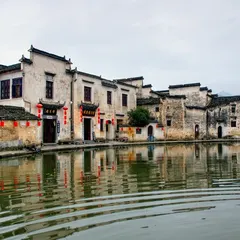
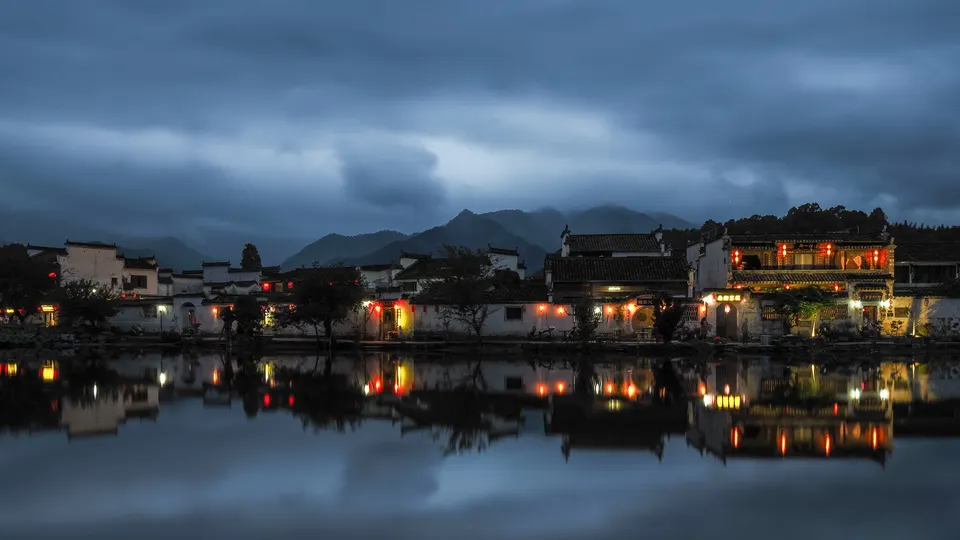
From the south shore appears the image that has earned Hongcun its fame as a “village in a painting”: the white façades and dark roofs are doubled in the still water, with the old South Lake Academy looking out from the north shore. Nothing about that framing is accidental. The lake was laid out in imitation of “Autumn Moon over the Calm Lake”, one of the classic scenes of West Lake in Hangzhou.
The comparison had an unexpected witness. The scholar Wu Xilin, a native of the Hangzhou area of all places, is credited with writing in the autumn of 1814 that the crowds strolling by the lake rivalled those of West Lake; hence, according to tradition, the nickname “little West Lake at the foot of Huangshan”. The shore remains an open-air workshop: in August 2026 the Xinhua agency photographed students painting from life beside the lake, heirs to the poets and painters who left verses and images here.
One night a year the lake changes role. At the Mid-Autumn Festival, Hongcun holds its lantern festival, recognised as intangible cultural heritage of Yixian County: a procession of about a hundred people spends nearly an hour going round the Moon Pond, the village entrance and South Lake with lanterns made and painted by hand, while the full moon floats on the water. How that night fits the original idea of the lake is the ending the audio guide keeps in reserve.