Ming Ancestral Hall
Lexu Hall Audio Guide (Lexu Tang)
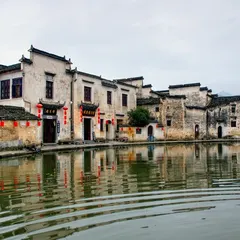
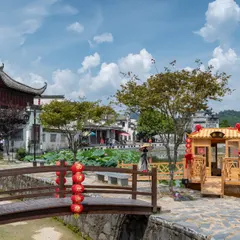
The ancestral hall of the Wang clan, set squarely in front of the Moon Pond, is the only Ming building still standing in Hongcun. For centuries it was much more than a temple: it was the real government of the village.
- 20 min of audio
- Huizhou Ming Architecture
Lexu Hall, the main ancestral hall of the Wang clan, occupies the centre of the north shore of the Moon Pond. According to the most widespread version, it was built in the early fifteenth century, in the first great period of prosperity of Hongcun, when the Wang were growing rich as officials and merchants. Today it is the only Ming-era building preserved in the village and heads the list of the ancient ensemble protected as a national monument since 2001.
Its “凸”-shaped plan measures about 24 metres across by about 33 deep, and the whole building rests on some seventy wooden columns. The sharpest contrast, however, lies in its history: here the lineage venerated its ancestors, debated the affairs of the village and enforced its own rules, and, as Hongcun tells it, the hall survived the Cultural Revolution because after 1949 it had become a grain store.
Highlights
- The only Ming building in Hongcun — A fifteenth-century survivor among 102 Qing and 34 Republican-era buildings
- Some seventy wooden columns — The “columns throughout the hall” technique and four faceted front pillars
- Carved moon beams — The Ming roof frame of the seven-bay hall, with brackets, struts and bearing blocks
- Jinshi plaques at the door — The pride of a clan that produced graduates of the highest imperial examination
- From temple to granary — The grain store that, so the story goes, saved it from the Cultural Revolution
On the north shore of the Moon Pond, at the heart of Hongcun, stands a building that competes neither in height nor in ornament with the merchant mansions around it. And yet it is the oldest in the village. Lexu Hall, known locally as Lexu Tang, was the main ancestral hall of the Wang clan: the place where the lineage venerated its ancestors and its sages, discussed important matters and enforced its own rules. Among one Ming building, 102 Qing ones and 34 from the Republican era, it is the only piece of the first prosperous Hongcun still standing.
The history of Lexu Hall begins with that of the village itself, founded in 1131 by families of the Wang clan who, depending on the version, arrived fleeing a fire or a war. In the Yongle era, the clan head Wang Siqi had the land surveyed by the geomancer He Keda, whom he called in as many as three times, and around 1405 he brought water into the village with an open channel. Sources disagree on the exact date of the hall, which some place in the early fifteenth century and others somewhat later, but all put it in the Ming era. What it holds inside, its architecture and its lesser-told episodes are best appreciated by walking through it with the audio guide, in three stops that run from the gateway to the back of the main hall.
The hall presides over the north shore of the Moon Pond, and a few streets away Chengzhi Hall shows the other face of the lineage: the private fortune of one of the clan’s salt merchants.
A Ming gateway among a hundred Qing houses
Lexu Tang (乐叙堂)
Summary of this stop
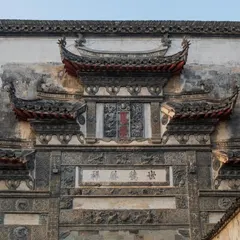
The façade looks straight onto the Moon Pond. From the threshold, hall and water together compose one of the eight classic views of Hongcun. The gateway combines stone with an arch of carved brick in the Huizhou style, and two stone drums flank the entrance. The front pavilion keeps its original form in essence, something exceptional in a village where almost everything on view is later.
That doorway also worked as a billboard of prestige. Above it hangs the “Shide Faxiang” plaque, dedicated to the moral heritage handed down by the Wang family. On either side, the jinshi plaques proclaim that the village produced graduates of the highest imperial examination, an honour that could only be displayed if the village had produced a jinshi. At the foot of this gateway, the narration reveals why the most discreet building in Hongcun is also the one with the most to boast about.
Rain courtyard and seventy columns
Lexu Tang light well
Summary of this stop
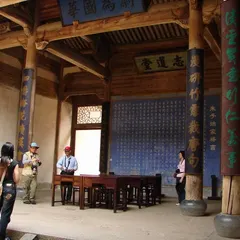
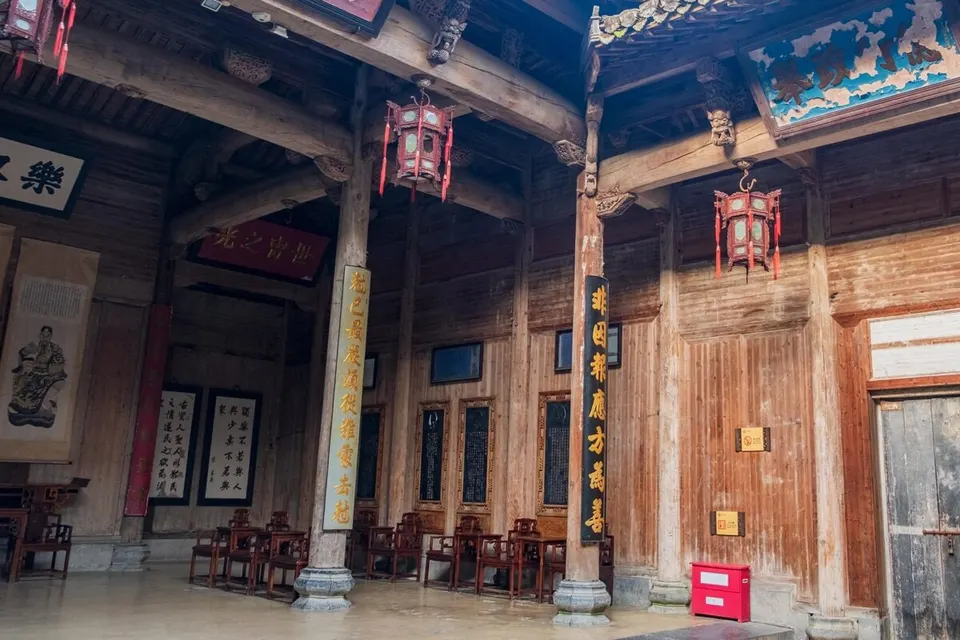
Beyond the entrance, the hall opens onto a central light well, through which sun and rain come in, surrounded by a gallery. Behind it extends the main hall, seven bays wide, held up by some seventy wooden columns spread across the whole room, the technique known as “columns throughout the hall”. The four front pillars stand out for their thickness and faceted section. Above, the roof frame keeps the typical Ming style: curved “moon” beams, struts, brackets and finely carved bearing blocks.
Local tradition adds an unusual episode to this work. Wang Xin, clan head and an official in Shanxi, is said to have paid for more than half of the construction without being in the village, and the villagers entrusted the direction of the works to his wife, Hu Chongniang, and to his sons. It is also said that the name did not come from the clan but from a district magistrate, Huang Biao, who proposed “Lexu” from a formula about order, family bonds and harmony. Beneath the beams, the audio guide completes the story of the text Wang Xin wrote about the hall and of the screen on which, according to the same tradition, it was carved.
From clan government to grain store
Lexu Tang main hall
Summary of this stop
At the back of the main hall it becomes clear what this whole forest of timber was for. Here the ancestors were worshipped, but village affairs were also debated, the lineage’s regulations enforced and ceremonies held. Between 1375 and 1606 the clan elites drew up their own regulations and covenants, and for centuries an unwritten rule held: state power did not reach below the county, and below it the clan ruled. In the village it is also known as “the hall of all the families”, and four branch halls are said to have depended on it. A couplet hung in the hall, as it has been handed down, sums up its programme: honouring the ancestors and bringing lustre to the house through study and good deeds.
The other half of the story is darker. Hongcun went into decline with the arrival of the Republic, and of its Ming phase only this hall has come down standing. According to village accounts, there were 26 ancestral halls here before 1966, and most of them disappeared during the Cultural Revolution; the Wang hall is said to have been saved because, after 1949, it served as a grain store. The lineage, meanwhile, goes on counting generations: a villager, Wang Senqiang, owner of the Shuren house, presents himself as a 95th-generation descendant of Wang Sheng and keeps genealogies of Hongcun. At this last point, the narration brings together the two faces of the place: the clan that governed and the granary that protected it.