Clan School
South Lake Academy Audio Guide (Nanhu Shuyuan)
In 1814 six private schoolrooms on the shore of a lake dug out of rice fields merged into a single school. Here the fortunes of Hongcun's merchants were turned into candidates for the imperial examinations.
- 25 min of audio
- Huizhou Architecture
South Lake Academy, Nanhu Shuyuan, was born in 1814 from the merger of the six private schools that the villagers of Hongcun had built on the north shore of the lake at the end of the Ming dynasty. The compound, of some 6,000 square metres, brings together a lecture hall, a pavilion for Confucius, two study pavilions, a tower overlooking the water and an inner garden, and is regarded as an archetype of the family academies that spread across the Huizhou region during the Qing dynasty.
It was the most serious wager of a village of merchants: investing their wealth in sons able to pass the empire's examinations. Two centuries later, the wager still stands. In September 2026 the first-year pupils of the Hongcun school held their initiation into letters here, with brush, tea for the teachers and a dot of cinnabar on the forehead.
Highlights
- Six schoolrooms in one — The Six Academies by the Lake, merged in 1814 into a compound of some 6,000 m²
- Yiwen Jiashu plaque — Calligraphy credited to Liang Tongshu, one of the great Qing calligraphers, then past ninety
- Zhidao Tang and the tablet of Confucius — The ladder of learning, from first letters to the imperial examinations
- Wanghu Lou — The tower where pupils rested with South Lake at their feet
- First-letters rite — First-year children, brush and a cinnabar dot before Confucius
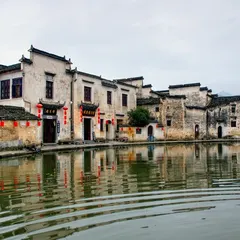
From the lakeside path, South Lake Academy looks like a single building: a long, low front of white walls and dark tiles doubled in the water. It is an illusion of unity. Behind that façade are six schools from the late Ming dynasty that the village decided in 1814 to merge into a single institution, the Nanhu Shuyuan, for a very specific purpose: preparing the sons of the Wang clan for the imperial examinations.
The history of South Lake Academy is that of Hongcun in its second great age of prosperity, between 1796 and 1908, when the Wang family produced officials and merchants who amassed fortunes and brought them back to the village turned into stone and timber. The scholar Wang Daokun described the merchants of Huizhou as “traders who love Confucianism”, and few places explain the idea better than this one. Knowing what to see at South Lake Academy means reading that idea in its plan: halls, pavilions, a tower and a garden. The audio guide covers the complex in four stops, from the shore to the tower.
The school looks straight out onto South Lake, and the merchant fortune that sustained it can be seen in all its splendour at Chengzhi Hall, the 1855 mansion of a salt merchant. A few steps away stand Hongcun’s ancient trees at the village entrance.
A façade that adds up to six schools
South Lake Academy (南湖书院)
Summary of this stop
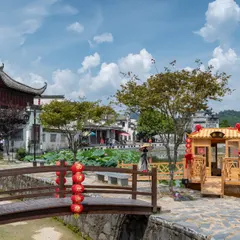
The first encounter is with the water. South Lake is not natural: it was dug in 1607 by deepening some hundred mu of rice fields south of the village and enclosing them with stone walls, in imitation of the “Autumn Moon over the Calm Lake” scene of West Lake in Hangzhou. With it the water system of Hongcun was completed, some two centuries after the channel of around 1405.
Along its north shore, the villagers lined up six private schools, known collectively as the “Six Academies by the Lake”. That is why some sources date the academy to 1814 while others prefer to count from those Ming schoolrooms: what today covers some 6,000 square metres is the sum of them all. In front of the façade, with the central causeway and the painted bridge crossing the lake, it becomes clear that the still water and the school were conceived together. What that reflection says about the village’s ambition is left for the narration on the shore itself.
A villager’s name over the door
Yiwen Jiashu (以文家塾)
Summary of this stop
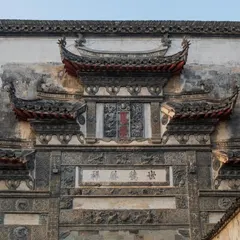
Above the entrance, a plaque gives the school’s official name: Yiwen Jiashu, “family school for cultivating letters”. The calligraphy is credited to Liang Tongshu (1723–1815), a former reader of the Hanlin Academy counted among the four great calligraphers of the Qing dynasty, who is said to have written it at about 93 by Chinese reckoning, shortly before his death.
The name also hides a local story. It is said that in 1810 the villager Wang Yiwen and the wealthy merchant Wang Shoujia invited a senior examination official, Luo Wenpin, for a stroll by the lake, and that it was he who proposed uniting the six schools into one great college. According to the story, the rich families put up the money and the poor ones the labour, the work took four years and the name on the plaque was chosen to honour Wang Yiwen. The word “Yiwen” thus carries a double reading that the audio guide reveals in front of the door.
From the first character to the imperial examinations
Zhidao Tang (志道堂)
Summary of this stop
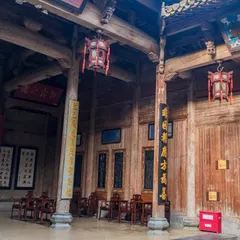
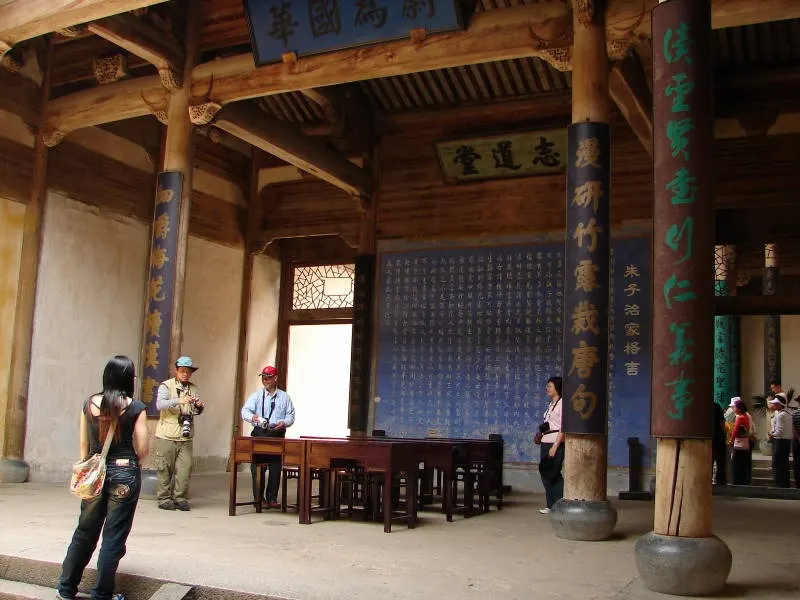
The architecture of South Lake Academy reads like a staircase. Qimeng Ge took in the children who were starting to read; Huiwen Ge, those already studying the Four Books and the Five Classics; Zhidao Tang was the hall where the master gave lessons, and Wenchang Ge kept the tablet of Confucius before which the pupils paid homage. Clans built schools like this to educate their own descendants in the hope of seeing them pass the imperial examinations and reach high office.
At the top of that staircase appears a surname. Wang Daxie, of a lineage with an ancestral home in Hongcun, obtained the juren degree in 1889, served as Qing envoy to Britain and Japan and was acting premier of the Republic of China in 1917 and in 1922. A local version holds that he received his first schooling here; his biography, by contrast, has him born in Hangzhou, with no documented time at the academy. The courtyard of Zhidao Tang also holds the clue to a rite that is still repeated in this place.
A tower for resting with a view of the lake
Wanghu Lou (望湖楼)
Summary of this stop
Wanghu Lou, the tower for gazing at the lake, was where pupils looked up from their books. Beside it, the inner garden of Zhiyuan served as a space for reading and rest. The compound is part of Hongcun’s ensemble of ancient architecture protected as a national monument of China, and today its surroundings draw painters who work from life by the water.
Its teaching role has not died out. According to village accounts, the compound has housed the Nanhu Central Primary School, and on 4 September 2026 the first-year pupils of the Hongcun school held their initiation into letters here: traditional dress, an oath before a portrait of Confucius, tea for the teachers, the character for “person” traced with a brush and a dot of cinnabar on the forehead to awaken wisdom. Hongcun also tells that Li Xiaojuan, one of the specialists who worked on the launch of the Australian satellites, learned her first letters in these halls. The stories of those who left this shore and went very far are saved for the last stop of the narration.