UNESCO World Heritage
Hongcun Water Channels Audio Guide
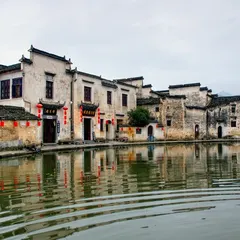
A mountain stream diverted six centuries ago runs past every door in Hongcun and slips beneath its halls: the streets were not laid out first and given water afterwards; it was the water that drew the village.
- 20 min of audio
- Hydraulic Engineering
The network of stone channels of Hongcun was born around 1405, when the Wang clan, punished for generations by fires and droughts, followed the advice of geomancers and diverted part of a mountain stream into the village. A stone dam at the head and a masonry channel that moves forward on the slope of the land alone were enough to bring fresh water to every house. The course, of “nine bends and ten curves”, set the line of streets and alleys, and some two hundred years later the system was completed with South Lake. When Hongcun was inscribed as a World Heritage Site in 2000, UNESCO singled out that integration of houses with a complete water system as a unique surviving example.
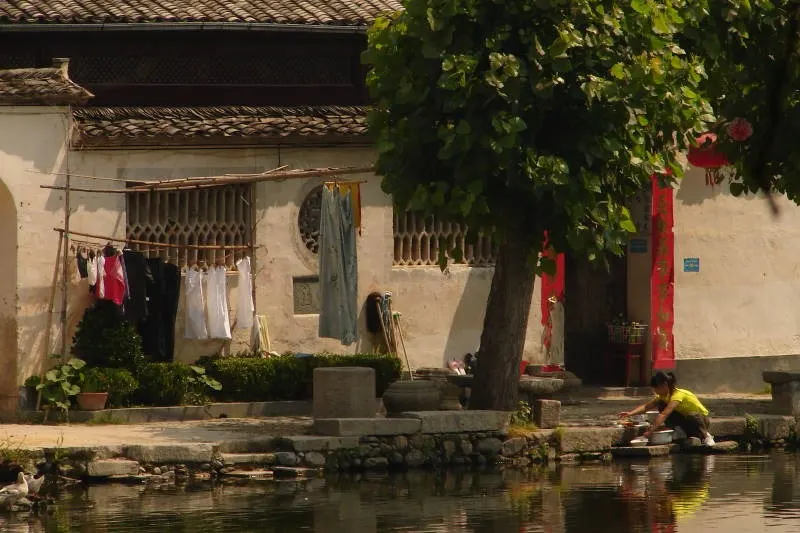
In the symbolic plan of the village, drawn as an ox, this winding channel is the animal's intestine. And it still works as it did on the first day: an old clan rule, according to tradition, reserved the water for drinking until eight in the morning; today villagers still wash clothes and vegetables on its stone steps, and during the deluge of June 2024 the flooded street drained, according to the head of the village committee, in under half an hour.
Highlights
- Head dam — the origin of the channel, around 1405
- Main channel — nine bends and ten curves past every door
- Stone steps — the everyday washing place of the village
- Deyi Tang — a pond from 1815 fed by the channel
- Channel street — the water always at the same level
Anyone planning what to see in Hongcun tends to think of its clan halls and the Moon Pond, but the thread that ties everything together runs at ground level. The village was founded in 1131 by the Wang clan and, during its first centuries, far from the stream, fires razed many houses and there were years of drought with no harvest. In the Yongle era (1403–1424), the clan head had a fengshui master survey the land, rearranged the buildings and brought in the water: around 1405 the channel that still runs beside the façades today was dug. The history of the Hongcun water channels is also the history of its architecture, because the grid of streets was built following the course of the water, and some families even brought it inside their homes. Accounts differ on its length, which some sources put at just over four hundred metres and others at about 1,200, probably because they measure either the main stretch or the whole network. The full route, from the dam to the point where the water leaves the village, makes sense by following the current with the audio guide, stop by stop.
The channel flows into the Moon Pond and from there the water carries on to South Lake; its source, the Xixi Stream, passes beside the ancient trees at the village entrance.
The dam born of fire
Xixi Stream dam
Summary of this stop
At the head of the village, a stone wall crosses the stream from bank to bank and diverts part of its flow into a masonry channel. There are no pumps and no wheels: the water moves forward using only the fall of the land. Sources do not agree on the name of the stream, which one version calls the West Stream and others name differently, but they do agree on the reason for the work. Beside the dam stands a replica of a stele whose original was erected in the spring of 1434 to explain why the Wang clan built the water system: two centuries of fires and years of great drought.
The authorship of the layout is still disputed. One version credits it to Wang Siqi, who hired the geomancer He Keda of Haiyang (present-day Xiuning) three times; another attributes it to a woman, Hu Zhong, said to have set the water plan of the village in the Ming era. In February 2000, under intermittent drizzle, the ICOMOS expert sent to evaluate the World Heritage nomination climbed up to this very dam. What he concluded after walking the channel is kept for the narration, at the point where the water begins its journey.
The ox’s intestine and the eight o’clock rule
Lane channel
Summary of this stop
In the alleys, the channel runs tight against the façades, with clear water always on the move. In front of the doors, slabs step down to the water: these are the stone steps, used for centuries to wash clothes and vegetables, draw water or irrigate kitchen gardens. The channel was the running water of the old village, and a couplet sums it up: to wash and draw water there was no need to walk far to the stream, because a clear spring ran past every door and down every alley.
According to tradition, the ancestral rule of the Wang clan laid down that channel water was for drinking until eight in the morning and that only after that hour could it be used for washing; another version speaks of water for cooking, and the original text of the regulation does not survive in the sources consulted. This stretch also reveals the symbolic reading of the village: Hongcun is conceived as an ox, with its head on Leigang Hill, its horns in the two trees at the entrance, its body in the houses and its legs in four old bridges. The winding channel is its intestine.
When the stream comes indoors
Covered stretch of the channel
Summary of this stop
At some points, the channel disappears beneath a wall or a threshold, crosses halls and courtyards and reappears in the street. Certain families went further and diverted the water into their homes to create water courtyards with fish ponds, such as Biyuan or Deyi Tang. The latter, from 1815, has in front of its hall a pond linked to the channel by a hidden conduit and surrounded by gardens: water in the garden and garden in the water.
That luxury comes at a price, because in the darkness of the covered stretches the silt settles. When Hongcun was inscribed in 2000, erosion in the surroundings had lowered the water level and silted up the channels, although most of the system remained in reasonable condition. That is why, every year, in the first lunar month and usually before Chinese New Year, the whole village clears out the mud with shovels, each household along the stretch beside its own house, with no machinery so as not to damage the old materials. At the hardest points someone has to climb inside to dig. Legend has it that, when there were no tools to unblock them, turtles were raised in these stretches and, with their constant coming and going, kept the mud from settling.
The village that does not flood
Channel street
Summary of this stop
Downstream, the current works like a compass: going against it leads into the village, and following it leads towards the exit and South Lake. The water passes through the Moon Pond, continues to South Lake, irrigates fields and orchards and returns to the river. Rain or no rain, its level stays at a fixed height, a little below the small slab bridges that lead to the doors, and that design of living water all year round explains how the village has come through repeated floods.
The most recent test came in 2024, when an average of 590 mm of rain fell on Huangshan between 18 and 28 June and many tourist sites closed. Hongcun stayed open: the sluice gates of the dam were shut so the channels only had to drain the rainfall and, according to the head of the village committee, the water that overflowed into the street stayed under 20 cm and drained away in less than half an hour. It is the integration of houses and water that UNESCO judged unique in 2000, and which villagers still use for their daily washing. The comparison with two great European cities left by that year’s evaluation visit is saved for the end of the route.