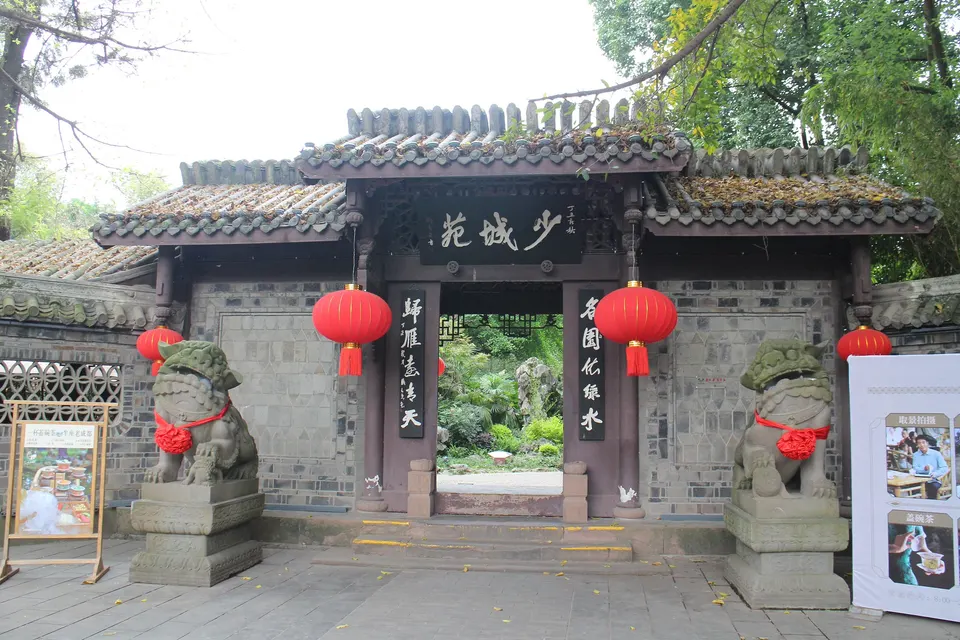
Sichuan's first public park
People's Park Audio Guide (Renmin Gongyuan)
The Manchus opened Sichuan's first public park here in 1911, the same year as the revolt that hastened the end of their dynasty. Today Chengdu's People's Park holds an obelisk to the railway rebels, the century-old Heming teahouse by the water and a corner where parents look for partners for their children.
- 75 min of audio
- Century-old teahouse
In 1911 General Yu Kun, commander of the Manchu garrison of Chengdu, turned part of Shaocheng, the Eight Banners enclosure, into a park to support the bannermen's families: it was the first park in the history of Sichuan. In its northwest sector stands the Monument to the Martyrs of the Railway Protection Movement, a brick and stone obelisk about 31.85 metres tall that the Sichuan Railway Company raised in 1913, with rails, sleepers and a locomotive carved on the pedestal. By the lake the Heming teahouse is still open, founded in 1923 and the only survivor of the six the park had in the Republican period.
The park holds unexpected episodes. According to a documented tradition, in 1946 a giant panda named Lianhe, a gift from the Nationalist government to Britain, made a brief stop here on its way to London Zoo and was the only panda exhibited in a park or zoo in China before 1949. In autumn 1952 some farmers from Yibin brought in a captured leopard and locked it in the broken cages of an old animal corner, and the queues of curious onlookers never stopped; with a foreign delegation due to pass, the city council moved it to a woodshed behind the Qingyang temple, and from that the Baihuatan zoo was born, opened in 1953.
Highlights
- Railway martyrs obelisk — About 31.85 metres of brick and stone with the same phrase in four calligraphies
- Pedestal reliefs — Rails, sleepers, a track switch and a locomotive under steam
- Heming Teahouse — Founded in 1923, the only survivor of the park's six Republican-era teahouses
- Gaiwan tea by the lake — Long-spout copper kettles and wandering ear cleaners among the tables
- Matchmaking corner — Between 300 and 400 parents look for partners for their children on busy days
In 1911, as Qing power was cracking, the Manchu general Yu Kun, commander of the Chengdu garrison, turned part of Shaocheng, the Eight Banners enclosure, into a park to support the bannermen’s families. That is how the first public park in the history of Sichuan was born, known for decades as Shaocheng Park and today as People’s Park (Renmin Gongyuan, 人民公园). The paradox was written in brick: soon afterwards, on that same Manchu ground, the Sichuan Railway Company raised an obelisk to the martyrs of the revolt that hastened the end of the dynasty.
The history of People’s Park is that of Chengdu in the twentieth century. On 5 September 1937 the first Sichuan troops leaving to fight Japan swore their oath here. Japanese aircraft bombed the park on 27 September 1940 and 27 July 1941, damaging the museum, the stadium and the zoo in raids that left thousands of casualties, and the obelisk stayed standing. A memorial wall recalls those bombings, and the statue of the Unknown Soldier of the Sichuan army, rebuilt in 1989, pays tribute to the more than 600,000 Sichuanese soldiers killed in that war. Beneath the park lies also Air-Raid Shelter No. 1, built in 1965: a vaulted tunnel 200 metres long, the oldest civil defence work the city preserves, open today for free as a refuge from the heat.
What to see in People’s Park is arranged in five beats: the obelisk, the railway reliefs on its pedestal, the Heming teahouse, its terrace by the lake and the corner where parents look for partners for their children. The architecture runs from the Republican obelisk to the old buildings of the Popular Education Center, now an exhibition hall on the Railway Protection Movement, and the Zhongzheng Library, but the park is understood above all by what has happened at its tea tables, a plot the audio guide unfolds from stop to stop.
The park occupies ground of the old Manchu city, whose last surviving remains are the lanes of Kuanzhai Alley, less than a kilometre away. Tea under the trees has another appointment at Wenshu Monastery, and the story of Chengdu’s pandas, which peeks out in the park’s old zoo, continues at the Chengdu Panda Base.
Eight Banners under a monument to rebels
Monument to the Martyrs of the Railway Protection Movement (辛亥秋保路死事纪念碑)
Summary of this stop
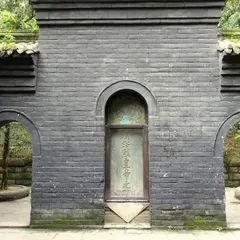
In the park’s northwest sector stands the Monument to the Martyrs of the Railway Protection Movement, a brick and stone obelisk about 31.85 metres tall (the park’s old official history and other sources give 31.86). It rests on a circular platform of 4.2 metres reached by 23 steps and consists of platform, pedestal, shaft and crown, a four-sided roof of glazed tiles with small spires joined by chains. Since 2016 it has been surrounded by a red sandstone railing. The park’s official website attributes the design to Wang Nan; other sources give it to Wang Mudan, a graduate of the Chengdu Railway School.
Its verticality contrasts with the domestic scale of the park, and the contrast is historical too: the ground it stands on was part of Shaocheng, the Eight Banners enclosure that the Manchu garrison opened as a park in 1911. Each face of the shaft repeats the same phrase, “辛亥秋保路死事纪念碑”, in a different calligraphic style, the work of four calligraphers. How a tribute to those who rose against the Qing ended up planted in the heart of the old Manchu quarter is left for the narration, at the foot of the obelisk itself.
Rails, sleepers and a locomotive in stone
Railway reliefs on the pedestal
Summary of this stop
On the pedestal sections the monument explains itself: rails, bolts and sleepers, a signal, a track switch and a locomotive under steam, carved in relief. On the south face, a white marble tablet bears the inscription of the Sichuan Railway Company, dated year 2 of the Republic, 1913.
That railway was the origin of everything. On 7 September 1911 the viceroy of Sichuan, Zhao Erfeng, arrested the leaders of the Railway Protection Movement and ordered his men to fire on the petitioners gathered in front of his office in Chengdu. One source puts the dead at 32 and another at “more than 30”: it was the so-called Chengdu Bloodshed, which turned a peaceful protest into an armed uprising against the Qing.
The date of the monument itself also admits nuance: the tablet and several sources place it in 1913, while others speak of a year of work between 1913 and 1914 and an inauguration in 1914, held just before the anniversary of 7 September. How a railway line ended up hastening the fall of a dynasty is the thread the audio guide untangles in front of the south face.
The singing crane, last of six
Heming Teahouse (鹤鸣茶社)
Summary of this stop
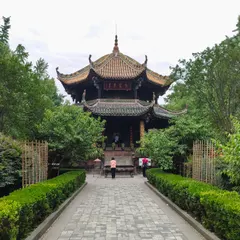
The Heming teahouse, “singing crane”, opened in 1923, when a merchant named Gong, from Dayi County, decided to set up a tea salon after strolling through Shaocheng Park. The name has two explanations: one attributes it to a dream of the founder with cranes singing in a pond; the other, to Mount Heming in his home region, a founding site of Taoism. In 1940 Gong handed the business over to Xiong Chuoyun, who commissioned the sign from the calligrapher Wang Jiazhen and expanded the place to more than 500 seats.
That sign was destroyed in 1952, but the horizontal board with the two characters “鹤鸣” that hangs today was rewritten in June 1988 by Wang Jiazhen himself. It is the signature of a house that has survived alone: of the six teahouses operating in the park in the Republican period, among them Zhenliu, Yongju, Lüyinge and Shedehui, only Heming is still open. In 1952, when the park, by then renamed People’s Park, reopened, most of the teahouses, restaurants and private bathhouses moved out.
According to a documented custom of that era, each teahouse had its clientele: students at Zhenliu, rich merchants at Yongju, local notables at Lüyinge, martial arts people at Shedehui, which was also the seat of the Shede archery society, and scholars at Heming. What the table someone chose said about them is told in front of the sign.
Contracts, novels and a last look by the lake
Tea terrace by the lake
Summary of this stop
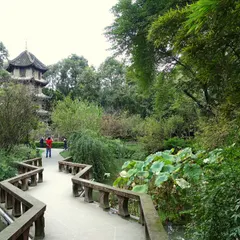
Heming’s terrace takes up open-air tables under the trees, beside the canal and the lake of the central island, the old lotus pavilion, fed since 1914 by a channel diverted from the Jin River. Tea is served in three-piece gaiwan, lid, cup and saucer; tea masters pour it from long-spout copper kettles and wandering ear cleaners circulate among the tables. A couplet hung in the house sums up the spirit of the place: “All is emptiness: sit a while without telling yours from mine; there is a road on both sides: drink a cup and let each follow their own.”
Those open-air tables have a history of their own. In 1929 the government forbade teahouses to put them out on the street and in parks, and those of Shaocheng, Zhongcheng and Zhijishi parks jointly submitted a petition to defend such an old custom. In the Republican period, moreover, Heming was the teachers’ meeting point: in the holidays of the sixth and twelfth lunar months, primary and secondary school teachers waited here for their contracts for the following school year, in a downward salary auction that Chengdu dubbed the “June and December war”.
Attentive ears also passed by these tables. A conversation the writer Ma Shitu overheard at Heming ended up in his novel “Daoguan ji” and, later, in the film “Let the Bullets Fly” (2010). During the war against Japan, the historian Chen Yinke, already blind in his right eye, took tea here and at Lüyinge, and the writers Zhu Ziqing and Ye Shengtao, who lived at opposite ends of the city, often met at Heming to see each other halfway. What was the last thing Chen Yinke ever saw is told on the terrace itself.
From the steel market to the in-laws’ market
The park's matchmaking corner
Summary of this stop
The matchmaking corner is a stretch of path where parents display sheets with the age, height, education and job of their unmarried children and chat among themselves in search of future in-laws. It sprang up spontaneously in 2005 and on busy days gathers between 300 and 400 parents; the huddles and the papers read up close give the place the air of a trading hall.
It is not the first time the park has served as a market. In 1984 the Chengdu Means of Production Service Company opened an unmarked market at Heming: every Friday morning steel, cement and other industrial materials were traded there over cups of tea. The thread that links the steel deals with other people’s marriages closes the audio guide’s route.