Chengdu's great Taoist temple
Qingyang Palace Audio Guide (Qingyang Gong)
A market where, by tradition, Laozi summoned his disciple; a provisional palace for an emperor in flight; two bronze goats that shine from so much rubbing. Qingyang Gong has spent centuries replacing what it loses, and it lives on thanks to the hands of its worshippers.
- 45 min of audio
- Taoist architecture
Qingyang Palace, Qingyang Gong, is the great Taoist temple of Chengdu. Its foundation is dated to 491 BCE, year 25 of King Zhao of Chu, under the name Qingyang Si, the green goat market, although that antiquity rests on the legend of Laozi and Yin Xi. In 881 Emperor Xizong of Tang, fleeing the Huang Chao rebellion, turned it into a provisional palace, and in 883 he paid for its expansion and gave it the rank of gong, palace. The Tang-era halls fell in the wars of the Ming dynasty; those that follow one another along the axis today were rebuilt between 1667 and 1671, under the Kangxi emperor, with an octagonal pavilion of 81 dragons and a main hall held up by 36 columns.
In the Song period, Qingyang Gong was Chengdu's great stage for plum blossom. The scholar Zhao Bian already records a plum market at the temple in the eleventh month, and the poet Lu You, posted to Sichuan, wrote that spring came earlier here. Already old, back in his native Shanyin, he went on remembering how he got drunk on flowers west of the Brocade City: twenty li of unbroken perfume, from Qingyang Gong to the Huanhua stream.
Highlights
- Bagua Pavilion — 81 dragons, one for each transformation of Laozi, in a structure assembled without wedges or bolts
- One-horned goat — Brass donated in 1723 that combines features of the twelve animals of the Chinese zodiac
- Sanqing Hall — 36 columns: 8 of wood for the Heavenly Kings and 28 of stone for the lunar mansions
- Imperial refuge — Emperor Xizong of Tang used it as a provisional palace in 881
- Taoist canon printing blocks — More than 13,000 pear-wood blocks carved in 1906 for the Daozang Jiyao
Qingyang Palace, known in Chengdu as Qingyang Gong (青羊宫), is the city’s great Taoist temple: a succession of courtyards and halls aligned on a single axis, from the gateway with the golden plaque to the terraces at the back. Its name comes from a market. The foundation is dated to 491 BCE, year 25 of King Zhao of Chu, when the place was called Qingyang Si, “the green goat market”. That antiquity, however, rests on the legend of Laozi and his disciple Yin Xi: the first text that records the name “Qingyang”, the Shu Wang Ben Ji attributed to Yang Xiong, is from the Western Han, centuries later, and the buildings seen today date from 1667-1671 and after.
The history of Qingyang Palace is a chain of replacements. A legendary market gave way to a monastery, and the monastery to a palace when a fleeing Tang emperor took refuge in it; the wars of the Ming dynasty razed the Tang halls and the Qing dynasty raised them again under Kangxi; a great bronze goat disappeared and two others took its place. According to the temple’s documented tradition, in 1966, when the Cultural Revolution broke out, its Taoist priests were expelled and forced back to lay life. What to see at Qingyang Palace is arranged in five stops along the axis, and its architecture, with columns that count stars and a pavilion that draws the cosmos, makes full sense when walked with the audio guide.
The city’s other great living temple, in this case Buddhist, is Wenshu Monastery. Its nearest neighbours are the Du Fu Thatched Cottage, a kilometre and a half away, and Wuhou Shrine, less than two.
A golden plaque that names a market
Qingyang Palace (青羊宫)
Summary of this stop
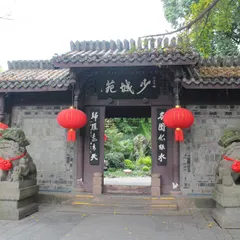
In front of the main gateway, the sign of golden characters “青羊宫” presides over the entrance; the original gateway was Ming-era. Those three syllables keep a name older than any of the buildings in the compound: Qingyang Si, the green goat market, the designation by which its foundation is dated to 491 BCE.
According to tradition, Laozi, after dictating the Tao Te Ching to the border guardian Yin Xi, summoned him a thousand days later at the green goat market of Chengdu, and Yin Xi kept the appointment. The legend, which already in Tang times was recorded on the stele “Inscription of the Qingyang Palace of Xichuan” by Le Penggui, adds a disguise: at the market it was not the sage who waited, but a boy leading a goat by a rope, a lad in the service of the Green Emperor sent by Laozi and transformed for the occasion. The boy led Yin Xi to the house of a certain Mr Li, where Laozi had just been reborn as a baby born already with white hair.
What happened in that house in front of the disciple, and why the temple bears the name of a messenger and not that of a sage, is left for the narration, in front of the plaque.
The fugitive emperor who turned the monastery into a palace
Lingzu Hall
Summary of this stop
The first hall on the axis, the Lingzu Hall, of about 400 m² and some 20 m tall, opens the sequence of courtyards. In front of it you grasp the jump in rank the place made. In 881, fleeing the Huang Chao rebellion, Emperor Xizong of Tang took refuge in Sichuan and used the temple, then called Xuanzhong Guan, as a provisional palace; there he held rites of fasting and offering.
In 883, already back in Chang’an, Xizong granted two million coins from the treasury and ordered “guan”, monastery, changed to “gong”, palace. With that money the monks expanded the compound, which came to be called Qingyang Gong. That is the most widespread version; another places the adoption of the name “Gong” in the Song dynasty.
Of that Tang palace nothing remains standing: the wars of the Ming dynasty destroyed its halls, and the present ones were rebuilt in stages between 1667 and 1671, under the Kangxi emperor. In the courtyard of the Lingzu Hall, the audio guide follows the trail of that imperial flight that changed the name of the place for ever.
Eighty-one dragons without a single nail
Bagua Pavilion
Summary of this stop
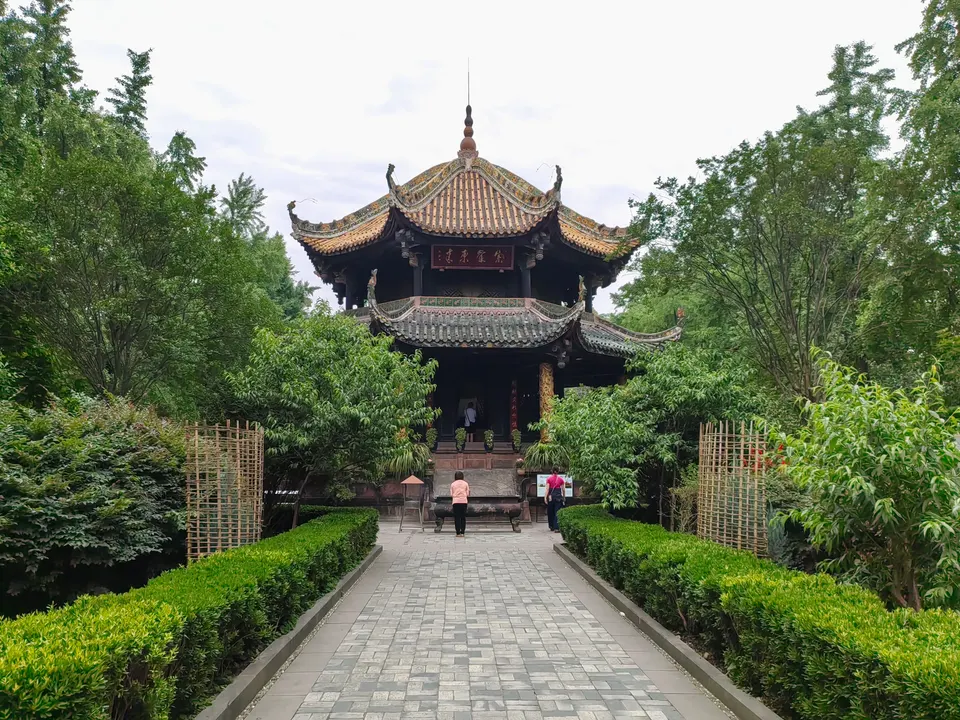
Past the Hunyuan Hall, rebuilt under Guangxu and dedicated to Laozi as Taishang Laojun, rises the Bagua Pavilion, of the Eight Trigrams. It is an octagonal pavilion conceived as a diagram of the cosmos: a square stone base under a round body, following the formula “round heaven, square earth”, with yellow, green and purple glazed tiles and a ceramic finial in the shape of a gourd about 3.6 m tall. It is held up by 16 solid stone columns of about 4.8 m, and the whole wood and stone structure fits together by joinery, without a single wedge or bolt. Inside, a statue shows Laozi riding a green ox.
The pavilion gathers 81 dragons, one for each of Laozi’s 81 transformations, and the eight outer columns appear wrapped in openwork relief dragons. According to the temple’s tradition, on the eve of finishing the work, at midnight, the stone dragon coiled round the column facing the Sanqing Hall came to life and tried to escape flying among the clouds; the celestial messenger on guard that night caught it and nailed it to the column with a divine punch.
They say the mark of that fist is still at the top of the column. Under the pavilion, the narration points out which one it is and what else its geometry hides.
Bronze goats worn smooth by hands
Bronze goats of the Sanqing Hall
Summary of this stop
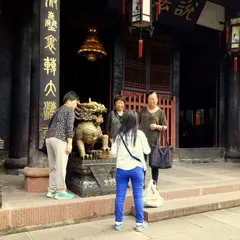
On the staircase of the Sanqing Hall, or Wuji, the main hall rebuilt in 1669, two bronze goats wait. The one on the left, one-horned, was donated in 1723, year 1 of Yongzheng, by the grand secretary Zhang Penghe; the one on the right, two-horned, was donated in 1829, year 9 of Daoguang, by a devotee from Chengdu of the Zhang family. Behind, the statues of the Three Pure Ones and the Twelve Golden Immortals rise among a forest of 36 columns: 8 of wood, for the eight Taoist Heavenly Kings, and 28 of stone, for the 28 lunar mansions.
The one-horned goat, cast in brass, is a puzzle: rat ears, ox nose, tiger claws, rabbit back, dragon horn, snake tail, horse mouth, goat beard, monkey neck, rooster eyes, dog belly and pig haunches, the twelve animals of the Chinese zodiac in a single body. A plinth bears a four-line poem signed “Xinyangzi”, Zhang Penghe’s pen name: the goat was bought at a market in Beijing and brought to the old sanctuary of Chengdu, where Yin Xi seems to recognise it. It came, according to its donation, “to replace Laozi’s trace”, because in the Ming period the temple already had a bronze goat “as big as a deer” that vanished without a trace; perhaps it ended up melted down to mint coins in the days of Zhang Xianzhong, the rebel warlord who occupied Sichuan at the end of the Ming dynasty, although its fate remains a mystery.
The goats shine from so much rubbing: touching the belly or the head eases, according to belief, a stomachache or a headache. Which bronze those hands receive today is a matter of disagreement: some descriptions present both goats as polished by touch, while others specify that Zhang Penghe’s is kept as a heritage piece and that on 9 June 2004 a replica was consecrated for worshippers to touch. At the staircase, the audio guide solves the zodiac puzzle animal by animal.
Thirteen thousand blocks and a flower fair
Jiangsheng, Shuofa and Tang Wang terraces
Summary of this stop
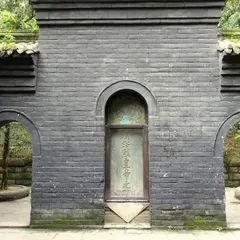
Behind the Doumu Hall, dedicated to the Mother of the Bears, mother goddess of nine stellar sons in the Taoist tradition, the axis ends in three terraces: the Birth terrace (Jiangsheng) on the left, the Preaching terrace (Shuofa) on the right and, in the centre, the Zijin terrace or Hall of the King of Tang, with the statues of Li Yuan, his wife and Li Shimin. Beyond the wall, the adjoining garden occupies the site of the Erxian An, the hermitage of the Two Immortals, built from 1695, year 34 of Kangxi, where the immortals Lü Dongbin and Han Xiangzi were said to have appeared. It was the mother seat of the Longmen Dantai Bidong branch of Quanzhen Taoism, and its grounds are today Chengdu Cultural Park.
In that hermitage in 1906, year 32 of Guangxu, the He Longxiang and Peng Hanran edition of the Daozang Jiyao, the compendium of the Taoist canon, was published. The temple keeps its woodblocks: pear-wood blocks engraved on both sides, more than 13,000 by the most quoted figure and more than 14,000 by other sources. After the Cultural Revolution, according to documented tradition, Abbot Zhang Yuanhe agreed with the publisher Bashu Shushe to reprint the compendium from those same blocks.
That same year 1906, the Qingyang Gong flower fair, held on the 15th day of the second lunar month, gave rise to the Industrial Promotion Exhibition (Quanye Hui): Chengdu was the first city in inland China to turn a temple fair into a modern exhibition. The flower fair went on being held in the Republic although the exhibition was suspended several times. At the end of the route, the narration links the birth of Laozi with that other life of the temple, the one that came out of its walls.