Buddhist monastery
Wenshu Monastery Audio Guide (Wenshu Yuan)
A working Chan Buddhist monastery in the heart of Chengdu that burned to the ground and was reborn around the hut of a single monk: today its 80 monks chant in Sichuanese dialect and entry is free all year.
- 60 min of audio
- Chan Buddhism
Wenshu Monastery was founded in the Daye era of the Sui dynasty (605–617) under the name Xinxiang Temple. At the end of the Ming, war razed it and only ten iron statues and two thousand-year-old firs were left; in 1697 the monk Cidu rebuilt it and gave it the name it keeps, Wenshu Yuan, after Manjushri. The expansion of the Daoguang era (1821–1850) fixed its present architecture: an axis of wooden halls in the style of the western Sichuan plain, reinforced with 82 stone columns and filled with bronze-cast images.
The contrast is in the life that goes on inside. The same community that keeps a fragment of the monk Xuanzang's bone, saved during the Cultural Revolution, and four sutras said to have been copied in blood, maintains morning and evening chanting with a Sichuanese-dialect chant handed down for more than 300 years, and since 2017 has served free tea to the public on Sundays and Buddhist festivals: more than 1,100 servings a day on average.
Highlights
- Main gate — The 1830 inscription that still recalls the old name, Xinxiang Temple
- Mahavira Hall — 10.56 m tall, bronze Buddhas of 1829 and two jade Buddhas brought from Burma
- Cidu's firs — The corner where a monk meditated among ruins and the monastery was reborn in the 17th century
- Thousand Buddhas Peace Pagoda — Iron, about a thousand Buddha figures and the ritual of three circuits
- Xiangyuan teahouse — Tables under the trees, a vegetarian canteen and free tea on Sundays
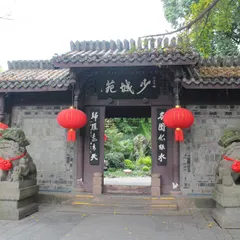
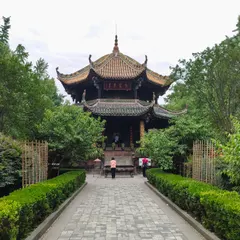
In the very centre of Chengdu, a three-bay wooden gateway leads into Wenshu Monastery (文殊院, Wenshu Yuan), a Chan Buddhist monastery that is not a museum but a home: about 80 resident monks under Abbot Zongxing, morning and evening chanting, the ritual meal in the refectory and confession every fortnight. It charges no entry on any day of the year, and within its courtyards incense smoke, wooden halls and tea tables under the trees live side by side.
The history of Wenshu Monastery has two births. The first, in the Daye era of the Sui dynasty (605–617), as Xinxiang Temple; some travel guide places it already in Tang times, but official and encyclopedic sources keep the Sui date. The second came after the war that at the end of the Ming burned all its buildings: in 1681 (1682 according to other sources) the monk Cidu settled to meditate among the ruins, and in 1697 he rebuilt it and gave it the name Wenshu, Manjushri in Chinese. The Kangxi emperor summoned him to court three times and three times received a no; in 1702 (1701 for the Chengdu Buddhist Association) he gave the monastery a board with the characters “Konglin”, “empty forest”, hence its other name, Konglin Tang.
The compound also holds pieces surrounded by tales in tradition: a kasaya embroidered with 248 Buddha figures attributed to Consort Tian, favourite of Chongzhen, the last Ming emperor; a Guanyin embroidered with human hair by the daughter of a viceroy of Shaanxi and Gansu; and a seven-storey pagoda drawn with the entire Diamond Sutra in characters of 4 mm. To learn what to see at Wenshu Monastery and read its architecture, from the gate that still bears the old name to the Xiangyuan tea tables, the audio guide walks the compound in five stops and an hour of narration, following the thread of a monk who said no to an emperor and of a community that still serves tea to whoever arrives.
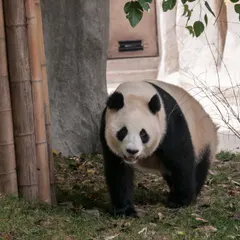
The open-air tea tables have their counterpart in the Heming teahouse in People’s Park, and the monastery’s Taoist counterpoint is Qingyang Palace. To the north, about ten kilometres away, lies the Chengdu Panda Base.
A fourteen-century-old name above the gate
Wenshu Monastery (文殊院)
Summary of this stop
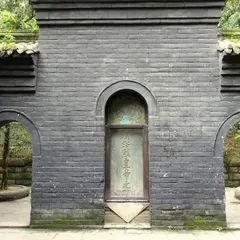
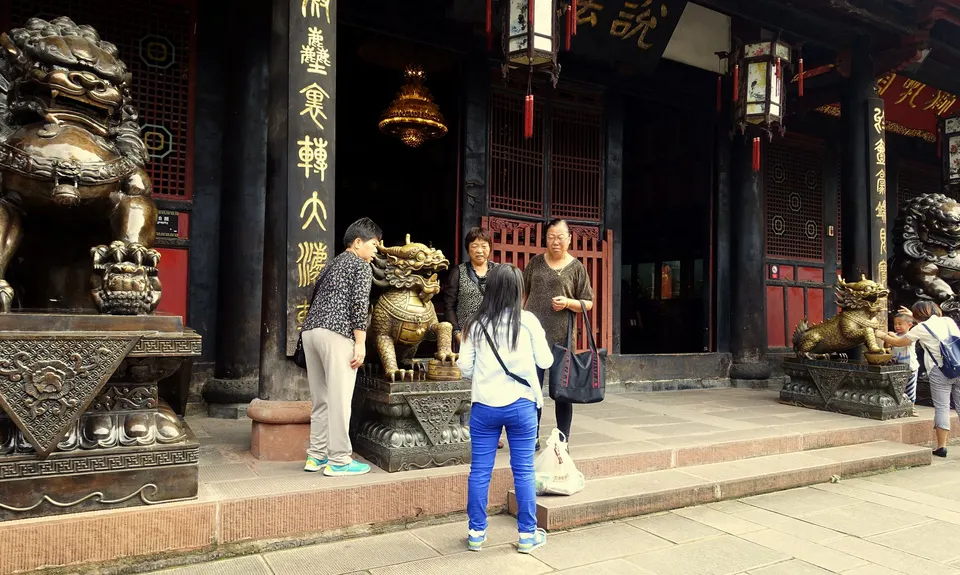
The entrance gateway, which forms a single piece with the Hall of the Heavenly Kings, opens in three bays symbolising the three gates of liberation. High up you read the characters 文殊院, today’s name; but above the central door appears another inscription, “古信相寺”, “ancient Xinxiang Temple”. It was written by Abbot Guochao in 1830, at the end of an expansion of the monastery, in memory of the temple that stood on this spot since the Daye era of the Sui, long before in 1697 it came to be called Wenshu Yuan.
That old name drags a legend behind it. According to tradition, Xinxiang Temple was born at the wish of the favourite concubine of Yang Xiu, Prince of Shu and son of Emperor Wen of Sui. One version says he had it built for a nun called Xinxiang; another, that the favourite herself left the court, took vows under the name “Master Xinxiang” and founded the sanctuary. If so, the four characters on the gateway would recall neither a saint nor an emperor but a palace woman. In front of the door, the audio guide tells the two versions of who Xinxiang was.
What the fire left and what came after
Mahavira Hall
Summary of this stop
The wooden halls of the main axis, facing south from the Hall of the Heavenly Kings to the sutra library, with the bell tower and drum tower on either side, give the impression of having always been there. They have not: at the end of the Ming dynasty war burned all the buildings of Xinxiang Temple, and of it only ten cast-iron statues of precept-guarding deities and two thousand-year-old Chinese firs remained.
The rebuilding of the Daoguang era (1821–1850) looked for materials that would last: the images in the halls of the axis were cast entirely in bronze and 82 stone columns were added as reinforcement, between openwork wooden windows with varied motifs. In the Mahavira Hall, 10.56 metres tall, the Buddha Sakyamuni appears flanked by Ananda and Kasyapa, cast in 1829.
On the altar also rest two Burmese jade Buddhas that arrived on two different journeys: the one on the left in April 1923, brought by the monk Xinglin, and the one on the right in 1938, brought by the monk Dengyun from the great golden pagoda of Burma. The narration in the courtyard follows the journey of those two figures to Chengdu.
Two firs where it all began
Firs behind the Mahavira Hall
Summary of this stop
Behind the Mahavira Hall, beside its rear eaves, stand two Chinese firs about 15 metres tall. They occupy the site of the pair of trees that flanked the gate of the old Xinxiang Temple, the ones that survived the fire at the end of the Ming. Between them the monk Cidu built his hut when he settled to meditate among the ruins.
It is said that neighbours saw a great light at night where he meditated and that for that reason they took him for an incarnation of Wenshu, Manjushri; other sources place the wonder later, in an image of the bodhisattva that appeared among the flames of his cremation. With the support of officials and notables, Cidu rebuilt the temple in 1697. The Kangxi emperor summoned him three times to the Beijing court and the monk refused all three; even so, the emperor ended up giving the monastery the calligraphed board “Konglin”.
The original trees died in 1963 and those seen today are replanted: what this corner shows is, in part, an absence. The audio guide fills it with the story of the monk of the hut who did not want to go to Beijing.
The abbot’s pagoda that saved a bone
Thousand Buddhas Peace Pagoda
Summary of this stop
The Thousand Buddhas Peace Pagoda is a hexagonal iron pagoda with about a thousand Buddha figures, dragons and small bells at the top, surrounded on three sides by galleries of inscribed steles. It was raised by Abbot Kuanlin (1905–1999), the same who, after the reopening of the monastery at the Spring Festival of 1977, added the teahouse, the vegetarian canteen and the Wenshu pavilion.
Before building, Kuanlin had to protect. Wenshu keeps a fragment of the parietal bone of the monk Xuanzang, found in Nanjing in 1942; during the Cultural Revolution the abbot carried it every day wrapped around his waist and saved it intact despite the persecution. When and how the relic reached Chengdu remains a matter of debate: the sources disagree on the date and on whether it was a distribution among several cities or a temporary deposit.
Around the pagoda a minimal gesture is repeated: making three clockwise circuits, which, it is said, dispels worries and brings peace. In front of the Mahavira Hall, popular belief adds another: gently stroking a century-old bronze plaque with the character 福, “fortune”, to gather all the good fortune in the world. At the foot of the pagoda, the audio guide tells how a relic crossed those years hidden in a belt.
Free tea under the monastery’s trees
Xiangyuan teahouse
Summary of this stop
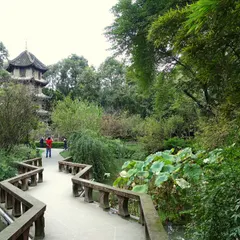
Xiangyuan is the landscaped area of the compound, open to the public, with a vegetarian canteen, a shop and open-air tea tables under the trees. Here the monastery stops looking like a monument and shows as what it is: a community of 80 resident monks that keeps up morning and evening chanting, the ritual meal in the refectory and fortnightly confession, without charging entry all year.
Since 2017, a group from the monastery has served free tea to the public on Sundays and Buddhist festivals, with an average of more than 1,100 servings a day. And in the halls the fanbai still sounds, Wenshu’s liturgical chant in Sichuanese style: it is based on the Sichuan dialect, it has been handed down by 18 generations of abbots since Cidu over more than 300 years and in April 2023 it entered the sixth provincial list of intangible heritage of Sichuan. The audio guide’s last stop tells, cup in hand, how that chant has passed from abbot to abbot to the present day.