Literary shrine of Tang poetry
Du Fu Thatched Cottage Audio Guide (Du Fu Caotang)
A poet on the run from war built a hut beside the Huanhua stream in Chengdu and wrote more than 240 poems in it. The hut vanished, but for twelve centuries the city has been rebuilding it on the same plot, until it became a great museum-garden.
- 90 min of audio
- Tang dynasty poetry
Du Fu arrived in Chengdu in the winter of 759, fleeing the An Lushan rebellion with his family, and in the spring of 760 built a thatched hut beside the Huanhua stream. He lived there three years and nine months and composed more than 240 surviving poems. Nothing of that hut is left standing, but the plot was never forgotten: the poet Wei Zhuang raised it again in 902, and the great rebuildings of 1500 and 1811 aligned on the same site an axis of five commemorative buildings, today surrounded by gardens, by the halls of a former Buddhist temple and by a cottage rebuilt in 1997 from the poems themselves.
The first owner of the cottage after the poet has a story of her own. In 766 the military governor Cui Ning gave it to his companion, Madame Ren. According to a documented tradition, in 768, with Cui Ning absent at court, she took a hundred thousand strings of coins from her estate, gathered a thousand men in two nights and led them in person against the prefect Yang Zilin, who had fortified himself in Chengdu with several thousand horsemen. Without supplies, the rebel abandoned the city; it is said that, with a reputation as a sorcerer, he unleashed a downpour and fled in boats that reached the courtyard. It was also Madame Ren who ended up donating the cottage as a Buddhist temple.
Highlights
- Axis of five buildings — Main gate, Daxie, Shishi Tang, Chaimen and Gongbu Ci, aligned in the rebuildings of 1500 and 1811
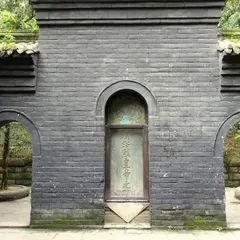
- “Shaoling Caotang” stele — About 175 cm tall, two dragons playing with a pearl and the calligraphy of a Qing prince
- 1997 thatched hut — Study, bedroom and kitchen furnished according to the descriptions in Du Fu's poems
- Broken-porcelain wall — The characters “Caotang” composed from blue-and-white porcelain fragments
- Daya Tang — A 64 m² mural and twelve poets, from Qu Yuan to Li Qingzhao, in the former temple hall
What you visit at the Du Fu Thatched Cottage, Du Fu Caotang (杜甫草堂) in its official name, is not a preserved house but an absence. Du Fu arrived in Chengdu in the winter of 759 with his family, a refugee from the An Lushan rebellion, and in the spring of 760 built a hut beside the Huanhua stream, where he composed more than 240 poems that have come down to us. The sources do not agree entirely on the dates: some place the building in 759 itself and round the stay up to four years; others separate the arrival from the construction and count three years and nine months, with an absence in Zizhou between 762 and 764. That one-mu hut is today, by the museum’s official figure, a compound of almost 800 mu, about 53 hectares between heritage zone and garden, although other sources give very different areas.
The history of the Du Fu Thatched Cottage is that of a plot nobody let disappear. In 902 the poet Wei Zhuang found the pillar bases there and raised a hut again, and since then every rebuilding, up to the great restoration of 1811, was done on the same site. At the end of 2001, moreover, extensive remains of Tang-era pavilions and dwellings were excavated in the northeast corner of the compound along with a batch of objects of the same period, now displayed in a hall built over the site itself. What to see at the Du Fu Thatched Cottage is arranged in five beats, from the axis of commemorative halls to the rebuilt hut, the corridor of red walls and the halls of the former Buddhist temple; its architecture and its signboards make real sense when walked with the audio guide.
From Chengdu, Du Fu went in 760 to look for the temple of Zhuge Liang, today Wuhou Shrine, and dedicated the poem “Shu Xiang” to it. A kilometre and a half from the cottage, towards the centre, stands the Taoist temple of Qingyang Palace.
Five halls on the plot of a hut
Du Fu Thatched Cottage (杜甫草堂)
Summary of this stop
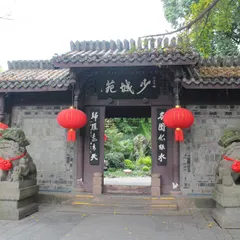
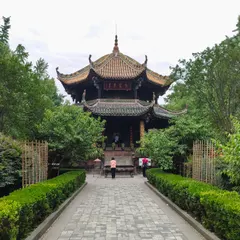
The visit starts in front of a grey brick screen wall and a main gate with the sign “杜甫草堂”, in the calligraphy of Guo Moruo. It is the first of five buildings aligned on a single axis: main gate, Daxie, Shishi Tang, Chaimen and Gongbu Ci. That order comes from the two great rebuildings of 1500, in the Hongzhi era of the Ming dynasty, and of 1811, in the Jiaqing era of the Qing. The museum maintains that the commemorative buildings have been preserved since then; another source believes that the war at the end of the Ming razed the complex and that what is visible is basically Qing work, reopened after a full restoration in 1952.
The second building, the Daxie, is an open wooden hall whose name means “the office”, a civil servant’s study. It was given this name in the restoration of the Jiaqing era (1796-1820), although Du Fu never had an office there: it is a posthumous tribute. It is followed by the Shishi Tang, the Hall of Poetic History, dedicated to the poet’s figure and work, whose poetry is known as the “poetic history” of the decline of the Tang.
Beneath it all is the plot. In 902 the poet Wei Zhuang located the place, where the pillar bases still remained, and built a hut again; the museum dates that work to 902, still in the Tang period, although in another text it places it in the Five Dynasties and other sources speak of the late Tang. Why a refugee’s hut ended up presided over by an office that never existed is something the narration reveals right there.
The brushwood gate and the title of Du Gongbu
Chaimen gate, Gongbu Ci shrine and the “Shaoling Caotang” stele
Summary of this stop
The fourth building on the axis is the Chaimen, the “brushwood gate”, and its name has changed three times. In the rebuilding of 1500 it was called “Huanhua Shenchu”; in that of 1811, “Yaolan Huajing”; and since the 1960s it has borne the name Chaimen, taken from a line of Du Fu’s poem “The Old Farmer”. The sign “柴门” is the work of the painter Pan Tianshou.
The axis closes with the Gongbu Ci, the shrine of the Ministry of Works, with a sign calligraphed by Ye Shengtao. Its name comes from 764, when the governor Yan Wu appointed Du Fu military adviser with the honorary title of vice-secretary of the Ministry of Works, the gongbu; hence the epithet Du Gongbu by which he is remembered. Inside are displayed editions of his work from the Song dynasty and translations into other languages.
East of the shrine, a pavilion holds the most emblematic corner of the compound: the “Shaoling Caotang” stele, about 175 cm tall by 80 wide, with two dragons playing with a pearl at the top. According to a documented tradition, the four characters were drawn in 1734 by Prince Guo, Yunli, son of the Kangxi emperor and younger brother of the Yongzheng emperor, when he stopped in Chengdu to pay homage to the poet; Shaoling was the nickname Du Fu gave himself. The poet’s memory, in this stretch, has been written in signboards.
The hut the autumn wind undid
Rebuilt thatched hut
Summary of this stop
North of the stele pavilion, past a wooden bridge, appears the thatched hut. It is a rebuilding of 1997, of five bays, divided into study, bedroom and kitchen and furnished from what Du Fu’s poems tell, with a table and stone stools in front. Its location was fixed according to the Ming-era layout: shrine in front, hut behind.
The original was paid for with other people’s help. In the spring of 760 his cousin Wang Shiwu brought him money for the work, and the poet asked Xiao Shi in writing for a hundred peach saplings for the village of Huanhua, as well as bamboo, alders, pines and fruit trees from other friends. In August 761 a storm tore the thatch from the roof and the rain flooded the inside. That night gave rise to the “Song of My Thatched Hut Wrecked by the Autumn Wind”, with its wish for thousands upon thousands of spacious rooms to shelter all the poor scholars of the world.
The poet’s poverty ended up giving way to celebration. According to a documented tradition, on the 19th day of the fourth lunar month Chengdu celebrated Huanhua Day, and in the Song period it was the great outing to the river of the year: the governor, whom they called “aotou”, head of the festival, gave a banquet at the Canglang pavilion of the cottage, the city lined the road with embroidered silks and there were water games and soldiers’ regattas. Already in the Yuan period, the governor still went out by the Zuo Bridge gate towards the shrine of the Lady of Huanhua, with official and private boats on the current. How that festival fits with the poem of the broken roof is the contrast the audio guide keeps for this point.
The red corridor and the broken-porcelain wall
Huajing and the “Caotang” screen wall
Summary of this stop
The Huajing is a narrow passage between red walls that links the commemorative complex with the old Caotang temple. At its east entrance it displays the sign “花径”, by Xiao Longyou, and a couplet by Guo Moruo. The temple exists because in 766 the military governor of Xichuan, Cui Ning, gave the cottage to Madame Ren, his companion, who incorporated it into her residence and later donated it as a Buddhist temple.
Beside the corridor stands the small shrine of the Lady of Huanhua, torn down in the Cultural Revolution and rebuilt in 1983. It is dedicated to Madame Ren, but popular legend gives it another origin: it says the Lady was a peasant girl of the riverbank who, while washing clothes, agreed to wash the robe of a wandering monk covered in sores, and that every time she dipped the robe lotus flowers sprang up until they covered the water. Hence would come the names of the pool, Baihua Tan, “of the hundred flowers”, and of the stream, Huanhua Xi, “where flowers are washed”.
At the end of the corridor waits the “Caotang” screen wall, with the two characters made of blue-and-white porcelain fragments. They were written in 1908 by Zhou Shanpei; they were damaged, and the present ones are the work of his brother, Zhou Zhujun. Mao Zedong stopped in front of them in 1958, and a well-known photo of him from behind was taken there. It is a classic photo spot, and its full story is heard in the narration.
A Buddhist temple turned poets’ hall
Daya Tang and the Wanfo Lou tower
Summary of this stop
The Daya Tang was the main hall, the Daxiong Baodian, of the Caotang temple. In 2002 the museum turned it into a hall of Chinese poetry, with a 64 m² mural on Du Fu’s life and poems and statues of twelve poets, among them Qu Yuan, Li Bai and Li Qingzhao.
Its name comes from another hall, far from here. According to a documented tradition, in the Northern Song Yang Su, a resident of Danleng and a devotee of Du Fu, travelled to Yibin, where the poet Huang Tingjian lived in exile, and asked him to copy in his own hand the poems Du Fu wrote in Sichuan. He had them all engraved in stone and raised in Danleng a hall to display them, which Huang Tingjian named Daya Tang, with a term from the Book of Songs. The museum recovered that name in 2002.
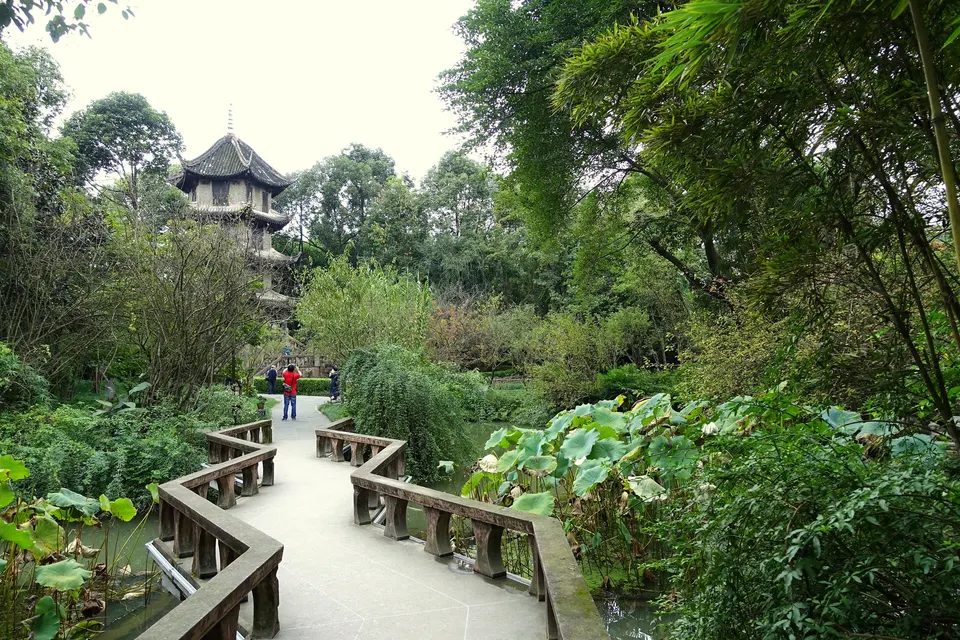
Nearby rises the Wanfo Lou, the Tower of Ten Thousand Buddhas, an octagonal four-storey wooden tower torn down during the Cultural Revolution (1966-1976) and rebuilt in 2005, 30.7 m tall with a new bronze bell at the top. And on the seventh day of the first lunar month, the Renri or “human day”, the rite “Renri you Caotang” in honour of Du Fu is held in front of the Daya Tang, recovered by the museum in 1992 and entered in the Sichuan intangible heritage catalogue; its origin is the poem that Gao Shi sent to Du Fu on a Renri day. How the circle of destruction and recovery closes there is the last thing the audio guide tells.