Panda breeding centre
Chengdu Panda Base Audio Guide
In 1987 it was a stony hill north of Chengdu and six pandas that had escaped starvation. Today it is a bamboo forest with 260 giant pandas, queues of admirers from before dawn and a tower shaped like a shoot that dominates the park.
- 120 min of audio
- Giant and red pandas
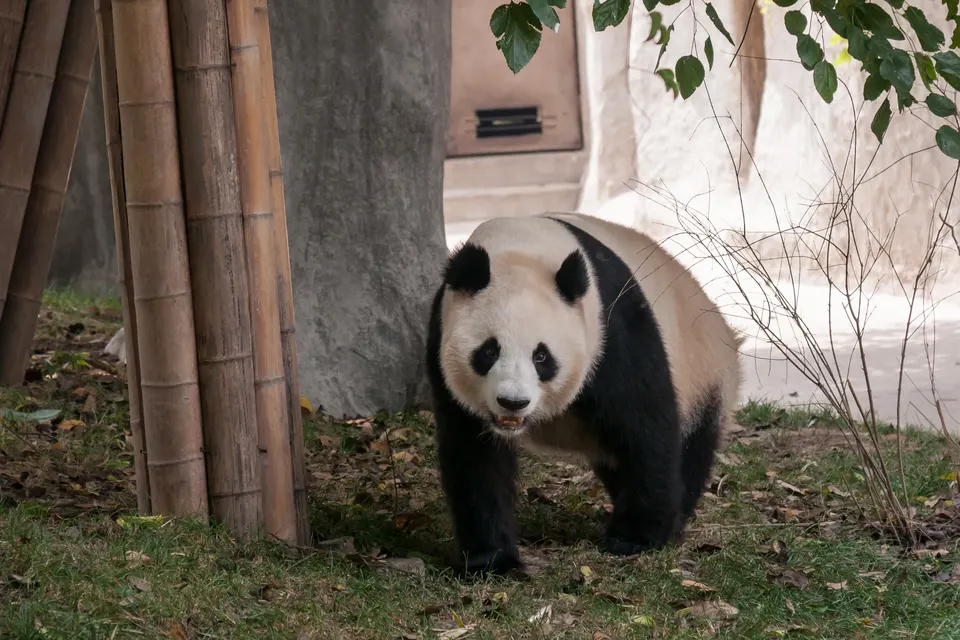
The Chengdu Panda Base was born from a failure. In 1986 the panda rescue centre that the Ministry of Forestry was going to build in the city was cancelled because the investor ran off with the money, and the municipal government and the Chinese Association of Zoological Gardens converted the chosen land into a breeding base. On 15 March 1987 Mayor Hu Maozhou broke ground at Futoushan, a low hill of poor soil and plant nurseries, and the first phase opened on 10 October of that same year. Starting from six founding pandas, the base grew for 25 years without adding a single wild animal and at the end of 2024 it totalled 260 giant pandas: the largest population of captive-born giant pandas in the world.
The real challenge was never housing pandas, but getting their cubs to survive. The twin-rearing technique devised here in 1990 raised survival from 30% to 70%, and training mothers to give colostrum for milking, since 2006, took it above 90%. The model has critics: some experts have reproached these programmes for producing animals little more than pampered pets for zoo visitors, while the base's director, Zhang Zhihe, argued that captive breeding is indispensable for studying the species, increasing the population and maintaining its genetic diversity.
Highlights
- Six founders, 260 pandas — Survivors of the bamboo famine turned into the largest population of captive-born giant pandas
- Sun, Moon and Star nurseries — Cubs from a few months to a year old, where twin survival was solved
- Huahua's villa — The base's star, with queues of 500 metres and two hours of waiting to see her for three minutes
- Panda Tower — 69.8 metres shaped like a bamboo shoot with 81 golden platforms shaped like hibiscus petals
- Red pandas — 64 animals in 2012, the largest captive population of red pandas in the world
North of Chengdu, where in the mid-eighties there were only poor fields, plant nurseries and a bumpy farm track, there now stretches a forest park of low hills, lakes and dense bamboo. Its official name is long, Chengdu Research Base of Giant Panda Breeding (成都大熊猫繁育研究基地), and its story fits in two figures: six sick and hungry pandas rescued in the mountains of Sichuan and 260 giant pandas at the end of 2024. Between one and the other lie 109 births and 161 cubs achieved up to 2012 without bringing in a single wild panda, a cub that pulled through at 51 grams at birth and an expansion that in 2022 took the area from 1,035 to 3,570 mu, about 238 hectares.
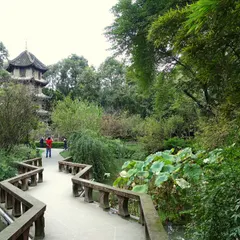
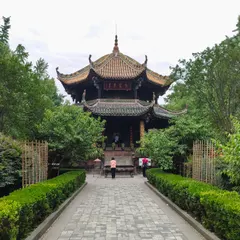
The history of the Chengdu Panda Base is that of a problem solved through trial, patience and grams: how to get an endangered species to multiply far from the forest. Its architecture tells that evolution in two stages. The old compound has villas in shaded zones, Swan Lake and bamboo paths planted on stone; the 2022 expansion adds circular pavilions among the trees, raised walkways and the Panda Tower. What to see at the Chengdu Panda Base runs from the nurseries with cubs a few months old to Huahua’s villa, by way of the red panda enclosures and the Chengdu Giant Panda Museum, closed on Mondays. The audio guide’s five stops follow that thread, from the South Gate to the tower, over 120 minutes.
The base does not live on the giant panda alone, either. In 2012 it housed 64 red pandas, the largest captive population of the species in the world, and the Sichuan Red Panda Conservation Research Centre; its enclosures have open-air walkways along which the animals sometimes leap. And from very early on it was an international showcase: in 1994 it began with Adventure World of Shirahama, in Japan, its first long-term breeding cooperation, which in 23 years added up to 10 births and 18 cubs. On 26 March 2014, the last day of her trip to China, Michelle Obama visited the base with her daughters Sasha and Malia and her mother, Marian Robinson: they fed pandas of about 18 months with apples stuck on the end of a long pole and, by her own account, she held in her arms a cub of about eight months. “They were so small, like stuffed animals,” she wrote.
Before 1949, the only panda exhibited in a park in China stopped over at the old zoo in People’s Park, in the city centre. On the way back to the city, the nearest point on the route is Wenshu Monastery.
A golden statue on a hill of stones
Chengdu Research Base of Giant Panda Breeding (成都大熊猫繁育研究基地)
Summary of this stop
The visit starts at the South Gate, the main access to the old compound. A few steps later appears the golden statue of a panda that marks the turn towards the villas and towards Swan Lake, with its waterbirds, anchor of the landscaped scenery that now covers the hill. Everything seems designed from day one for this animal, and yet the place was born from a plan that went wrong.
In 1986 China’s Ministry of Forestry planned to build a panda rescue centre in Chengdu, but the project was cancelled because the investor ran off with the money. The land was already chosen, and the municipal government and the Chinese Association of Zoological Gardens decided to use it for something else: a breeding base. On 15 March 1987 Mayor Hu Maozhou broke ground at Futoushan, a low hill in the north of the city, with stony soil, poor fields and nurseries, joined to the town by a single bumpy farm track.
Between the shine of the statue and that hill nobody wanted lies the whole history of the place. By the gate, the narration tells how an abandoned project ended up as a starting point.
The bamboo planted before anything else
Bamboo groves of the old paths
Summary of this stop
On the way to the villas, the path closes in between dense bamboo on both sides. It is not decoration: it was the first thing the builders did. The first phase took up 80 mu on the Bailianchi nursery of the municipal parks service, and before anything else qinsi bamboo and guanyin bamboo were planted. The works were completed in less than a year, with the opening on 10 October 1987, and the second phase added 560 mu, more than half expropriated from farmers.
Bamboo has a deeper meaning here, because the wound that explains the place was precisely its lack. In the Minshan and Qionglai mountains, mass bamboo flowerings left pandas without food and 108 starved to death. The sources do not entirely agree on the dates: some speak of flowerings in 1974 and 1984, another places the great flowering in 1983. From that crisis came the six founders of the base: the females Meimei, Guoguo and Susu and the males Qiangqiang, Chuanchuan, “No. 9” and “No. 6”.
Beneath the canes planted in 1987, the audio guide gives names and character to those six survivors, from whom everything that followed began.
Nurseries: twins, 51 grams and a live birth
Sun, Moon and Star nurseries
Summary of this stop
In the Sun, Moon and Star nurseries you see cubs from a few months to a year old. The Moon nursery hosted in 2017 the public presentation of the 11 cubs born that year. It is the space that best sums up the place’s real challenge: it was not enough for the pandas to give birth, the cubs had to survive.
The turning point came in 1990. On the opening day of the Beijing Asian Games, Yaya was born together with her brother Xiangxiang, and the two were the first assisted-rearing panda twins to survive, alternating nursing from their mother, Qingqing, with an incubator. That technique raised cub survival from 30% to 70%, and Yaya later had 9 litters and 13 cubs. Since 2006, training mothers to give colostrum for milking took the figure above 90%, and that same year a cub weighing 51 grams at birth pulled through, the lightest ever raised successfully in captivity: on 14 September, at a little over a month, it already weighed 1,289 grams.
In September 2015 the base also dared something its own keepers feared. The cameras of the PANDAPIA platform went into a nursery and broadcast live, for four hours, a panda giving birth: it was the first time the public saw a birth from start to finish. The mother could accidentally hurt the cub or the cub could be stillborn, and in the end it was the base’s top manager who authorised it, with an agreed slogan: “it is not just a stuffed toy, it is a real life.” In front of the nurseries, the narration reconstructs those four hours without a net.
Huahua, the two-hour queue and the “guolai”
Panda villas of the old compound
Summary of this stop
In the old compound, seven numbered villas are spread across shaded zones, and one of them can be recognised from afar by the line in front of it. It is the villa of He Hua, “Huahua”, born with her right foot turned outwards and turned into the base’s star. In 2024 people were waiting from 6 in the morning, an hour and a half before opening; at 7:40 the line measured 500 metres and a phrase went around that sums up the phenomenon: “two hours of queueing, three minutes of Huahua”.
In front of her villa a custom is repeated that her followers know well. Her keeper, whom the public calls “Grandpa Tan”, calls her in Sichuan dialect: “Huahua, guo lai”, that is, “come here”, which in his pronunciation sounds like “guolai”. The panda turned her head every time she heard it, and among fans the joke spread that Huahua thinks her name is Guolai. Her family has its own story too: her father, Meilan, was born in 2006 at Zoo Atlanta and, classified at birth as a female, was raised as a “girl” until the breeding programme uncovered the mistake; it is said the base even chose him a “boyfriend” in an online vote. Her mother, Chenggong, has a reputation for bravery: in 2009 she bit to death a feral cat that had got into her enclosure.
Huahua is the most visible fruit of a population that grew for 25 years without wild pandas: up to 2012, 109 births and 161 cubs from the six founders. From the base also came the pair that in 2007 travelled to the Madrid Zoo Aquarium, Hua Zui Ba and Bing Xing, who raised six cubs there in 17 years; on 29 April 2024 their replacements arrived from Chengdu, the young pair Jin Xi and Zhu Yu. In front of the villa, the audio guide also tells the less friendly side of so much fame, from the drone that in October 2024 made Huahua climb a tree to the lists of visitors banned for life.
From three metres to one, under the bamboo shoot
Panda Tower and circular pavilions
Summary of this stop
On 1 January 2022 the expansion opened on a trial basis, taking the base’s area from 1,035 to 3,570 mu, about 238 hectares, almost 2.5 times the previous one. A first group of 43 pandas inaugurated the new enclosures, and among the first to occupy them were Xiong Bang and Long Bang, returned from Wakayama.
From the raised walkway the logic of the design becomes clear. The 168.64 hectares of the expansion were laid out without altering the relief of low hills: paths and bridges for visitors above, logistics below. The enclosures are circular pavilions scattered among the trees, in zones such as Adventure Valley, Endless Hills or the Forest, and the distance changed: where pandas used to be viewed from 3 metres, it is now a little over 1. A floor-to-ceiling glazed restaurant, surrounded by three panda houses, lets you eat facing the animals, and the West Gate lookout opens a wide view over the new enclosures.
Above it all looms the Panda Tower, of steel and glass, shaped like a bamboo shoot after the spring rain: 69.8 metres, 9 floors and a lookout over Chengdu. Inside are 81 golden platforms shaped like hibiscus petals, the city’s flower. Under the tower, the narration closes the route by measuring the distance between that poor hill of 1987 and the forest that covers it today.