Temple of the Three Kingdoms
Wuhou Shrine Audio Guide (Wuhou Ci)
A temple whose gate plaque is dedicated to an emperor but which all Chengdu calls by the title of his minister. At the back rises the tomb mound of Liu Bei, founder of the Shu kingdom, which in more than 1,700 years nobody has opened.
- 90 min of audio
- Intact imperial tomb
Wuhou Shrine is the only place in China where an emperor and his chancellor are worshipped together: Liu Bei, founder of the Shu Han kingdom, and Zhuge Liang, his minister and strategist. The Huiling tomb and the Han Zhaolie temple were built in 223; Zhuge Liang's shrine came later, founded by Li Xiong in the Shaocheng district and moved next to the tomb around the year 500. In 1390 a Ming prince merged the three into a single complex, and the present buildings, from 1672, arrange the axis so that the minister's hall sits behind and lower than the sovereign's.
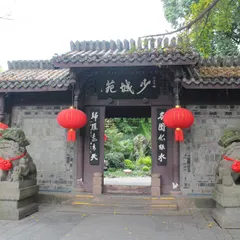
The hierarchy was written in stone and wood, but the city decided otherwise: the great vermilion plaque at the entrance reads “Han Zhaolie Miao”, temple of Emperor Liu Bei, and yet the people of Sichuan call the whole complex Wuhou Ci, after Zhuge Liang's title. Since the Song dynasty, moreover, every lunar New Year the people of Chengdu came here to greet these heroes of Shu Han as “gods of joy”, a custom that stayed alive even at the spring festival of 1938, with war at the door.
Highlights
- “Han Zhaolie Miao” plaque — The emperor's name on the gate of a temple everyone calls by the minister's
- Stele of the Three Excellences — 367 cm of stone carved in 809, the only Tang stele Chengdu still has
- Galleries of the 28 dignitaries — 14 civil ministers and 14 generals of Shu Han, each with their own stele
- Liu Bei's hall — A gilded seated statue 3 metres tall, the largest in the complex, and an absent son
- Huiling tomb — A 12-metre mound that in more than 1,700 years has never been looted or excavated
In Chengdu, among courtyards, cypresses and red walls, Wuhou Shrine, known locally as Wuhou Ci (成都武侯祠), brings together in a single complex two cults that began separately. The one for Liu Bei, founder of the Shu Han kingdom in the Three Kingdoms era, began with his tomb, the Huiling, and his temple, the Han Zhaolie, built in 223; the museum dates the complex to 221, when work on the tomb began, and the exact date remains a matter of debate. The one for Zhuge Liang, his chancellor, was founded separately by Li Xiong, ruler of Cheng Han from 303 to 334, in the Shaocheng district, and around the year 500 it was moved next to the tomb. Since then there have been collapses, rebuildings and a change of name that no prince could stop.
The history of Wuhou Shrine passes through a poet, Du Fu, who came looking for it in 760; through a Ming prince who in 1390 merged the tomb and the two temples to stress the sovereign’s power; through the rebel Zhang Xianzhong, during whose occupation of Chengdu the shrine ended up torn down; and through the rebuilding of 1672, the one visitors walk through today. Its architecture follows an axis that shrinks as it advances, from Liu Bei’s golden hall to Zhuge Liang’s smaller one, and ends, along an alley of red walls with bamboo on the other side, at the imperial mound. Inside the complex, since 1998, also stands the Sanyi temple of the sworn brothers Liu Bei, Guan Yu and Zhang Fei, moved whole from Tidu Street. What to see at Wuhou Shrine is arranged in five stops, from the gate plaque to the foot of the tomb, and it makes full sense when walked with the audio guide.
The poet who came to find the temple in 760 had just built his hut beside the Huanhua stream, today the Du Fu Thatched Cottage. Towards the centre, a kilometre and a half away, lies People’s Park, and a little further on lie the lanes of Kuanzhai Alley.
A plaque for the emperor, a name for the minister
Wuhou Shrine (成都武侯祠)
Summary of this stop
In front of the main gate, a great vermilion plaque with four gilded characters announces “Han Zhaolie Miao”: temple of Emperor Zhaolie, that is, of Liu Bei. A pair of Ming-era stone lions stands guard in front. There is no trace of Zhuge Liang on the plaque, and yet the people of Sichuan call the whole complex Wuhou Ci, shrine of the Marquis of Wu, after the minister’s title.
The paradox has an author. In 1390 Zhu Chun, Prince Xian of Shu, found the shrine in ruins, restored it completely and, arguing that “sovereign and minister must be one”, merged the Huiling tomb, the Han Zhaolie temple and Zhuge Liang’s shrine into a single joint place of worship. To enhance the sovereign’s power he tore down the temple dedicated exclusively to the chancellor, and the effect was the opposite: the minister’s name ended up covering the whole complex.
The plaque, hung by Liu Yuan, also carries a twentieth-century signature. In 1921 General Liu Chengxun raised funds to restore the two halls and the galleries, in a seventeen-month job, and when it was finished he added a dedication in which he presented himself as a descendant of Liu Bei in the forty-eighth generation. What that signature says about power and memory in Chengdu is revealed by the narration, in front of the gate.
Du Fu’s cypresses and a stone of three masters
Stele of the Three Excellences
Summary of this stop
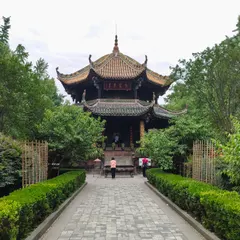
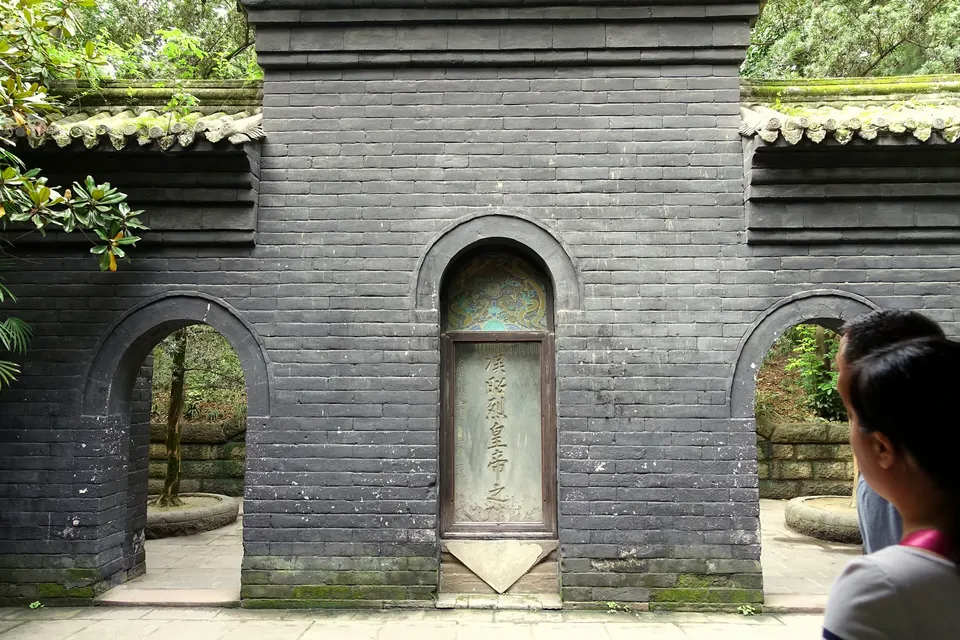
Between the main gate and the second gate, on the east side, a brick pavilion shelters the Stele of the Three Excellences (Sanjue Bei), surrounded by cypresses. It was erected in 809, year 4 of the Yuanhe era, and owes its name to the sum of three masteries: the text by Pei Du, the calligraphy of Liu Gongchuo, elder brother of the calligrapher Liu Gongquan, and the carving of the stonecutter Lu Jian. It stands 367 centimetres tall, 95 wide and 27 thick, spreads its text over 22 lines of regular script and is the only Tang stele that Chengdu preserves.
The cypresses are not there for decoration. In 760, already settled in Chengdu, the poet Du Fu visited the shrine and the Huiling tomb and, before the image of Zhuge Liang, wrote the poem “Shu Xiang” (“The Chancellor of Shu”), which opens by asking where to look for the chancellor’s temple and answers: outside the City of Brocade, among dense cypresses.
Almost a century later, between 846 and 859, the governor of Chengdu Li Hui assigned guardian families to the tomb and the two temples and set sacrifices for the four seasons of the year. By Tang times, the place was already both a destination for poets and an official cult, and this stop reconstructs how that fame was woven.
A golden emperor and the son who is missing
Liu Bei's hall and galleries of the 28 dignitaries
Summary of this stop
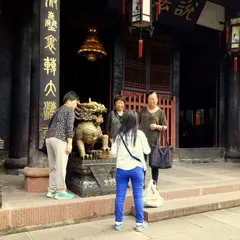
In the courtyard in front of Liu Bei’s hall, two facing galleries display the entire court of Shu Han: 14 civil ministers on one side and 14 generals on the other, 28 statues with a stele in front summarising each one’s life. At the back, the seven-bay-wide Zhaolie hall holds the seated statue of Liu Bei, 3 metres tall and entirely gilded, the largest in the whole complex.
Beside it is his grandson Liu Chen, Prince of Beidi, who took his own life in the Zhaolie temple when Deng Ai’s army reached Chengdu and his father, Liu Shan, decided to surrender. Of Liu Bei’s son and successor there is no image in the hall. When and why it disappeared is disputed: one tourist source places the destruction of his statue in the Song period, as a judgement on his surrender without a fight, but a Ming text by Cao Xuequan still counts him among the figures that accompanied Liu Bei in the temple.
The galleries also have their dark page. From 1925, when the warlords divided Chengdu among themselves, troops were quartered in the city’s temples, and at Wuhou Ci they even used the galleries of ministers and generals as dormitories; there were soldiers garrisoned in the complex until the end of 1949. What that barracks was like among the heroes of loyalty is told by the narration in the courtyard itself.
The chancellor’s lower hall
Zhuge Liang's hall (Jingyuan Tang)
Summary of this stop
As you advance along the axis, the complex shrinks. It is no coincidence: when the rebel Zhang Xianzhong occupied Chengdu at the end of the Ming dynasty, the shrine was torn down, and the rebuilding of 1671-1672, directed by the Sichuan judicial commissioner Song Kefa, fixed the order seen today. In front and higher, Liu Bei’s temple; behind and lower, Zhuge Liang’s, so that the minister is literally below the sovereign.
Zhuge Liang’s hall, under the “Jingyuan Tang” plaque, has half the floor area of the emperor’s. Inside, the chancellor’s image is flanked by his son Zhuge Zhan and his grandson Zhuge Shang, who both died fighting in Mianzhu: three generations of a family devoted to Shu, beside a bronze drum displayed in their memory. Among the inscriptions of the complex is the “attack on the heart” couplet (Gongxin Lian), calligraphed by Zhao Fan, which puts winning hearts before winning battles and leaves a warning to whoever rules Shu afterwards.
Although the architecture relegates him a step, this is where the name everyone knows the place by really lives. What that contrast says about power and popular memory is revealed by listening to the narration in the hall itself.
The mound nobody has opened
Huiling tomb mound
Summary of this stop
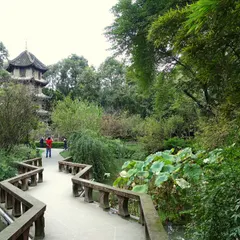
A flagstone path winds between two red walls, with bamboo on the other side, to the gate of the Huiling tomb, southwest of Zhuge Liang’s hall. Behind the screen wall, the gate, the spirit way and the resting hall rises the earthen mound: 12 metres tall and 180 in circumference, ringed by a wall. It is the origin of the whole complex: Liu Bei’s tomb and temple were built in 223, and around the year 500 Zhuge Liang’s shrine was moved from Shaocheng to its side.
In more than 1,700 years the mound has never been looted or excavated. The official chronicle of the Three Kingdoms says that Liu Bei was buried at Huiling, and he is held to lie there beside two of his wives. Doubt exists, however: Liu Bei died at Baidicheng, in Fengjie, in the fourth month of the year, and the cortege did not reach Chengdu until the eighth. In 1961 the historian Guo Moruo argued that nobody could transport a corpse upriver for four months in the heat, and since then the idea has circulated that the mound would be only a cenotaph. In Fengjie, surveys in 1982 detected under the Kuizhou hotel a cavity with a metal signal, and several genealogies of the Liu clan place the burial there, though with a place name that did not exist in the Three Kingdoms era.
Since the mound has never been opened, the question remains unanswered. The arguments on each side are laid out by the narration, at the foot of the hill.