UNESCO heritage
Drum and Bell Towers Audio Guide (Gulou and Zhonglou)
For more than six centuries, a drum and a bell decided when Beijing's gates closed and its streets emptied. The two towers still stand face to face at the end of the central axis, among hutongs: one of wood on red walls, the other of grey stone, and at the top a giant bell that is no longer struck.
- 45 min of audio
- Central Axis of Beijing
The Drum and Bell Towers close the Central Axis of Beijing to the north, a World Heritage Site since 2024. They were first raised in 1272, in the Yuan Dadu; the Drum Tower seen today is from the Ming period, rebuilt in 1420 farther east, and the Bell Tower was rebuilt from 1745, by order of Qianlong, entirely in brick and stone so that it would never burn again. Hence the contrast that leaps to the eye from the square: a wooden pavilion on a brick base facing a grey, stony tower.
Each sounding added up to 108 strokes, and the first of the night closed the city gates and emptied the streets. In 1924 the towers stopped telling the time. The drums returned in 2001 and sound every hour on the hour, but the great Yongle bell, the largest ancient bronze bell preserved in China, remains still: at New Year its voice is simulated with digital sound.
Highlights
- Drum Tower — Ming wooden pavilion on a brick base and 69 steps up to the upper floor
- Drum hall — 25 timekeeping drums and the only original one, with its drumhead torn
- Drumming on the hour — Drummers in traditional dress and a score based on the 24 solar periods
- Square between the towers — About 100 m along the central axis between the wooden tower and the stone one
- Yongle Bell — The king of bells, the largest ancient bronze bell preserved in China
At the northern end of Beijing’s central axis, surrounded by the grey roofs of the hutongs, the Drum and Bell Towers (鼓楼和钟楼, Gulou and Zhonglou) stand face to face. About 100 metres of square separate them: to the south, the Drum Tower, broad, with red walls and a wooden pavilion; to the north, the Bell Tower, slender, grey, entirely of brick and stone. For more than six centuries they set the capital’s official time with drums and an enormous bronze bell, and on their sounding depended when the city gates closed and the streets emptied.
The history of the Drum and Bell Towers begins in 1272, year 9 of the Zhiyuan era of the Yuan dynasty, when Beijing was called Dadu and the Drum Tower was known as the Qizheng Lou. In 1420, with the move of the capital to Beijing by the Yongle emperor, the Drum Tower was rebuilt farther east; the Bell Tower burned soon afterwards and was rebuilt from 1745, by order of Qianlong, entirely in brick and stone. In 1924, after Puyi’s expulsion from the Forbidden City, the towers stopped telling the time; in 1925 the Drum Tower housed the capital’s People’s Education Centre and the Bell Tower became its cinema. They reopened to visitors in 1987 and 1989, and on 27 July 2024 they entered the World Heritage list as the northern end of the Central Axis of Beijing, one of its 15 components.
To know what to see in the Drum and Bell Towers one must climb both: 69 steps lead to the upper floor of the Drum Tower, where on the hour the drums sound again, and at the top of the Bell Tower hangs the largest ancient bronze bell preserved in China. Around them, the neighbourhood still keeps pigeons on its roofs; many have a whistle tied on, the geshao, and the hum they leave over the towers is for many Beijingers the sound of old Beijing. The audio guide follows the complex in four stops and 45 minutes, from the base of the Drum Tower to the chamber of the great bell, following the thread of a city whose time was not marked by a clock but by a drum and a bell.
To the southwest, beside Shichahai lake, Prince Gong’s Mansion is the largest Qing princely residence left in Beijing; the axis these towers close crosses farther south the Forbidden City, and about two kilometres to the east rises the Lama Temple.
A tower that moved east
Beijing Drum Tower
Summary of this stop
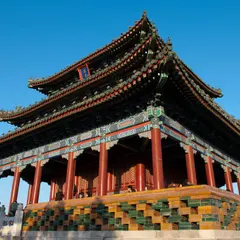
The south façade of the Drum Tower sums up its architecture: a 4-metre brick base opened in vaulted passages, red walls and, on top, a wooden pavilion with overlapping eaves of grey tile edged in green, up to a height of 46.7 metres. A pair of stone lions keeps watch before the south door. Through a small door at the northeast corner of the base the staircase begins: 60 straight stone steps and 9 more that turn west to the platform.
What cannot be guessed from below is that this mass is the second version of itself. The first was raised in 1272, in the Yuan Dadu, under the name Qizheng Lou. When Yongle moved the capital to Beijing in 1420 and the new palace ended up shifted east relative to the Yuan one, the tower was also rebuilt farther east, on the site of the old central pavilion of Dadu. Since then it has closed to the north the axis that runs through the city, inscribed in 2024 on the World Heritage list as the Central Axis of Beijing.
On the ground floor, seven interconnected vaulted passages now house the digital exhibition “The History of Time” and the light show “Gongming”, of about 8 minutes, every hour. In front of the façade, the audio guide tells why an entire tower had to move to follow a palace.
Twenty-five drums and one split
Timekeeping drum hall
Summary of this stop
On the upper floor 25 drums stand in a row on red-lacquered wooden stands with carved clouds: one larger, symbolising the year, and 24 smaller, one for each solar period of the Chinese calendar. They are replicas arranged on the model of the Jiaqing period. Beside them work the clocks of the old timekeeping system: the beilou, in which each ball takes 24 seconds to roll through a copper tube and 3,600 balls complete the 24 hours, and a copper water clock that sounds a gong at each ke.
Of the 25 original drums only the largest survives: 2.22 metres tall, 1.40 in drumhead diameter, its skin torn and blade cuts clearly visible. Who made them is not clear: some sources attribute them to the Eight-Nation Alliance, in 1900; others to bayonets of the Japanese army during the invasion of China. In 1988 two copies of this drum were made.
Silence came in 1924, when the towers stopped telling the time. That same year the Drum Tower was renamed Mingchi Lou, “Tower of Remembering Shame”, with an exhibition of photographs and models of the invasion of Beijing by the Eight-Nation Alliance; the change is attributed to the capital’s governor, Xue Dubi, although other sources point to the warlord Feng Yuxiang. On 31 December 2001 the “evening drums and dawn bell” returned, and today, on the hour, drummers in traditional dress play here a score by the percussionist Zhu Xiaolin written according to the 24 solar periods. The narration at this stop pauses before the wounded drum.
The square that emptied Beijing every night
Square between the two towers
Summary of this stop
From the centre of the square, about 100 metres of esplanade aligned on the central axis, the two towers can be compared at a glance: to the south, the Drum Tower, of wood on a brick base; to the north, the Bell Tower, grey and stony, because after burning soon after 1420 it was rebuilt from 1745 entirely in brick and stone so it would not burn again, in a project that lasted two years or twelve, depending on the source. Liu Xinwu’s novel “Zhonggulou”, published in 1984 and awarded in the second edition of the Mao Dun prize, left the phrase that portrays the pair: “the Drum, fat; the Bell, thin”. It tells a single day in December 1982 in a courtyard of nine families at the foot of the towers, with chapters named for the double hours of the Chinese clock.
There was a time when this square emptied the city. Each sounding added up to 108 strokes, with the popular rhythm “eighteen fast, eighteen slow, another eighteen neither fast nor slow”; 108 is the sum of the 12 months, the 24 solar periods and the 72 pentads of the year. The first sounding of the night, the dinggeng, around eight, marked the closing of the gates and the cutting of traffic: it was the jingjie, the “clear street”, and from that moment only the night watchmen circulated, with gong and wooden clapper.
The esplanade, which seems eternal, was remade a little over a decade ago. In December 2012 the Dongcheng district ordered the courtyard houses surrounding it cleared in order to give it back its original look according to Qianlong-era maps: about 4,700 m² of dwellings, with homes of about 20 m² on average. A district official said those houses had no historical value and cited the fire risk in alleys with no access for firefighters; He Shuzhong, of the Beijing Cultural Heritage Protection Center, replied that a rich accumulation of heritage was being destroyed. Among the residents there were those who had wanted to leave for thirty years and those who did not want to go. An earlier plan, of 2009, that demolished the houses to open an underground shopping centre had been halted after opposition from civic groups and part of the neighbourhood. In the middle of the square, the audio guide leaves open the question of which history deserves to stay.
The king of bells in its stone box
Beijing Bell Tower
Summary of this stop
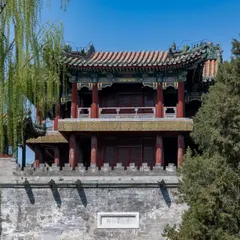
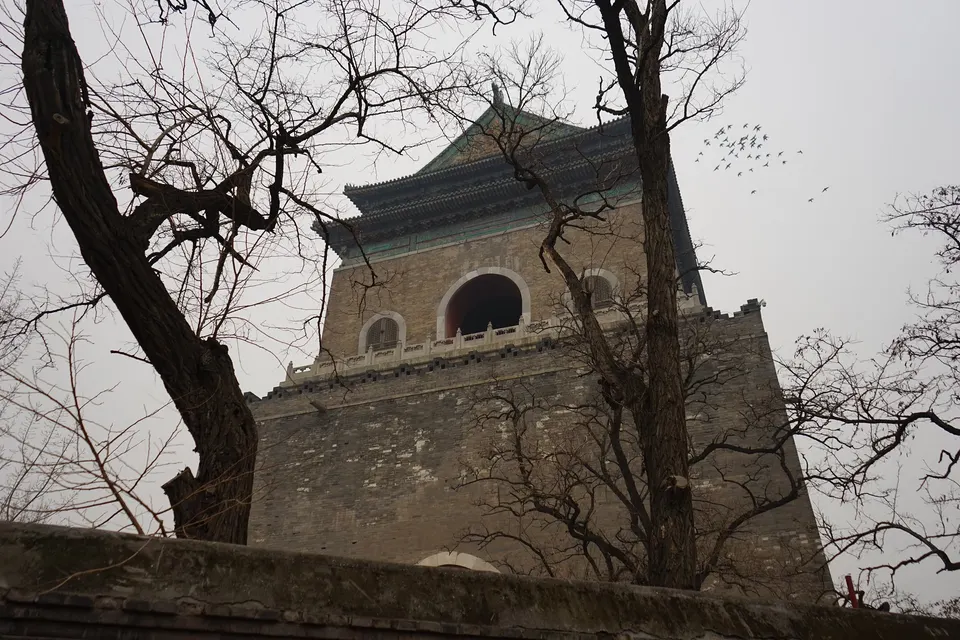
The Bell Tower is the slender one of the pair: grey walls of stone and brick, a roof of black glazed tile edged in green, stone brackets carved to imitate wood, a white marble balustrade and windows of openwork stone. It measures 47.95 metres in total height according to the most cited figure; the 33 metres that some sources give correspond to the body of the tower above the base. To the south stands Qianlong’s imperial stele recalling its reconstruction. In the upper chamber, under a hemispherical vault, hangs from an octagonal wooden frame the bronze bell with the inscription “大明永乐年”, flanked by two logs of about 2 metres with which it was struck.
It is the largest and heaviest ancient bronze bell preserved in China, the “king of bells”. The most widespread figure gives it 7.02 metres in height, 3.4 in maximum diameter and about 63 tonnes, although other sources lower the height or the weight. The first bell hung here, of iron and from the Yongle period, sounded poor and was replaced by another also from the Yongle period; when the change was made is disputed, because one version places it in Yongle’s own reign and another in 1983, when the 1420 bell would have passed to the Dazhong Si Ancient Bell Museum. The four vaulted passages on each floor cross in a cross plan and communicate vertically like a resonance box: according to measurements by the Institute of Acoustics of the Chinese Academy of Sciences, the sounding could be heard almost 4 kilometres away with no tall buildings in between. How so many tonnes were raised without cranes is resolved by popular belief with earth ramps as high as the tower, watered in winter until they froze. Today the bronze is no longer struck: at festivals such as Chinese New Year its tolling is simulated with digital projection and sound.
The bell was cast to the west, in the alley now called Zhuzhong Hutong; of the foundry only the name of a bus stop on Gulou Xidajie remains. From there comes the Beijing legend of Hua Xian, the master founder’s daughter who, it is told, threw herself into the molten bronze so that the bell would turn out perfect and to save her father from Yongle’s wrath. In the version that reached the West, translated by Lafcadio Hearn in 1887, she is called Ge-ai and after each stroke the bell leaves a lament that sounds like “hsieh”, “shoe”; in another, her ghost roams the tower at night looking for the embroidered shoe she lost when she leapt. The alley’s tradition, however, ties the sacrifice to another bell from the same workshop, the Huayan. From the galleries one sees to the south the Wanchun Ting pavilion of Jingshan on the axis and, around, the tapestry of grey courtyard roofs; the audio guide closes here, with the city at one’s feet, the story of the girl and her shoe.